
Bremainers Ask – Lord Andrew Adonis

Bremainers Ask – Lord Andrew Adonis

Lord Andrew Adonis is a Labour peer, historian and journalist who served in government under both Tony Blair and Gordon Brown. Prior to entering frontline politics, he was a fellow of Nuffield College, Oxford, Public Policy Editor at the Financial Times and a political columnist for The Observer. He joined Tony Blair’s Downing Street staff in 1998, first as a constitutional and educational adviser, as part of the Number 10 Policy Unit and was subsequently promoted to Head of the Policy Unit in 2001.

After being appointed to the House of Lords in 2005 he became Minister for Schools. In 2009, he became Transport Secretary and was the originator of the prospective High Speed Two (HS2) rail network. He later served as Director of the Institute for Government from 2010 to 2012 and was founder chairman of the National Infrastructure Commission from 2015. He resigned in 2017 over the government’s pursuit of Brexit and became a leading figure in the People’s Vote campaign. He is Chair of the European Movement. His latest book is Ernest Bevin: Labour’s Churchill.

Stewart Luscott-Evans: How can UK politics be fixed? Is PR part of the answer, and if so, will we see it in our lifetimes?

Yes, PR is part of the answer. I support the type of PR used for the Scottish and Welsh parliaments and I think we may see it in our lifetimes for the House of Commons too, but it has got to win an election first and that requires close cooperation between the progressive parties across the UK.

Ruth Woodhouse: As recently elected Chair of the European Movement UK, what do you see as your immediate priorities?

Turning it into a mass-membership organisation. This means engaging with the grassroots, renewing our social media and communications and raising public awareness that the European Movement exists and is the primary vehicle for pro-European and Remain movements in the UK.


Tom Maguire: What policies would you advise a Labour government to adopt on the EU?

Rejoin, step by step. Brexit is the biggest foreign policy blunder in my lifetime and will negatively impact our economy and geopolitical status. Nothing less than reversing the mistake our country has made should be the policy of any party credibly working in the national interest. But it will need to be done in stages, starting with the Customs Union and the Single Market.


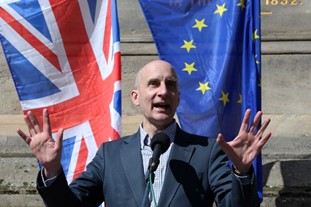
Lord Adonis at European Movement event Milton Keynes College
Andrew Hesselden: How can we ensure that future generations of young people grow up with a connection to and interest in European cooperation?

We must focus on building organisations like the European Movement which have a presence and can reinforce the benefits we’ve achieved from European integration. History is a crucial factor here too. As the wartime generation has largely receded, we’ve become disconnected from their experience of how the continent healed itself after WW2.

David Hance: Would the campaign to rejoin require a new political party, a UKIP opposite perhaps?

I know from past experience that new parties find it extremely difficult to break through in our electoral system, although Labour did it a century ago, and the SNP has just done it in Scotland. What we should be aiming to do is offer a return to Europe as part of a broader progressive agenda – advocated across all progressive parties – and seek to work together to establish a coalition that, like New Labour, is electable, radical and passionate about European integration.


Lisa Ryan Burton: In the aftermath of the 2010 election, is it true you attempted to form a Labour/Lib-Dem administration and, if so, why did that fail in favour of a Conservative/Lib-Dem coalition?

Yes, it is. I published a book called ‘5 Days in May’ which gives a behind-the-scenes insight into the talks following the 2010 election. It failed because the Lib Dem leadership considered itself closer to the Cameron/Osborne austerity agenda rather than the progressive economic strategy that was being implemented by Gordon Brown and which also featured in the Lib Dems’ own activist-approved manifesto.

Next month’s Bremainers Ask guest will be German MEP Terry Reintke. A very vocal anti-Brexit supporter, Terry serves on influential EU committees, is Vice President of the Greens/EFA group in the European Parliament and an active member of the EU-UK Friendship Group. If you have a question for Terry, please email it to us before 7 June at enquiries@bremaininspain.com.


Votes for Life Update from the British Embassy

Votes for Life Update from the British Embassy

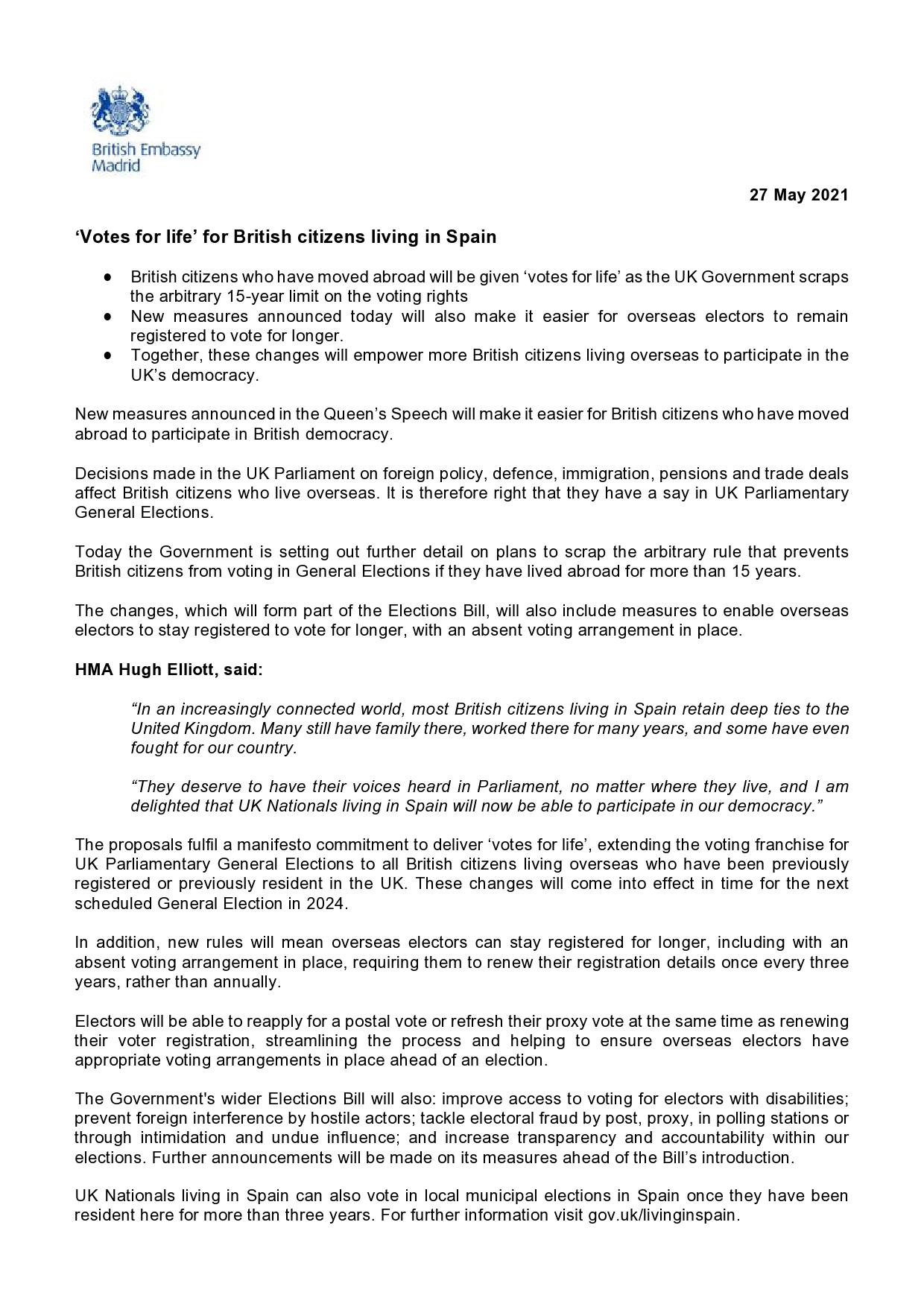
The government has announced today that British citizens who have moved abroad will be given ‘votes for life’ as the UK Government scraps the arbitrary 15-year limit on the voting rights. All British citizens who are living overseas who have been previously registered or previously resident in the UK will be able to vote in UK Parliamentary General Elections. In addition, the new rules will mean overseas electors can stay registered for longer requiring them to renew their registration details once every three years, rather than annually. Overseas electors will also be able to reapply for a postal vote or refresh their proxy vote at the same time as renewing their voter registration, streamlining the process and helping to ensure they have appropriate voting arrangements in place ahead of an election. These changes, which will form part of the Elections Bill will come into effect in time for the next scheduled General Election in 2024. UK Nationals living in Spain can also vote in local municipal elections in Spain once they have been resident here for more than three years.

Votes for Life has been featured in the Press too, including some articles written by Bremain Chair Sue Wilson. Click the links below to read more:

Yorkshire Bylines

El Pais in English

The Olive Press

The Local

Europe Street News

Citizen’s Rights On The Agenda – House Of Lords – European Affairs Committee

Citizen’s Rights On The Agenda – House Of Lords – European Affairs Committee

A month ago, the new House of Lords European Affairs Committee was formed, to replace the now defunct EU Select Committee. As expected, many of the members of the former committee, including the Chair, Lord Kinnoull, transferred across to the new committee. This was fortunate for us, as our Vice Chair, Lisa Ryan Burton, and members of the Bremain Lobby Group, were already in contact with committee members.

When we conducted our recent Brexit Impact on Brits Abroad (BIBA) survey, Lisa advised the committee we were compiling a report, based on concerns raised by our members in their survey testimonials. The committee expressed an interest in seeing our report, and subsequently, and, we believe, as a direct result of our contact with them, I was invited to give evidence to the committee on 25 May.

The first hour of the meeting was given over to representatives of EU citizens in the UK. The second hour was for UK nationals in the EU, where I was joined by Jane Golding, Chair of British in Europe, and Dr. Michaela Benson of Brexit Brits abroad.

The topics covered ranged from the implementation of our citizens’ rights provisions; to issues surrounding residency applications; from vulnerable groups to mobility; and from professional qualifications to government support, or lack of.

It is over four years since I first presented evidence to Hilary’s Benn’s House of Commons Brexit Committee. Many of the topics under discussion have changed very little in the interim. Some issues have been resolved as we’d hoped, some as we feared. Despite my experiences over the last five years, the pre-meeting nerves haven’t changed either. But I survived to tell the tale, and I hope I managed to cover the topics that concern you the most. Let’s hope the committee take our comments on board and help us hold the government to account. I look forward to reading their report in July.

To read more about the European Affairs Committee, click here

If you wish to view the 25 May proceedings, you can do so on the parliament channel here

Sue Wilson – Chair

Here are some links to reports about the Committee meeting:

The Local

The London Economic

Yorkshire Bylines

The Olive Press

Life after Brexit: What are the issues that worry Brits in Spain the most?

Life after Brexit: What are the issues that worry Brits in Spain the most?

From concerns about healthcare to problems regarding work and residency, a new survey reveals the main worries that are keeping UK nationals living in Spain awake at night, Bremain in Spain head Sue Wilson explains.

Back in April, Bremain in Spain launched a membership survey to investigate which Brexit-related issues were still of concern to our members. The ‘Brexit Impact on Brits Abroad’ working group (BIBA) was established and set to work on designing a survey that would encourage members to share their views and feelings.

The aim of the project was to discover how Brexit was impacting our members lives, employment, families and health, and what were their major concerns going forward. We received over 600 individual testimonies, covering a wide range of topics, with many more members contributing.

Whilst we don’t claim that our survey results represent the views of all, or even the majority, of our members, let alone those of all UK nationals in Spain, the issues raised will be recognisable to many.

Unsurprisingly, healthcare was a topic raised by many of our members. Despite government reassurances, fears of losing the protections afforded by the Withdrawal Agreement, whether likely or not, are very real.

One member, who wished to remain anonymous said, “I am worried that I cannot afford to pay for private medical insurance and will be left without recourse to any medical help at all.” Many others spoke of the effect on their mental health, such as Nicholas Evans, who said that despite feeling prepared and having made all the right arrangements, he still “felt awful” when Brexit actually happened. He said, “it has had a significant negative impact on my mental health. I feel disempowered, abandoned and betrayed.”


TIE Example

Applications for Spanish residency was another hot topic, especially for those that had been unable to get appointments and were keen to legalise their status. Judith Hughes said, back in April, “I applied for my residency on 23 December, and I am still waiting. It was impossible to book an appointment,” adding “it is difficult to move on so many fronts without having residency” – a point made by many who are unable to process their driving licence applications. I am delighted to be able to report that, as I write this, Judith has finally had her residency application approved. She told me, “I can’t believe it has finally happened. I had started to think it never would. The stress has affected my quality of life. Finally getting my residencia does not take away from the fact that life has been made infinitely more stressful and complicated by Brexit”.

You can read the full article over at The Local The Local