
Walking our way back to EU
The Rejoin Ramble reached Brussels at the weekend, carrying its message of hope from the British people, writes Bremain Chair Sue Wilson MBE for Yorkshire Bylines.
On Friday 5 June, it was my privilege to accompany the Rejoin Ramble on the final leg of its journey from London to Brussels. My 18km contribution was a mere fraction of the 320km journey undertaken by Peter Corr, Clare Hall, Ceira Sergeant, Steve Rouse and Marissa Zoeller, in all weathers. My two blisters were as nothing to compared to the 17 blisters of my fellow ramblers.
The five intrepid travellers were met at various stages of their 14-day journey by pro-EU campaigners. But the welcome outside of the European parliament was the highlight of the journey, drawing a considerable crowd that included current and former MEPs.
We're back in the EU 😁😱❤️🇪🇺
#RejoinEUyoutu.be/Zd8BFHRZOYs?…
— National Rejoin March (@marchforrejoin.co.uk) 6 June 2026 at 06:57
Delivering a message
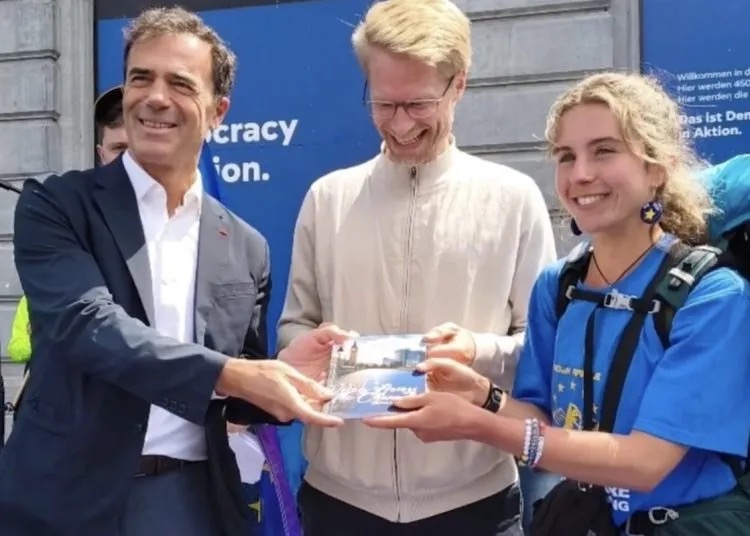
The main aim of the ramble was to deliver a message from the British people, namely that we want our EU citizenship back. This message was hand-delivered in the form of a booklet entitled Voices across the Channel containing hundreds of individual messages of support for rejoining the EU.
The booklet was handed over by Sergeant – who was too young to vote in the Brexit referendum – to Sandro Gozi MEP, Renew FR, co-chair of the EU-UK parliamentary partnership assembly. In his response, Gozi questioned the crowd as to whether the pre-Brexit promises of “Mr Disaster” (otherwise known as Nigel Farage) had been delivered. There were resounding cries of “No!”
Gozi also reminded the crowd that the door was open and that any application from the UK to rejoin would not only be welcomed, but could even be fast-tracked. This point was reiterated by Richard Corbett, the former leader of Labour MEPs who said,“the UK is looking increasingly isolated. The leaders of Spain, Poland and Hungary recently made it clear the EU would welcome us back.”
When citizens believe in a cause, they can achieve the impossible. Walking 330km from London to Brussels to support the UK’s return to the EU is proof of that. Congrats to these determined marchers. One day, @Nigel_Farage, Mr. Disaster, will have to answer for the cost of Brexit. pic.twitter.com/7nsk2aGnnO
— Sandro Gozi (@sandrogozi) June 5, 2026
The voice of the people
Corr, who is organiser of the National March for Rejoin (NMR)– including the fourth annual rally taking place in London on Saturday 20 June (NMR IV) – pointed out that the UK now has the largest pro-EU campaign across Europe. A recent YouGov poll shows that 70% of the British people support closer ties with the EU, and at least 56% now want to fully rejoin the bloc. “We always hear from politicians and the media, but not from ordinary people,” Corr stated, adding that “this is a clear sign from the British people. We made a mistake. We need each other, we are stronger together.”
Corr’s partner, Hall added, “for several years, we’ve worked to challenge misinformation and keep alive the case for Rejoin. Public opinion is shifting, as more Britons realise Brexit failed to deliver. Our message to politicians on both sides of the channel is that Britain belongs in the EU.”
It was a pleasure to speak at the arrival in Brussels today of the Rejoin Ramblers, who hiked there all the way from London
— Richard Corbett CBE (@richardcorbett.bsky.social) 5 June 2026 at 18:53
Government reticence
While the people are making an effort to clearly outline their hopes and desires to the European parliament, the government is keeping the EU guessing. While there may be plenty of governmental wishful thinking, and attempts at cherry-picking, clearly defined goals have yet to surface. EU politicians have warned the British government that its refusal to negotiate a broader reopening on trade and economic integration will likely jeopardize any efforts to ‘reset’ EU/UK relations.
Gozi, who chairs the European parliament’s UK delegation has suggested that in order to “safeguard peace and prosperity across the continent, Britain should go further and rejoin the single market”. Gozi has also criticized Keir Starmer for ruling out the UK’s membership of an EU common market or customs union, saying, “the world has changed since those red lines were drawn”.
UK/EU summit under threat
With just weeks to go, the forthcoming ‘reset’ summit between the European Union and the UK looks to be under threat. The EU says it is “working to conclude the key files of last year’s Common Understanding” which include an SPS agreement and a Youth Experience Scheme.
EU trade commissioner, Maroš Šefčovič, said the youth mobility scheme – which is one area where talks remain deadlocked – was one of the top three issues, and one that the EU cared very deeply about. The summit was expected to take place in mid-July but could now be delayed until later in the summer.
The @marchforrejoin.co.uk team have arrived in Brussels after walking from London to meet press & politicians & hand over a book of messages to the EU parliament from British citizens
Our Chair @suewilson91.bsky.social also there after taking part in the last leg. Well done everyone 👏 #RejoinEU
— Bremain in Spain (@bremaininspain.com) 5 June 2026 at 11:33
Walking back to EU, step by step
When the ramble arrived in Brussels, I was reminded of many former visits to the EU capital, each time receiving a warm welcome. To be back at the European parliament was a bittersweet moment, revisiting the joy of working together with dedicated people from many different countries, and the sadness that we are now outside that special club.
We will never forget those that lied to get us here. We will never forget those that are hampering our efforts to return. But most important of all, we will never forget the rights, benefits and opportunities that were taken away from us for no other reason than to save a dying party from self-destruction.
Until the day when our government catches up with public opinion, we will keep fighting to get back what has been lost. Dithering won’t cut it. Placing barriers in our way won’t cut it. Having unrealistic demands won’t cut it.
We’ve watched and waited for Starmer’s ‘step-by-step’ approach, and we’ve barely moved an inch. Surely now it’s time to pick up the pace, stop rambling and get in the car and drive at top speed. Brussels has made it clear we would be welcomed back, so what on earth are we waiting for? We’ve got a country to save!
And for those wanting to get on board, join us in London for the NRM IV on 20 June, to deliver another message from the people, this time to our own government – if you want to stay in power, you’d better start listening and acting in the best interests of the country.
We want our EU citizenship back, and those of us of a certain age cannot afford to wait.
Immigration numbers are down: so why is the rage still rising?
If the latest immigration and asylum figures tell us anything, it’s that the far-right will never be appeased, writes Bremain Chair Lisa Burton for Yorkshire Bylines.
Migration is down 48% from last year and 82% from 2021. Small boat arrivals and the asylum backlog are also down, while 70,000 people were returned or deported. Yet, anti-immigration rhetoric has only intensified. Labour cannot win the immigration battle
Labour delivered what the public wanted: a huge fall in net migration to 171,000 in 2025 from 331,000 in 2024 – the lowest in over a decade. Yet online reactions show that parts of the public and the political class are so radicalised that no reduction will ever suffice.
Nigel Farage can’t say these numbers are good, because he relies on anti-immigration sentiment. It’s been his trump card, since before the Brexit referendum. He says the drop in net migration is primarily driven by a ‘brain drain’ of British citizens leaving the UK in large numbers due to high taxes and being replaced with low-skilled workers.
Not so. Numbers are down because fewer people are coming from outside the EU for work, and fewer family members are arriving with them. Emigration has been steady for years, and, indeed, the Home Office issued a statement correcting such claims.
On the Home Office’s Facebook page, their post on migration reduction drew nearly 5,000 mostly negative comments, many using dehumanising language. Dianne Abbott and David Lammy – two leading Black Labour politicians – are frequent targets. The comments and reactions were similar across all media outlets that reported the story.
Asylum backlog down, asylum decisions up
In 2023, the Conservatives, through their intentional mishandling of the asylum system and the Illegal Migration Act ‘pause’, created a backlog, which at its peak was around 175,000 people awaiting an initial asylum decision.
The latest official figures show that there are now 48,758 people awaiting an initial decision – a 72% reduction from its peak.
The number of people claiming asylum also fell by 12% in the year ending 31 March.
Between 1 January and 20 May 2026, 7,576 people crossed the English Channel by small boat from France, a reduction of 41% on the same period last year; down from over 47,000 to 39,000 since 2022 under Conservative control.
The number of asylum seekers in hotels peaked at 56,000 under the Conservatives in September 2023, with around 400 hotels in use. This number has since dropped by 63%, a 35% year-on-year fall to just 20,885 people.
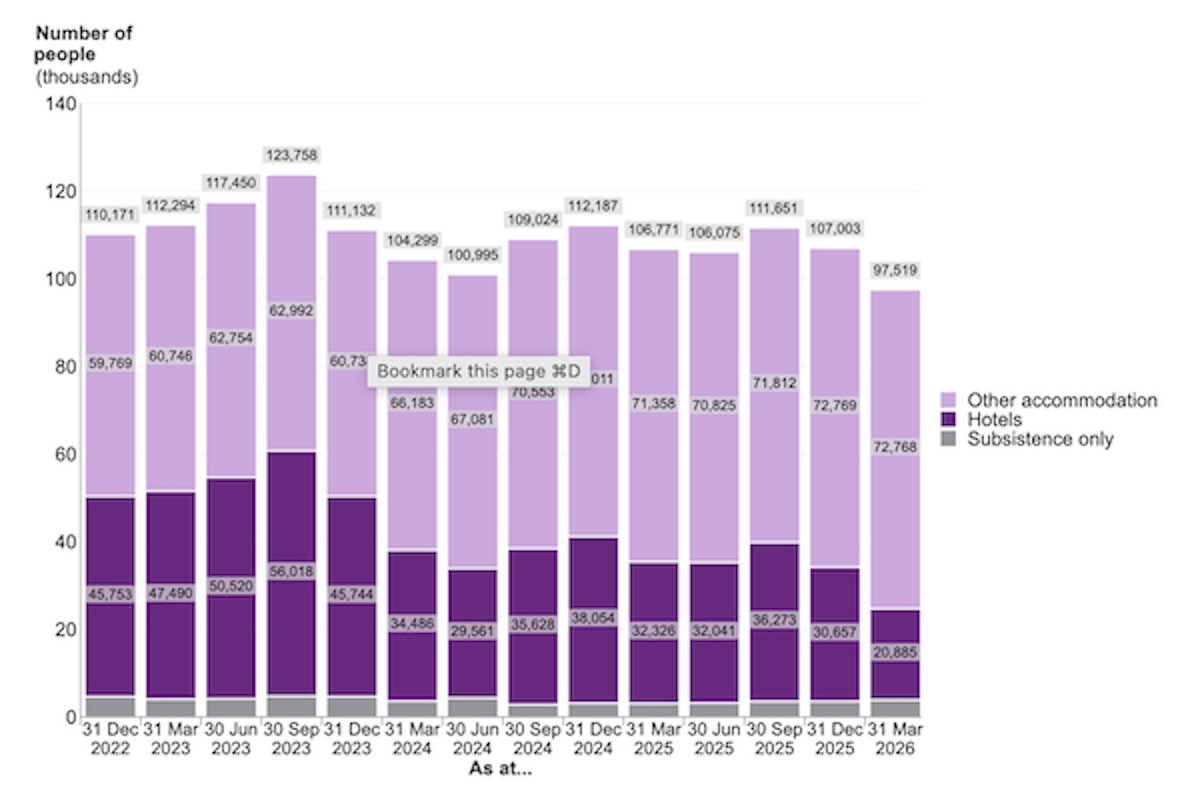
Explanations for this from anti-immigrant voices are that people have just been moved into ‘nice houses’, or that Labour is fiddling the figures, yet Labour has also deported the highest number of people since 2017, with almost 70,000 deportations since coming to office. This includes nearly 10,000 foreign national offenders, a 36% increase over the previous 21 months under the Conservatives.
Far-right parties blame migrants for public struggles, promoting the idea that stopping ‘illegals’ will solve issues. Asylum-related spending was estimated to be £4.9bn last year. When you compare this with the total UK government expenditure of approximately £1.29tn, it amounts to less than 0.4% (ie 40p in every £100) of public spending.
The rise of anti-immigration rhetoric
A decade ago, the language used today around migrants, ethnic minorities and ‘non-British’ people would have been seen as shocking, racist and dangerous. Many see Brexit as the catalyst that normalised the language of xenophobia, which then crept into mainstream language and discourse – remember the UKIP ‘breaking point’ poster? Brexit was a huge win for the global far-right and a petri dish to see just how far the British public could be pushed into voting for national harm via the politics of fear and overtly xenophobic and dehumanising imagery and language. It can be seen as the start of the normalisation of lying, and the post-truth society we now live in.
Anti-immigration rhetoric won the Brexit vote, but instead of bringing appeasement, things have only got worse. Brexit was a huge win for right-libertarians, and the far right both domestically and worldwide, and it ushered in a different type of politics. The politics of ‘them and us’, the politics of ‘fear the dark stranger’
A battle of brutality on the right
Despite immigration falling, the far-right parties are not about to give up on their ‘us and them’ rhetoric. We are doubtless going to witness a battle over who can be the more extreme, each of them pushing harder to appease the monstrous movements they have helped to create and to ensure the hate and anger don’t dry up.
Elon Musk continues to amplify these movements online through his platform and algorithms. What was once confined to fringe spaces is now being pushed steadily closer to mainstream political discourse.
What was once confined to fringe forums is now increasingly said openly and without shame on mainstream political platforms and across social media.
Sloganeering hides the reality of the dark road ahead
There is a frequent claim that Britain is a Christian country. However, it remains a multi-faith and increasingly secular society. This language is sometimes used as coded discriminatory rhetoric, especially concerning Muslims, who make up around 6% of the population. The far-right adopts Christian imagery, but not Christian values. Christian nationalism is another form of religious extremism built around exclusion, identity and fear. It is no different to Islamist extremism: it is the other side of the same coin.
Calls are made for remigration: a euphemism for the mass removal of immigrants and ethnic minorities, including people with citizenship and, in some cases, those born in the UK. Directly imported from the European far-right, particularly identitarian and ethnonationalist movements, demands are couched in sanitised language made to sound administrative rather than what it means in practice.
Far-right soundbites that collapse under scrutiny
And yet, is remigration even possible? Restore Britain’s website states, ‘If a legally resident foreign national is unable to speak English, lives in social housing, claims benefits, refuses to work, fails to integrate, commits a crime, or actively hates our way of life and wishes to do us harm, they will be deported, and all state benefits will be withdrawn from foreign nationals”.
But slogans collapse under scrutiny. On average, 40% of families receiving Universal Credit are working. And what happens to mixed-nationality families? To someone who worked and paid taxes for decades before falling on hard times? To pensioners who paid into the system all their lives? Will they, too, be deported? Is that the sort of nation they wish us to be proud of?
Because, once you move beyond the soundbites, the reality becomes obvious. The only way to carry out “mass deportations” on the scale now discussed by sections of the British far-right would be through an enormous expansion of state force and power: people taken from homes, families separated, communities targeted, citizenship rights weakened, and entire groups of people permanently treated as suspicious or as conditional members of society. Human rights and other legal protections that would need to be removed would not apply only to the ‘out groups’: everyone would lose them.
A constant need to create new enemies
Immigration could fall further and net migration could hit zero, but the rhetoric would not end, because this is no longer just about numbers. Once a movement convinces people that their problems are caused by outsiders, minorities, migrants, Muslims, refugees, or ‘non-British people’, it constantly needs new enemies and new escalations to sustain itself. If the boats stop, they move on to legal migrants, then citizenship, then onto ethnicity, culture, religion, language, integration’, or ancestry.
You can already see this happening now. The conversation has shifted from ‘illegal immigration’ to whether certain people can ever truly be British at all.
Appeasement is never the answer
This is why appeasement fails. Every concession simply legitimises the framework further. Every attempt to outbid the far right on immigration drags the political centre closer to ethnonationalism, while the far right simply moves on to a more extreme position.
If this type of politics continues unchecked, it will lead to a non-inclusive society where citizenship becomes conditional, where all minorities exist on permanent probation, and where being ‘British’ is increasingly defined not by law or shared civic values, but by ethnicity and race.
That is not patriotism. It is white nationalism dressed up in the language of border control, and if you truly believe in British values, you must reject it and call it out for what it is.
As Winston Churchill said of appeasers, in January 1940, “Each one hopes that if he feeds the crocodile enough, the crocodile will eat him last.”
Drunk in charge of the machinery of government?
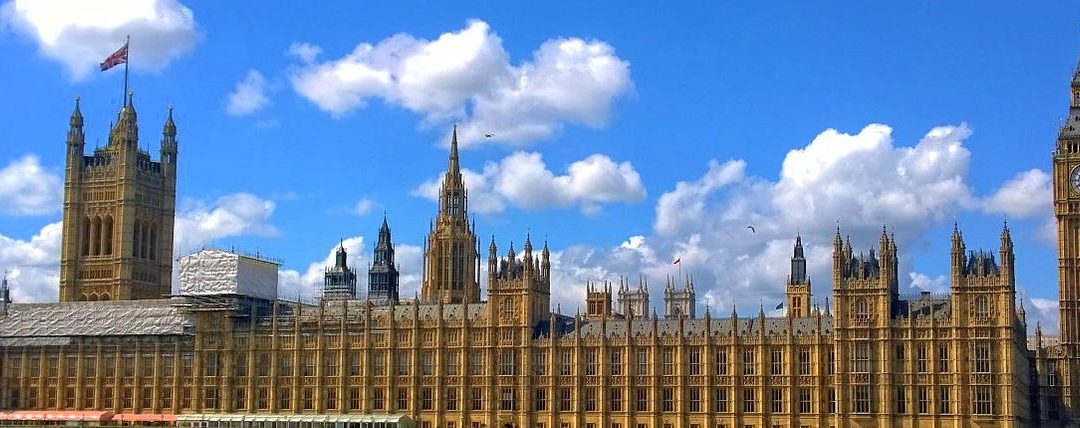
New Green MP Hannah Spencer is a breath of fresh air in the Palace of Westminster, but the smell of alcohol is getting up her nose, writes Bremain Chair Sue Wilson MBE for Yorkshire Bylines.
Former plumber and gas engineer, Hannah Spencer, was elected as the new Green Party MP for Gorton and Denton in February this year. Since taking up her role in parliament, she has advocated for more “people who do jobs like mine” to follow in her footsteps. This, she says, would provide better representation to “normal people” rather than from career politicians and “posh boys”.
Spencer has been vocal about how her background contrasts with the lifestyles of her colleagues and has highlighted an “out of touch” and “unprofessional” culture within Westminster.
Hannah Spencer riles fellow MPs with attack on parliament’s drinking culture
— The Guardian (@theguardian.com) 27 April 2026 at 18:59
Westminster drinking culture
The latest topic of parliamentary cultural behaviour to come under Spencer’s scrutiny has been the freedom of MPs to access alcohol – and cheaply at that – while working. She criticised the “normalised” consumption of alcohol in Westminster, stating that she could “smell the alcohol” on MPs in between votes. Spencer also argued that a cleaner or bank worker would be sacked if returning to work smelling of booze, but said MPs, who are in charge of making vital national decisions, treat it as a “pantomime”.
Her comments have provoked considerable comment, from both sides of the argument. Yet, it’s hardly the first time similar issues have been raised
Those in favour
Arguments for maintaining the status quo have come mainly from MPs themselves, but not exclusively. A number of Labour MPs have defended the current culture due to the frequent long hours that MPs are required to work.
Neil Coyle, Labour MP for Bermondsey and Old Southwark, said he hadn’t had a drink for 4 years (following his own unfortunate comeuppance), but didn’t believe an alcohol ban was necessary. Labour MP for Bolsover, Natalie Fleet, said that the smell of “fags and beer” was one of the things that made work in Westminster a “tiny bit normal”. (A voluntarily-adopted smoking ban applies in Westminster, except for specific areas).
Reform UK Limited leader, Nigel Farage – so often photographed with a pint in his hand – has also jumped on the bandwagon. Farage mocked Spencer’s stance, suggesting that, with the Greens’ progressive attitude towards legalising drugs, she would have no problems with MPs smelling of marijuana, as long as they didn’t smell of alcohol – an argument the Greens have been quick to dismiss.
The News Agents journalist, Jon Sopel said that “back in the day” it would have been “amazing to meet an MP who didn’t smell of alcohol”. So, if it was ok then, what’s the problem now? He added that “no one votes the wrong way because they’ve had a pint”. Maybe so, but is anyone seriously suggesting that MPs are saying ‘no’ to a second or a third one?
"No one votes the wrong way because they've had a pint… It'd be amazing to meet an MP who didn't smell of alcohol back in the day"
Green MP Hannah Spencer has sparked debate after criticising MPs drinking inside Parliament – so, should it be banned?
www.thenewsagents.co.uk/article/shou…
— The News Agents (@thenewsagents.co.uk) 27 April 2026 at 19:00
Those against
A common thread from those that feel drinking on the job is inappropriate and unprofessional, is what happens outside of Westminster. The argument in favour of the current drinking culture has focused mainly on MPs’ long and late hours, but so many other professions can make that same claim: doctors, nurses, bus drivers, police, the fire service, lorry drivers, air traffic controllers. To name but a few. Regardless of the fact that getting drunk, or even a little tipsy, at work would be a disciplinary matter, likely resulting in being fired, what member of the public would want the services of a less-than-sober surgeon or taxi driver?
Green Party leader Zack Polanski defended a drinking ban saying, “the idea that MPs can go for a drink and then make decisions on 69 million people’s lives – and not be doing that sober – will seem very strange to the public”.
Alliance party MP, Sorcha Eastwood, said she had worked in Tesco, manufacturing, the health service and construction, all of which had long hours, mostly low pay and lots of pressure. She questioned whether, in the place where MPs make laws for all other workers, is it really “OK for us to drink during work?”
Parliament’s own watchdog, the Independent Complaints and Grievance Scheme, has said the drinking culture in Westminster has been a “frequent factor” fuelling inappropriate behaviour, and that alcohol consumption is “leading to intimidating behaviour like shouting and swearing”.
MPs are human so they deserve an alcoholic drink whilst working?
NHS workers, often work for 12 hours plus and would never dream of this…
Let's not even get started on the pay disparity between an MP and a nurse 👇 https://t.co/sqeVEFHqxZ
— NHS Nurses (@SocialistNHS) April 27, 2026
One rule for them, one rule for the rest of us
Regardless of the arguments from both sides of the political spectrum, perhaps what’s more important is what the public think. In a recent YouGov poll, the public came down strongly in favour of MPs having to abide by the same rules as the rest of the working population, with 76% thinking drinking on duty was somewhat/completely unacceptable and only 15% believing it was somewhat/completely acceptable.
With Green MP Hannah Spencer criticising fellow MPs for drinking alcohol ahead of evening votes in Parliament, the British public likewise disapprove – 76% brand this unacceptable, including 52% "completely unacceptable"
yougov.com/en-gb/daily-…
— YouGov (@yougov.co.uk) 27 April 2026 at 17:48
But drinking while on duty at Westminster is only one of a number of issues whereby MPs seem to get a much more preferential deal than the average worker.
While the House of Westminster bars are most likely the cheapest place to buy alcohol in the whole of central London, MPs and peers also have the luxury of subsidised (by us, the taxpayers) workplace restaurants, as well as generous expenses, including pricey accommodation in London (although, is there any other kind?). Not to mention annual pay rises – awarded by themselves, to themselves – above the level of inflation: something so often denied to many other groups of workers.
If those benefits weren’t enough to prove our representatives have a better employment deal than your average worker, then perhaps we should also remember that they only attend Westminster 4 days a week, and between 170 and 250 days a year.
Perhaps, then, if MPs spent a little less time improving their own lot and a little more time improving ours, we might feel a little more tolerant of ‘the odd pint’ while on duty. Bottoms up!
We had a huge campaign against drinking and driving.
I think we need one against drinking and working.
And by we I mean the Westminster bubble of privileged MPs who get discount booze.
It has been illegal for the rest of us for decades.
— BladeoftheSun (@bladeofthes.bsky.social) 27 April 2026 at 17:39
Aligning with the EU: what are we waiting for?
Since Keir Starmer is being assailed from all sides on his plans for EU alignment, might he not just as well risk an even bolder move? Bremain Chair Sue Wilson MBE writes for Yorkshire Bylines.
Brexiters are raging over the latest government efforts to ‘reset’ Brexit. Plans for the UK to align more closely with EU rules are being drowned out by cries of ‘betrayal’ from the right and demands for more ambition from the left. With Starmer being criticised from all directions over his Brexit ‘reset’ policy, isn’t it time to risk a bolder plan?
@pimlicat.bsky.social “We simply don’t have any time to waste on aligning at speed with our largest trading partner: the one lever our government can pull to not just stem the losses but turn the tide.”
www.bestforbritain.org/voters_actio…
— Best for Britain (@bestforbritain.org) 13 April 2026 at 13:45
Resetting EU/UK relations
With the government’s Brexit code of silence now firmly lifted, the prime minister has acknowledged the ‘deep damage’ Brexit has caused the UK economy. Starmer has stressed that a “stronger, closer relationship with Europe is in the UK’s best interest”, particularly at this volatile moment in time.
As part of the ongoing Brexit ‘reset’, new legislation will see the UK more closely aligned to single market rules, including accepting EU food standards, cutting red tape and improving trade, to the tune of an estimated £1bn. The legislative process will echo earlier pre-Brexit proceedings, when the government adopted hundreds of EU laws. What’s different now is that the UK no longer has voting rights and can no longer shape EU legislation.
New EU rules will be introduced using “secondary legislation”, not requiring the same level of scrutiny or parliamentary involvement as primary legislation. That lack of scrutiny has proved controversial, although the government insists peers and MPs will still retain a “role” in approving the bill.
The Brexiters are raging because Keir Starmer plans for the UK to align more closely with some EU rules.
Yes, it will make the UK a rule-taker, but that is the fault of Brexit and Brexit politicians. They were repeatedly warned this would happen.
Brexit cannot end Britain’s… pic.twitter.com/YEJGCfOcYv
— Nick Reeves #RejoinEU #NAFO #FBPE (@nickreeves9876) April 13, 2026
Brexit “betrayal”
Apart from complaining that parliament is being sidelined, Nigel Farage has described the plans as “a backdoor attempt to drag Britain back under European Union control”. He has vowed to oppose the legislation “every step of the way” and claims “it is a total betrayal of the Brexit vote”.
Perhaps the Reform leader has conveniently forgotten promises made by the Leave campaign before the referendum – that we would keep our single market rights. Had that been the case, Farage would have no need to complain at Starmer’s attempts to restore at least some of what was lost.
Of course, it’s not just Reform that is opposed to the legislation. Tory leader Kemi Badenoch criticised the plan as “offering the worst of both worlds” (at 3:56) while Sir Iain Duncan Smith described aligning with EU rules without having a say as both “demeaning and damaging” [subscription needed]. Plus, the usual right-wing nonsense about “sovereignty”.
WHAT ARE YOU AFRAID OF, PRIME MINISTER?
Apparently, ministers are bracing themselves to face down opposition to “dynamic alignment” with the EU from those who “scream treason” over the powers in a new EU-UK reset bill.
STARMER IS TRULY UNFATHOMABLE!
Why is he worrying what the… pic.twitter.com/liwEhc380Y
— REJOIN CAMPAIGN (@sonofr) April 13, 2026
EU reset too much/not enough
While Starmer’s ‘reset’ might be too much for the Brexiters, it’s not enough for many pro-Europeans. After months of silence on the subject, the government’s changing attitude towards Brexit has certainly been welcomed. However, the pace of the reset seems painfully slow, and the insistence on sticking to Labour’s ‘red lines’ – no single market, no customs union, no rejoining -appears inflexible, cowardly and foolish.
In an attempt to stem the tide of failing support, Labour has tried emulating Reform and the far-right, to no avail. Having finally appeared to accept it was losing more support to the left than the right, the government has now changed tack but is still saddled with poor comms and a lack of nerve. While his recent actions regarding Iran may have tempered his disapproval ratings, Starmer’s popularity is still through the floor. He is not only unpopular with both sides of the Brexit debate but is failing to please traditional Labour voters who have moved on to the more socialist, environmentally friendly Greens.
What are we waiting for?
Starmer’s latest legislation will undoubtedly help the British economy, improve EU/UK relations, and limit the damage of Brexit. But why stop there? With the majority of the British public now in favour of rejoining the EU, what are Labour so afraid of? Support for Brexit is dying off (literally), and nobody born this century voted for Brexit. As for the reception we might receive from our European neighbours, EU countries have been going out of their way to encourage our return, not least the new Hungarian Prime Minister.
With changing public opinion, Brexit is likely to play a considerable role at the next general election. Are we likely to see a return to the single market, customs union and/or the EU itself in Labour’s manifesto? Based on the evidence of the last 2 years, I’m not sure they have the courage. Or at least, Starmer doesn’t.
But why wait? The longer we remain isolated, the more damage Brexit will do and the harder it will be to ‘take back control’. With Labour – and Starmer in particular – so unpopular, and so criticised over Brexit, what have they got to lose by going the whole hog and taking a stand, before someone else beats them to it?
Farage says we are trying to get into the EU via the back door. As a proud nation with much to offer, we should be marching up to the front door and striving to be back where we belong – at the heart of Europe.
The way things stand, Starmer might just as well be hanged for a sheep as a lamb. Or forever be remembered as the pro-EU PM that didn’t have the balls to do what was in the best interests of his country, and his party.
Distance us further from the EU – suicide
Leave things as they are – meh
Get closer to the EU but without a say – feels rather self defeating
Rejoin the EU and become a full participant in every decision – only sensible way forward
— Edwin Hayward (@edwinhayward) April 13, 2026

Banknote redesign has the usual suspects in a a flap
The Bank of England’s proposals to feature wildlife on banknotes have been met with dismay in some quarters, writes Bremain Chair Sue Wilson MBE for Yorkshire Bylines.
Nigel Farage is outraged! The cause of his latest indignation? A decision by the “PC mad, loony” Bank of England (BoE) to remove historical figures from British banknotes, replacing them with British wildlife. A decision, Farage claims, that is the very “definition of woke”.
i, for one, am delighted that we finally have a definition of “woke”
— shardcore (@shardcore.org) 12 March 2026 at 09:23
Fisticuffs over a fiver
Farage’s focus thus far has been on the proposed removal of Winston Churchill from the £5 note. Having regularly invoked Churchill in the framing of his own political arguments, he has been known, on occasion, to misrepresent the former prime minister’s views, not least on Europe.
It is unclear whether Farage is equally concerned about the removal of JMW Turner, Jane Austen or Alan Turing, assuming he’s even heard of them. As for Farage’s attitude towards wildlife, his support for fox hunting and badger culling is perhaps all you need to know.
Manufactured outrage
It will come as no surprise that Reform UK Limited has been joined on this particular soapbox by the Tories. Kemi Badenoch described the decision as “deeply depressing that under Labour our national heroes are considered too ‘divisive’ to be on banknotes”, despite the fact that the decision was made by the Bank of England, not the government.
Writing for The Telegraph, former Conservative cabinet minister, Tom Tugendhat described the proposal as telling “a dismal story of national decline”, adding on X that it amounted to “forgetting who we are, what made our country great and who we can become”.
More surprising was to see leader of the LibDems, Ed Davey, also jump on the bandwagon, claiming this was the “worst time to do this”. He obviously hadn’t read the brief explaining that it would be a “few years” before the new notes enter into circulation.
Winston Churchill helped defeat fascism in Europe. He deserves better than being replaced by a badger 🦡 pic.twitter.com/D0ryOQYSTu
— Ed Davey (@EdwardJDavey) March 11, 2026
A relatively modern tradition
With so much fuss being made over his replacement, many would be forgiven for thinking that Churchill had featured on a fiver since the second world war. In fact, non-royals have only featured on British banknotes since 1970, and Churchill only for the past 10 years.
Considering how often we hear cries of ‘patriotism’, or lack thereof, from right-wingers, why did we not hear similar protestations when other historic figures – not least Elgar, of Land of Hope and Glory fame – were removed from our currency. As for Darwin, Shakespeare, Dickens, Nightingale and other famous Britons, I suspect they too would fall under Farage’s inaccurate definition of ‘woke’.
The Bank of England has only put non royals on bank notes since 1970.
Farage and Co. losing their minds over a relatively modern tradition.
— Otto English (@ottoenglish.bsky.social) 11 March 2026 at 23:36
The public choice
What has been completely overlooked by the outrage brigade is the background to the decision, and the involvement of the British public. The BoE’s chief cashier confirmed that banknotes are regularly redesigned “to increase counterfeit resilience”, adding that the new proposals were a way to “celebrate different aspects of the UK”.
As to the involvement of the public, a consultation process asked 44,000 people which themes they would like to see on the next banknotes. The outcome was that 60% chose ‘nature’ as one of their preferred options, with ‘architecture and landmarks’ coming a close second with 56%. Some way behind in third place was ‘historical figures’ with 38%, so you could say that Churchill’s removal was the “will of the people”. A small detail that Farage has chosen to overlook.
My humble submission to the new Bank of England with concepts for the new bank notes to please both sides.
— Tom Wilson (@feedthedrummer.bsky.social) 11 March 2026 at 14:57
The wrong focus
With the wealthy in our country continuing to get richer at the expense of the less well off, if there’s an argument to be had over banknotes, this isn’t it. Farage’s fabricated outrage only serves to stir up discontent, the only thing he’s any good at. It does nothing to solve the problems of those whose only concern regarding British banknotes is whether they’ll have enough of them to pay their bills.
Farage, with his many sources of income and seemingly unlimited expenses and donations, does not have those worries. Nor, it seems, will he ever understand what it feels like to be in that precarious position. Anyone who thinks otherwise is a few banknotes short of a full wallet.
Sign Up to our Newsletter
Official Partners
Members of