Bremainers Ask……  Farrukh Younus

Bremainers Ask…… Farrukh Younus

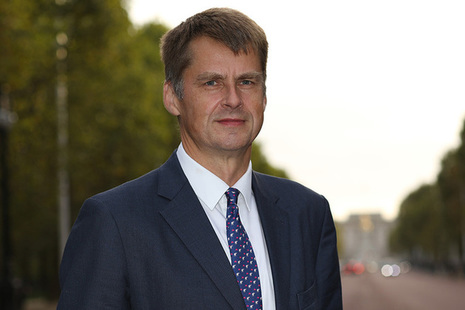
With a background in mobile phone strategy across Europe and Asia, Farrukh is dedicated to understanding and delivering solutions based on new technology. He regularly attends industry-leading conferences and has spoken on the subject to the EU in Brussels. 

Farrukh currently runs a video platform, Implausibleblog, delivering lifestyle content via social media, focusing on understanding consumer behaviour with regards to digital content and digital advertising. He is a regular commentator on the political landscape, having generated over 1.6 billion impressions on Twitter/X.

Lisa Burton : You have always been very outspoken on Brexit. Has it had any direct or personal effect on your life or profession?

At first, Brexit didn’t affect me directly: it was more an ideological frustration. It never made sense to me to limit our ability to live, work, and study on the continent we’re part of, or to isolate ourselves from our nearest neighbours.

But as I became more vocal online, some brands chose not to work with us. Implausibleblog used to be just lifestyle fun: food, fashion, travel and tech. The addition of news has changed our dynamic and increased our reach such that we get in a day what we used to get in a month, in terms of impressions and engagement. The Highlights tab on Twitter helps us show some of our non-news content. 

That was initially disappointing and even a little disheartening. I understand brands want to stay politically neutral, but staying silent is exactly what helped deliver Brexit in the first place. So, I made a personal vow: as long as I have the platform, I’ll continue expressing my views, because without voices like these, we risk ending up in an even worse situation.

Interestingly, some staff at the very brands that cut ties would privately tell me they appreciated my honesty, liking and engaging with my political content in private. I also see the same frustration in many people, but they feel unable to express it publicly. Having made the decision to speak out, I find myself considerably more at peace.

It feels strange to live in a time where speaking sincerely is more of a luxury than a right freely exercised by many. We can communicate instantly across the globe, yet doing so effectively and honestly remains difficult. Navigating brand neutrality in a corporate-driven world is a challenge, but thankfully some, like Lush, take a more direct approach. It gives hope that, one day, others may follow suit. How bad does it have to get before people are willing to speak out?

On a lighter note, I have many friends across Western Europe, and I’m grateful that, at least for now, Brexit hasn’t curtailed my ability to travel and visit them.


Valerie Chaplin : What do you think re the current state of the Government and do you think the UK will rejoin the EU?

The Government seems lost and confused, desperate to deliver growth while fully aware that Brexit is holding the UK back yet pressing ahead regardless. After the chaos and ideological excess of Johnson, Farage, and others, we’ve entered a new phase where even pro-European voices feel powerless to pull the UK closer to the EU.

Even small, sensible measures, like regulatory alignment, provoke outrage from Brexit hardliners. Labour risks abuse and accusations of ‘betrayal’ no matter what it does, so if it’s going to act, it might as well commit fully rather than tiptoe around it.

I don’t see Keir Starmer steering the UK back into the EU anytime soon. His reluctance to challenge populist misinformation or confront the far right reinforces the perception that Labour lacks the courage to lead on this issue. While there are voices within the party advocating closer ties with Europe, they remain marginal, on the fringes rather than shaping meaningful policy.

It was refreshing to hear Mayor of London Sadiq Khan recently call for joining a Customs Union and the EU Single Market before the end of this parliament, framing the next election as a de facto vote on EU re-entry. Given Labour’s 15 major u-turns since taking office, this may be their only path to a second term. Yet Starmer’s leadership has often been a letdown, so one can only hope Labour appoints someone stronger to guide the nation into the election.


Steven Wilson : Spain has been at the forefront of criticism of Israel & the US. Do you expect others, including the EU itself, to voice similar opposition?

Pedro Sánchez has shown that it’s possible for a liberal democracy to uphold its values without being subjugated to another nation’s folly, especially when military action violates international law.

We see occasional sparks of dissent across Europe, but not enough momentum. Europe and the US share much culturally and democratically, it’s like we’re cousins. While there are differences, from climate policy to food standards, common ground remains. Yet I don’t see enough European voices speaking up right now. Until we apply fairness equally and have the courage to call out our allies when they act wrongly, little will change.

A stark illustration of this is the recent interview between The Economist editor-in-chief Zanny Beddoes and Tucker Carlson. I used to be a fan of the publication, critical of Carlson. Today, it feels reversed, Carlson spoke with more moral clarity than Beddoes. It’s a new, upside-down norm we must navigate. What’s missing is a collective European political response to these crises. We saw one approach to Russia’s attack on Ukraine and a very different one to Israel’s strikes on Gaza. Now, as war with Iran grows unpopular across Europe, meaningful criticism is still lacking.

I don’t want fewer ties between the UK, EU, and US. I want better standards, objectives, and a collective approach to peace and stability. Diplomacy shouldn’t disguise rightful criticism; otherwise, the public is left frustrated with weak, vague statements from politicians.


Anon : Should the King’s state visit to the US be cancelled?

In my view, yes. It’s hard to see how he could attend in good conscience while the US is flouting international norms, and President Trump is actively trolling our Prime Minister, Keir Starmer. Even if I’m no longer a fan, he’s still the UK’s PM.

How can we persuade the Government that mimicking far-right immigration policies is doing more harm than good, not least to themselves?

Labour has entered office with good ideas, but poor planning and delivery have forced repeated U-turns. Pension means-testing was set too low, the two-child benefit cap flip-flop exposed contradictions, and MPs were suspended for supporting policies the Government now celebrates.

Worse, in trying to appeal to the public, Labour has abandoned its values on immigration. Instead of promoting the benefits immigrants bring, as Canada’s Mark Carney has done gracefully, Labour is echoing hardline, far-right talking points. Home Secretary Shabana Mahmood’s immigration stance, now backed by Conservative leader Kemi Badenoch, is a glaring sign of how wrong the approach has gone.

This is a tone problem from the top. Starmer has chosen the easy path: mimic the Conservatives and Reform UK to appeal to a disenfranchised audience, rather than explain why a fair, progressive immigration policy benefits the country. In doing so, he alienates the left and centre, and fails to unify the wider public.

After 14 years of Conservative chaos, we deserved stability, integrity, and decency. Instead, Starmer has repeatedly abandoned those principles for short-term political gain. Unless Labour finds a new direction, I don’t see the party recovering under his leadership.

Sue Scarrott : With so many pressing matters needing Government attention, such as Brexit, cost-of-living, privatised water scandals, state of the NHS/Care sector, FPTP voting system etc, what should be the Government’s main priorities?

Nobody expected Labour to fix 14 years of austerity and division overnight, real repair will take time. In a crisis, good leadership first rallies people, sets a bold tone and direction, then methodically tackles issues.

Labour has fallen short here: messaging has been weak and inconsistent, and “growing the economy while making Brexit work” feels contradictory and uninspiring. Gaslighting the nation that post Brexit trade deals make up for the loss in GDP from being in the EU really is insulting.

Labour’s policies often seem driven by fear rather than ambition. Labour scaled back its strong green industrial revolution over bond-market fears, yet clear communication of its benefits (jobs, cheaper energy, security) might have won support for the investment.

The top priority must be genuine vision and ambition: end defensive spin, reject narrow interests, and lead with strong principles. Why, for example, no full ban on offshore donations? Because Labour themselves have received millions in donations from off-shore firms. Labour can’t fix the broken system if they themselves are exploiting it.

Principles first, then sharper, positive messaging. Traditional media will criticise anyway, but bolder choices would gain huge backing from online and new media. I’d love something positive to tweet about, not immigration policies so awful they’re endorsed by Kemi Badenoch.

20 months after the landslide, it’s odd to say, but Labour’s priority needs to be a clearer vision and better execution. The 15 major U-turns reflect poor delivery, not necessarily bad ideas. If the winter fuel allowance cap was set higher, it could very well have been a Labour success story right now. 

People want to recapture that electric election-night energy, the surge of hope, the bold momentum to rebuild Britain after years of stagnation. Instead, the Government under Starmer and Reeves has settled into a cautious, low-momentum style that’s increasingly reminiscent of Harry Enfield’s Kevin the Teenager: sulky, defensive, moaning “it’s so unfair!” at every challenge, lacking the drive and spark that once inspired voters.


Matt Burton : You have over 120,000 followers on X. Have you seen your engagement drop or rise since Elon Musk took over?

I began posting political content before Musk’s takeover, and I haven’t noticed any major change in overall reach: the more followers I gain, the greater the potential visibility. What I have observed, however, is that follower count isn’t as crucial as posting frequency. That said, having more people see a post initially does help amplify its reach.

One thing that can be disheartening is seeing a post receive 10,000 likes while another, equally valid post, gets only 50. Often, reach isn’t determined by content quality, which can be frustrating, especially for videos that take far more time and effort. But this is a common experience across social media, not just X.

Recently, I’ve noticed a platform-driven change. According to Grok, it was introduced in January 2026, but I only really noticed it in March. Now, if I like posts about flowers, I start seeing more flower content; if I like posts about food, I see more food. It’s reminiscent of X’s early days when it was old-school Twitter, and it’s refreshing to see how quickly the algorithm can respond to what you actually want to see, almost in real time.

What all of this really shows is that it’s not the content itself but the platform that determines reach, scale, and visibility. We’ve shifted from a culture of sharing and expressing views freely to one where some content is amplified, some is limited, and some lands somewhere in between. As a result, content is often shaped to fit perceived algorithmic preferences rather than simply reflecting what you want to say. And it doesn’t help that most social platforms operate the same way. They are designed to capture attention and spark engagement, which is a curious way of conditioning human interaction.


David Eldridge : Can Starmer survive?

At a time when the UK is being drawn into conflict with Iran, even as Labour insists it is not engaging in an offensive role, Keir Starmer appears far more level-headed than any of the Conservatives. Yet it is frustrating to hear the repeated line of “defensive, not offensive,” when UK bases are being used to arm bombers, and we know strikes are occurring in Iran. What began as a commendable stance of standing up to Trump and avoiding entanglement now seems undermined, with the country being pulled in from the sidelines.

On the question of Starmer’s survival as Labour leader, the initial optimism has given way to concern. His response to the Farage riots was promising, but subsequent actions suggest a decline: from the “island of strangers” remarks, to publicly calling for the resignation of the former West Midlands chief constable over a misjudgement, despite having made his own far greater error by ignoring advice and appointing Peter Mandelson anyway.

Starmer, Yvette Cooper, and Shabana Mahmood were all impressive in opposition. But in office, they have changed. Mahmood has taken a hardline stance on immigration and asylum, aligned with Kemi Badenoch’s approach. Cooper endorsed proscribing a group later deemed lawful by the UK High Court. And Starmer jumped on the antisemitism bandwagon over the Maccabi fan ban, unable to distinguish between public safety and antisemitism, despite the Green Party leader, who is Jewish, stating it was not antisemitic.

Can Starmer survive? Perhaps. Many Labour voters demonstrate the same loyalty to a leader that Conservatives have long exhibited. In an ideal world, leaders would be held to the same scrutiny as opposition figures. But British politics is increasingly driven by loyalty, regardless of actions or errors. That’s why Boris Johnson survived for so long, and why Starmer might as well. 20 months after the landslide, it’s odd to say, but Labour’s priority needs to be a clearer vision and better execution. The 15 major U-turns reflect poor delivery, not necessarily bad ideas. If the winter fuel allowance cap was set higher, it could very well have been a Labour success story right now. 

People want to recapture that electric election-night energy, the surge of hope, the bold momentum to rebuild Britain after years of stagnation. Instead, the Government under Starmer and Reeves has settled into a cautious, low-momentum style that’s increasingly reminiscent of Harry Enfield’s Kevin the Teenager: sulky, defensive, moaning “it’s so unfair!” at every challenge, lacking the drive and spark that once inspired voters.


Coming next month … Professor Christina Pagel

Christina is professor of operational research at University College London, using mathematical tools to support delivery of health services. She is also President Elect of the UK Operational Research Society and a Fellow of the Academy of Medical Sciences.

Since January 2025, she has been tracking the authoritarian actions of the Trump administration (trumptractiontracker.info) and writing about their implications for the US and internationally.

Christina is passionate about healthcare and defending liberal democracy and is a regular commentator on social media, with 66k followers on Bluesky and 176.5K followers on X.

If you would like to submit a question(s) for Christina for consideration, please email us no later than noon on Wednesday 8 April.


REGISTER TO VOTE

REGISTER TO VOTE

A Guide


As of 16 January 2024, UK nationals are now able to register to vote in UK elections, regardless of how long they have lived abroad. British citizens, eligible Irish citizens and citizens of Crown Dependencies can register as overseas voters as long as they:

  • were previously registered to vote in the UK or
  • were previously resident in the UK


Get ready to register

Before starting the process of registration, you will need to have access to proof of your ID and your former UK address.

To prove your ID you will need to provide your National Insurance (NI) number and your date of birth. If you have a British passport (current or expired), you will need to scan it for ID purposes. If you have lost your NI number, you can search for it here

To prove your address you will need to provide documentation containing your full name and address details. Acceptable documentation includes:

  • a UK driving licence (current or expired)
  • correspondence from HMRC or the Dept. for Work and Pensions
  • council tax statement/demand
  • credit card statement
  • utility or mobile phone bill
  • letter from an insurance company
  • P45 or P60 form or payslip
  • bank/building society passbook
  • local authority rent book

In the event that you are unable to provide satisfactory evidence of your ID and former UK address, you will have the option of providing an attestation. You will need to ask someone (not a close family member) to attest to the details you provide. Your attestor must be over 18 and registered to vote in the UK, but they do not need to be a UK resident.


How to register

You can register to vote from overseas online on the government website here

When applying to register, use the last address where you were registered as a UK resident. If previously registered to vote at more than one UK address, use the most recent address at which you were registered.

Any eligible voters that previously resided in the UK, even as children, but have never been registered to vote, can apply using their last UK address.

Details provided will be verified by local authorities who are responsible for the electoral role in their area.

Once registered to vote, you will need to renew your registration every three years (previously annually), before 1 November.

An easy read guide on the registration process is available here


Feedback

We would be very interested to hear about your experiences in registering to vote using the government website. The process will be straightforward for some and more complex for others, but it is important that we understand how it works for you, and any issues that need resolving. Please email us with any feedback, good or bad, of your experiences of the registration process. Be assured we will notify the DLUHC and the Electoral Commission regarding any issues, in order to improve the process.


Useful links

Electoral Commission: Overseas Voters- Resources for British Citizens Overseas

Electoral Commission: FAQs

British Embassy – Living in Spain – Voting

LibDems Abroad: Brits Abroad and Brits Abroad Q&A


Voting by Proxy
 

If you are unable to vote in person in the UK, then we strongly recommend voting by proxy as postal voting has proved unreliable in the past & your vote may not arrive in time to be counted.


How to apply & what you need

Once you have registered to vote, there are 2 ways to apply for a proxy – online or by post.

Before you start the process, you will need your:

  • N.I. number or other ID, e.g. birth certificate
  • Details of your Proxy: name, address, contact details
  • Digital signature (a photo)

The government have produced as Easy Read Guide that explains the process in more detail.


Who can act as your proxy?

You need to appoint someone you trust to act as your proxy who is:

  • 18 years or over
  • Registered & eligible to vote

Further information is available from the Electoral Commission: How to vote by proxy.

If you are unable to find a friend or family member to act as your proxy, you can approach your local political party. They have a vested interest in finding someone to act on your behalf.

Bremainers Ask – David Knopfler

Bremainers Ask – David Knopfler

Founder and former guitarist of the legendary Dire Straits rock group, David has achieved international stardom and success. Since leaving the band in 1980, David has embarked on a solo career as a singer-songwriter.

David is a regular commentator on politics on Facebook, X, Bluesky and Substack – read his newsletter on ‘Institutional MAGA racism

 Ruth Woodhouse : You recently referred to the “butterfly effect” and “small acts of resistance” with regard to addressing current ills. In practical terms, how do we employ this approach to fight the ever-rising tide of xenophobia?

You can never know when a small act of resistance makes a substantial difference. My father in 1939 had to get across two borders with no papers. A man with a milk cart and horse, with no reason to help a young stranger, just a small act of grace, decided to risk letting him hide in his cart and got him across one of them. At another he traded a blind eye from a border guard for his watch. Against all odds, he managed to get onto one of the last Kindertransport as a steward, even though officially the kids were unaccompanied. He described his escape to England as “a series of small miracles.” There is no one right or wrong way to unknowingly perform a small miracle. I think perhaps the article you are referring to was about the almost Herculean effort it sometimes takes to not embarrass or humiliate someone with opposing views to you in social media, which tends to amplify biases to create conflict rather than reduce it. Staying true to principles whilst not engaging ego, when addressing someone who might simply be uninformed rather than a card-carrying arsehole who tests patience, is not a trivial thing to hold to. I feel a small sense of failure, not victory, if I have to resort to blocking someone. The resistance there is not to amplify the bias the platform relies on for stickiness but still to insist that truth matters. You can never know the through effect of one thoughtful act or one thoughtful reply. 


Valerie Chaplin : Do you think the UK should rejoin the EU and stop pandering to Trump?

There is a lot to unpack here. The man in Dublin asked for directions who started his reply by saying “Well I wouldn’t start from here” knew a lot.

I would of course prefer that we’d never left. Rejoining is extremely complex and would require a series of circumstances in all 27 member countries. The EU now holds a substantially smaller percentage of global trade than it did ten years ago. If the UK were to rejoin it would boost that share by three or four percent and bring the EU within striking distance of matching the US for trade, which is making its own trading position more difficult by Trump’s tariffs and general boorishness on the world stage. There are many compelling arguments for the UK to return to the fold and none from the UK’s perspective for not doing it. 

Historically, not pandering to US Presidents as a UK PM would have been close to unthinkable. Churchill certainly had to, and Blair destroyed his own reputation when siding with Bush Jnr over the so-called “old Europe” that elected not to illegally invade Iraq. It’s not hard to imagine the Daily Mail headline: “Blair destroys the special relationship and our nuclear umbrella.” Starmer is very short on good options too, but yes, in my view, a principled refusal to pander to what looks very much like 21st Century fascism seems necessary. However, he has to consider how best to serve the national interest as he sees fit. I think it’s become very difficult to say that “pandering” is viable any longer. A closer look at Canada’s PM, Carney’s workaround AND realigning with the EU as much as possible would seem existential for both Starmer and the UK. 


Steve Wilson : Do you believe Reform have a realistic chance of forming the next government?

Reform is a political party with all its roots in weaponising xenophobia, racism and fear of immigration. They are currently trying to pretend that, rather than the extreme far-right wrecking ball Farage and Faragism has always been, they represent the new centre-right. They don’t, but it’s a public relations adjustment that is working well for them. Currently polling close to 30% across the country, they are certainly a serious political threat to liberal democracy. They would replicate much of what the MAGA movement has done in Minneapolis. 

At present, with our first-past-the-post electoral system, they would be unlikely to procure enough seats to win outright – but they could conceivably still, with alliances, form a government. It is more likely that the Liberal Democrats would hold their noses and ally with Labour to prevent them, but Hitler seized power, in large measure, through the ballot box and then absolute power thereafter. To me, Farage is a substantial risk and all legal efforts should be taken to keep him away from the levers of power while there is still sand in the hourglass. 


Juliet Lodge : What can we and musicians do together to advance understanding of Europe?

Musicians in the main have always been good at uniting diverse groups of people. Audiences in the main are little different country to country… some understand lyrics better than others but the transformative experience of “the church of Bruce”, for example, with Bruce Springsteen is well known. Peter Gabriel with Womad was famous for bringing global musicians onto one stage. 

I once realised when making an album in the Netherlands that we unintentionally had about eight different nationalities working together in the same room: that’s just how music innately is… it builds bridges, not walls. Brexit has committed a terrible act of cultural vandalism to this effect and, yes, cross-cultural resistance to being defined and contained by mere borders has always been foundational to music and its alchemical soft power. To restore freedom of movement and friction-free trade in Europe would be an absolute good. 

Anon : Do Labour stand any chance of turning things around and winning the next election, with or without Starmer?

Labour have inherited a chess board where the odds of winning a second term are difficult but not impossible. Sometimes, even with a great player, a game is objectively lost because only bad moves are left. It’s hard to say if that’s the case yet — but they do need to stop making any more blunders. No Government can win an election polling at 20%. They will ultimately be judged on their record and on living standards of the many. A week is a long time in politics. It’s their power to lose. 

Lisa Burton : If you could remove one barrier Brexit created for musicians tomorrow, what would it be?

One measure wouldn’t be enough. We need freedom of movement first and foremost but friction-free trade too. The loss of our European passports was probably the biggest gut punch for professional musicians in the UK – but touring is goods and services – people, equipment and merch have to freely travel too. A tour of 9 or 10 countries in Europe used to be no harder than a tour of 10 cities in Britain. Now it’s almost unimaginably complex – and beyond the means of small and medium-sized performers. Tinkering is welcome, but fundamentally rejoining is the only realistic fix. But political allegiances shift all the time – we’ll have to see what opportunities can be found and take them if presented. 


David Eldridge : Do you think McSweeney’s resignation will allow Starmer to remain in office for longer or will it hasten his departure?

 It’s likely a useful bloodletting. McSweeney fell on his sword (or was pushed onto it) over the Peter Mandelson scandal. That hasn’t fully played out yet. However weak Labour look – the right are fracturing worse. What we need are unifying alliances to keep the far right out of the mainstream where they are currently building strongholds. We live in “interesting times” of instability, when small changes can have powerful effects. We need to have a care that our solitary nudges aren’t misjudged. 


Anon : Pro-Europeans seem split between those wanting to rejoin the EU tomorrow and those who believe it will take a generation at least. What’s your best guess re the likely timeframe of a return to the EU?

I don’t doubt that we shouldn’t have left. I don’t doubt that we need a real public inquiry into Brexit to investigate how dark money, foreign malign influence, and Cambridge Analytica-style tactics of targeting persuadables tipped the scales on the referendum vote of 2016 before we can honestly address the size and scale of the hole under the waterline. Bilge pumps aren’t the answer. I think the timescale is very hard to know. 

In 1988 the Soviet Union was a fact as solid as the USA. By 1989 it was over, in the desire of Germany to reunify and tear down the wall. We are all Europeans… some are just taking a little longer to finally realise and recognise it. It feels like an immensity to imagine but, when a dam begins to leak, pretty soon the innate pressure opens the river up to its natural state again. 

Next month

With a background in mobile phone strategy across Europe and Asia, and a dedication to delivering new technology solutions, Farrukh Younus is probably best known for his video platform, Implausibleblog. He is a regular commentator on the political landscape, having generated over 1.6 billion impressions on Twitter/X.

If you wish to submit a question for Farrukh for consideration, please email us no later than noon on Monday 9 March.


Bremain Glossary of Terms

Bremain Glossary of Terms

There have been many legislative and administrative changes since Brexit, and keeping up to date with the terminology can be difficult. Here, we have put together a Glossary of Terms which we hope will make things easier to understand and to refer to if needed.

We hope you will find it useful.

You can find the Glossary Terms below, or you can download them as a PDF HERE


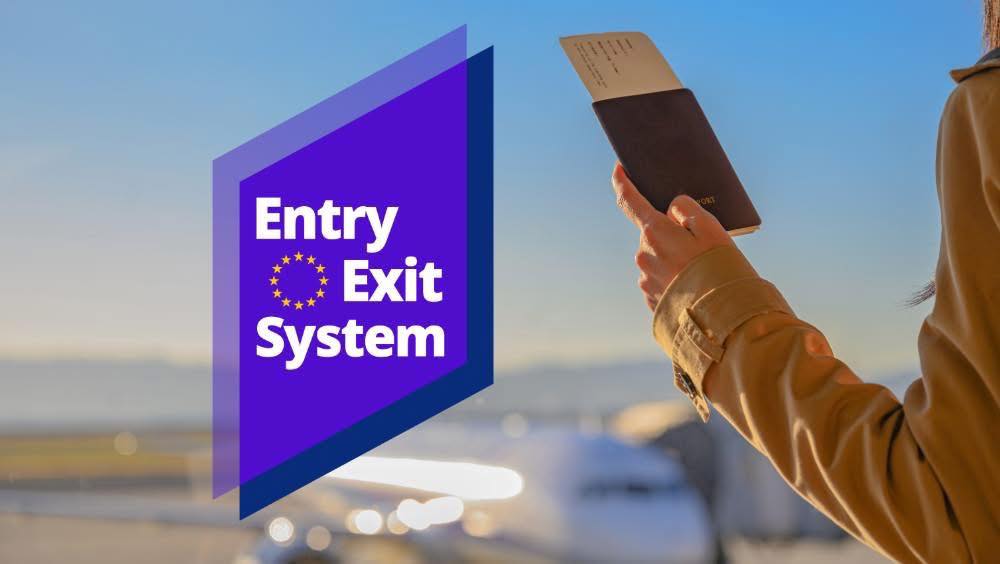
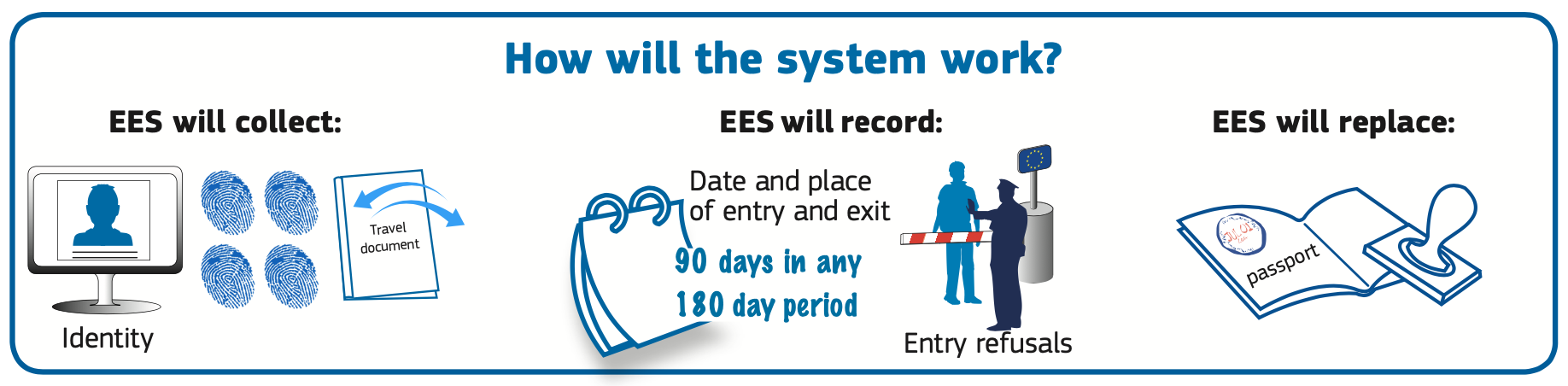
EES (Entry/Exit System) is a new digital border system being introduced by the European Union to register non-EU travellers each time they cross the external borders of participating European countries. It will replace manual passport stamping by electronically recording a traveller’s name, passport details, biometric data (such as fingerprints and a facial image), and the date and place of entry and exit. The system is designed to improve border security, speed up checks over time, and automatically monitor how long a visitor has stayed in the Schengen Area to prevent overstaying. More information can be found here.


EFTA Member States
– Iceland, Liechtenstein, Norway and Switzerland.


ETIAS
(European Travel Information and Authorisation System) is a pre-travel authorisation required for travellers visiting most EU and Schengen countries for short stays (up to 90 days in any 180-day period). It is not a visa, but an online security screening completed before travel. Applicants provide personal and passport details, answer security questions, and pay a small fee. Once approved, ETIAS authorisation is electronically linked to the traveller’s passport and is valid for multiple short visits over a set period. It is due to come into force at the end of 2026. More information can be found here.


EU Member States
– Austria, Belgium, Bulgaria, Croatia, Republic of Cyprus, Czech Republic, Denmark, Estonia, Finland, France, Germany, Greece, Hungary, Ireland, Italy, Latvia, Lithuania, Luxembourg, Malta, Netherlands, Poland, Portugal, Romania, Slovakia, Slovenia, Spain and Sweden.


Frontier worker
– a person who is resident in one state but regularly works in one or more states as an employed or self-employed person.


GHIC
– The Global Health Insurance Card (GHIC) allows UK residents, regardless of nationality, to access state-provided healthcare during temporary stays in the EU under the UK-EU reciprocal healthcare agreement. It replaces the EHIC but is not valid in the EFTA countries of Norway, Iceland, Liechtenstein or Switzerland.

EU residents who previously qualified for an EHIC (e.g. S1 holders) also qualify for a GHIC. However, like the EHIC, it cannot be used in your country of residence.

The GHIC is available to UK residents and S1 form holders registered from 1 January 2021. For all the details on eligibility, applications, and coverage, see here.

Lawfully resident – an EU citizen or a UK national lawfully resides in the host state in accordance with free movement law before the end of the transition period. This includes the right of residence, irrespective of whether it is a permanent right of residence, its duration (e.g., an arrival in the host state one week before the end of the transition period and residing there as a job-seeker is sufficient and irrespective of the capacity in which these rights are exercised (as a worker, self-employed person, student, job-seekers, etc).

NIE – a fiscal (tax) number that is necessary to carry out legal activities in Spain. It is a white A4-sized paper, and you retain the same number for life (just like your British social security number). The NIE number should not be confused with the Spanish green residency document or the new TIE card (Tarjeta de Identidad de Extranjero), which includes the NIE number (see ‘Residencia’ and ‘TIE’). Having only an NIE certificate or number does not make you a legal resident of Spain, and it does not provide healthcare coverage. You will need an NIE number to buy property, buy a car, or connect to utilities, etc.

Posted Worker (or ‘Detached Worker’) – an employee sent by their employer to carry out a service in another country on a temporary basis.


Padrón –
an abbreviation of ‘empadronamiento’, a padrón is a certificate obtained from your local town hall (ayuntamiento), that provides proof of residence in the municipality and the habitual residence therein, etc.​

Everyone living in Spain must be registered on the local “Padrón” of the current place of residence. If you live in several locations, you should only register in the place where you live the most. The document has a short shelf life and should be renewed regularly, especially if your residencia document does not include your current address.

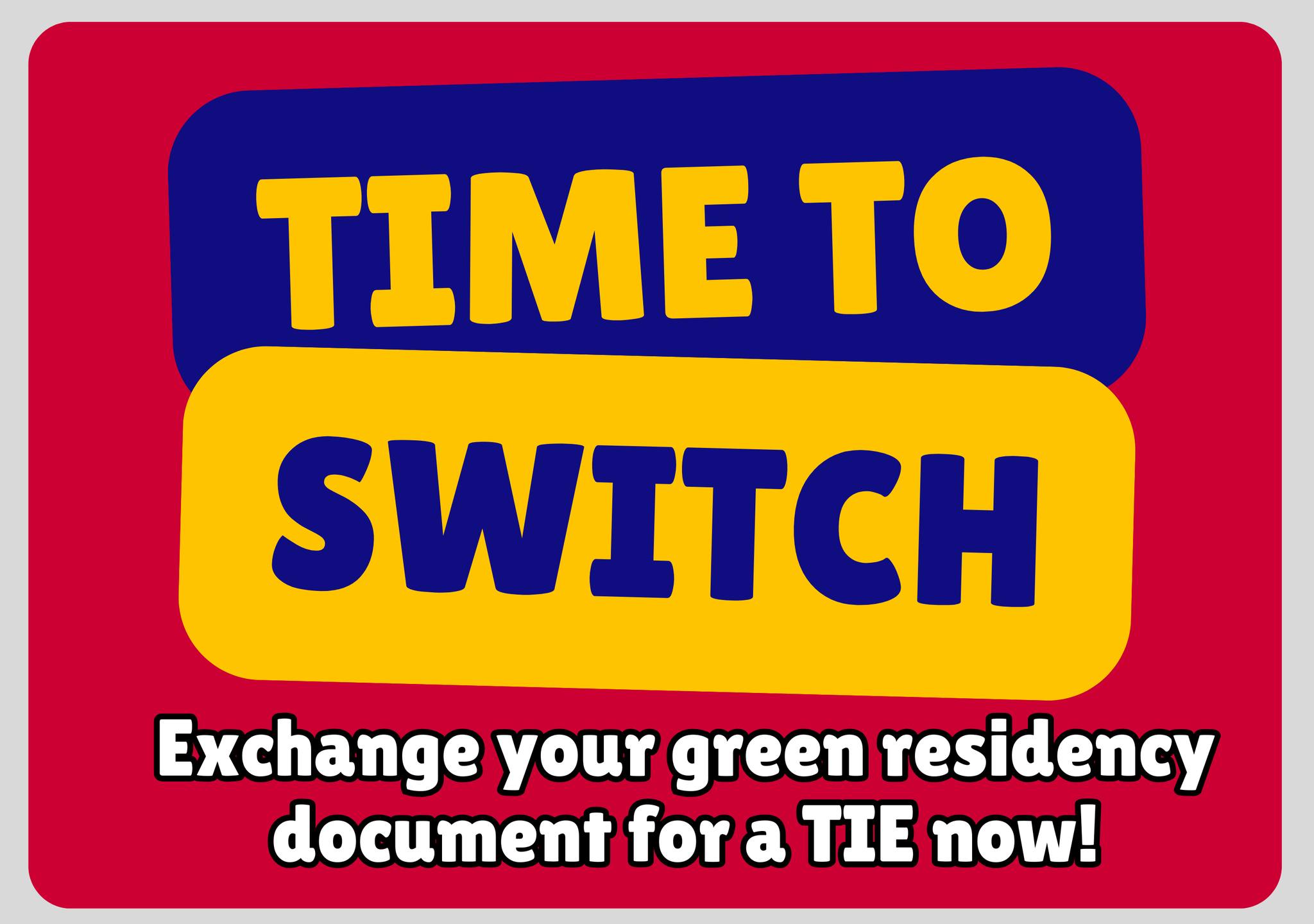
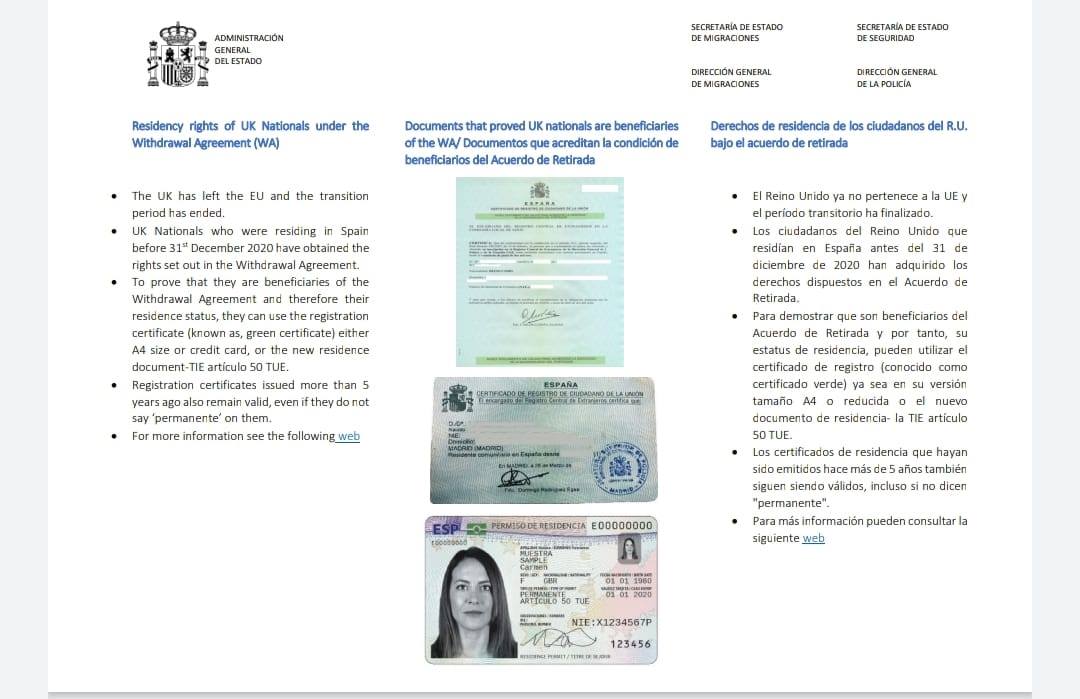
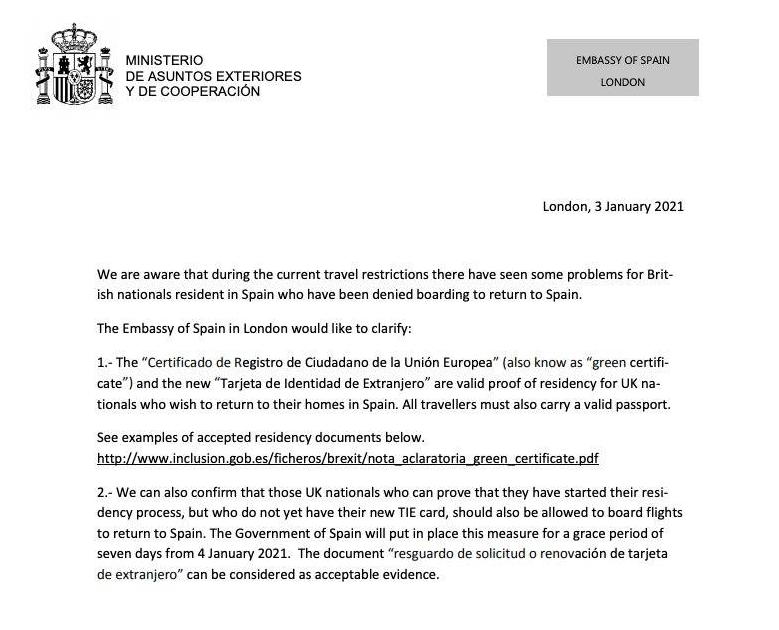
Residencia – a term often used to refer to the green EU residence certificate (TIE) or, more recently, the green EU residence card – is proof of residency provided by the Spanish authorities, now replaced by the new TIE. It contains your name and tax number (NIE), and although it is no longer issued, it remains proof of residency. It provides evidence of the same legal rights, including those covered by the Withdrawal Agreement, as the new TIE. There is no legal requirement to replace your existing green residencia with the new TIE; however, it is highly recommended, as there are benefits to doing so. While the green document/card continues to prove residency status within the country, it is not recognised outside of Spain. Furthermore, with the new Entry Exit System (EES) now in force, only a TIE will exempt you from the new border controls and ensure you are allowed entry into Spain. (See more below on TIEs).

S1 – a certificate of entitlement issued to individuals who live in one Member State but have their healthcare costs covered by another, for example, state pensioners, and entitles them to access to state-provided healthcare on the same basis as domestic nationals. You can find more information on the UK government website here.

Third country national – a national of a country that is not an EU Member/EFTA state. As of 1 January 2021, UK nationals are now third-country nationals in Europe and will lose rights associated with EU citizenship, such as freedom of movement.


TIE –
the ‘Tarjeta de Identidad de Extranjero’, or Foreigners’ Identity Card – is a biometric ID card that contains the identity details of a foreigner living in Spain.

Now that the UK is outside the EU and a 3rd country, the TIE has replaced the older green residency document/card. For those who were legally resident in Spain before the end of the Brexit transition period, the TIE will also identify those whose rights are protected by the Withdrawal Agreement.

Due to the introduction of the EU’s new travel Entry/Exit System (EES) We encourage all British residents in Spain to update their old green residency document to a TIE as soon as possible to avoid problems when entering or leaving Spain or other EU countries.

Withdrawal Agreement (WA)– The international agreement between the UK and the EU that sets out the respective rights and obligations of both parties, following the UK’s withdrawal from the EU. The WA protects the rights of EU nationals residing in the UK and UK nationals residing in the EU before the end of the Brexit transition period and enshrines these rights in law. You can read more here.  


**Disclaimer** 
This glossary is for general information only and does not constitute legal or professional advice. Rules may change, so readers should check official sources or seek professional guidance where necessary. Last updated February 2026.