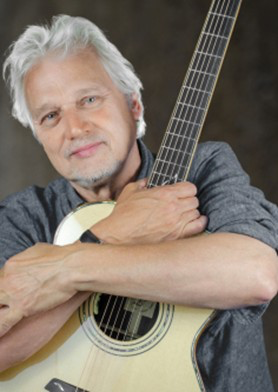
Founder and former guitarist of the legendary Dire Straits rock group, David has achieved international stardom and success. Since leaving the band in 1980, David has embarked on a solo career as a singer-songwriter.
David is a regular commentator on politics on Facebook, X, Bluesky and Substack – read his newsletter on ‘Institutional MAGA racism’
Ruth Woodhouse : You recently referred to the “butterfly effect” and “small acts of resistance” with regard to addressing current ills. In practical terms, how do we employ this approach to fight the ever-rising tide of xenophobia?
You can never know when a small act of resistance makes a substantial difference. My father in 1939 had to get across two borders with no papers. A man with a milk cart and horse, with no reason to help a young stranger, just a small act of grace, decided to risk letting him hide in his cart and got him across one of them. At another he traded a blind eye from a border guard for his watch. Against all odds, he managed to get onto one of the last Kindertransport as a steward, even though officially the kids were unaccompanied. He described his escape to England as “a series of small miracles.” There is no one right or wrong way to unknowingly perform a small miracle. I think perhaps the article you are referring to was about the almost Herculean effort it sometimes takes to not embarrass or humiliate someone with opposing views to you in social media, which tends to amplify biases to create conflict rather than reduce it. Staying true to principles whilst not engaging ego, when addressing someone who might simply be uninformed rather than a card-carrying arsehole who tests patience, is not a trivial thing to hold to. I feel a small sense of failure, not victory, if I have to resort to blocking someone. The resistance there is not to amplify the bias the platform relies on for stickiness but still to insist that truth matters. You can never know the through effect of one thoughtful act or one thoughtful reply.
Valerie Chaplin : Do you think the UK should rejoin the EU and stop pandering to Trump?
There is a lot to unpack here. The man in Dublin asked for directions who started his reply by saying “Well I wouldn’t start from here” knew a lot.
I would of course prefer that we’d never left. Rejoining is extremely complex and would require a series of circumstances in all 27 member countries. The EU now holds a substantially smaller percentage of global trade than it did ten years ago. If the UK were to rejoin it would boost that share by three or four percent and bring the EU within striking distance of matching the US for trade, which is making its own trading position more difficult by Trump’s tariffs and general boorishness on the world stage. There are many compelling arguments for the UK to return to the fold and none from the UK’s perspective for not doing it.
Historically, not pandering to US Presidents as a UK PM would have been close to unthinkable. Churchill certainly had to, and Blair destroyed his own reputation when siding with Bush Jnr over the so-called “old Europe” that elected not to illegally invade Iraq. It’s not hard to imagine the Daily Mail headline: “Blair destroys the special relationship and our nuclear umbrella.” Starmer is very short on good options too, but yes, in my view, a principled refusal to pander to what looks very much like 21st Century fascism seems necessary. However, he has to consider how best to serve the national interest as he sees fit. I think it’s become very difficult to say that “pandering” is viable any longer. A closer look at Canada’s PM, Carney’s workaround AND realigning with the EU as much as possible would seem existential for both Starmer and the UK.
Steve Wilson : Do you believe Reform have a realistic chance of forming the next government?
Reform is a political party with all its roots in weaponising xenophobia, racism and fear of immigration. They are currently trying to pretend that, rather than the extreme far-right wrecking ball Farage and Faragism has always been, they represent the new centre-right. They don’t, but it’s a public relations adjustment that is working well for them. Currently polling close to 30% across the country, they are certainly a serious political threat to liberal democracy. They would replicate much of what the MAGA movement has done in Minneapolis.
At present, with our first-past-the-post electoral system, they would be unlikely to procure enough seats to win outright – but they could conceivably still, with alliances, form a government. It is more likely that the Liberal Democrats would hold their noses and ally with Labour to prevent them, but Hitler seized power, in large measure, through the ballot box and then absolute power thereafter. To me, Farage is a substantial risk and all legal efforts should be taken to keep him away from the levers of power while there is still sand in the hourglass.
Juliet Lodge : What can we and musicians do together to advance understanding of Europe?
Musicians in the main have always been good at uniting diverse groups of people. Audiences in the main are little different country to country… some understand lyrics better than others but the transformative experience of “the church of Bruce”, for example, with Bruce Springsteen is well known. Peter Gabriel with Womad was famous for bringing global musicians onto one stage.
I once realised when making an album in the Netherlands that we unintentionally had about eight different nationalities working together in the same room: that’s just how music innately is… it builds bridges, not walls. Brexit has committed a terrible act of cultural vandalism to this effect and, yes, cross-cultural resistance to being defined and contained by mere borders has always been foundational to music and its alchemical soft power. To restore freedom of movement and friction-free trade in Europe would be an absolute good.
Anon : Do Labour stand any chance of turning things around and winning the next election, with or without Starmer?
Labour have inherited a chess board where the odds of winning a second term are difficult but not impossible. Sometimes, even with a great player, a game is objectively lost because only bad moves are left. It’s hard to say if that’s the case yet — but they do need to stop making any more blunders. No Government can win an election polling at 20%. They will ultimately be judged on their record and on living standards of the many. A week is a long time in politics. It’s their power to lose.
Lisa Burton : If you could remove one barrier Brexit created for musicians tomorrow, what would it be?
One measure wouldn’t be enough. We need freedom of movement first and foremost but friction-free trade too. The loss of our European passports was probably the biggest gut punch for professional musicians in the UK – but touring is goods and services – people, equipment and merch have to freely travel too. A tour of 9 or 10 countries in Europe used to be no harder than a tour of 10 cities in Britain. Now it’s almost unimaginably complex – and beyond the means of small and medium-sized performers. Tinkering is welcome, but fundamentally rejoining is the only realistic fix. But political allegiances shift all the time – we’ll have to see what opportunities can be found and take them if presented.
David Eldridge : Do you think McSweeney’s resignation will allow Starmer to remain in office for longer or will it hasten his departure?
It’s likely a useful bloodletting. McSweeney fell on his sword (or was pushed onto it) over the Peter Mandelson scandal. That hasn’t fully played out yet. However weak Labour look – the right are fracturing worse. What we need are unifying alliances to keep the far right out of the mainstream where they are currently building strongholds. We live in “interesting times” of instability, when small changes can have powerful effects. We need to have a care that our solitary nudges aren’t misjudged.
Anon : Pro-Europeans seem split between those wanting to rejoin the EU tomorrow and those who believe it will take a generation at least. What’s your best guess re the likely timeframe of a return to the EU?
I don’t doubt that we shouldn’t have left. I don’t doubt that we need a real public inquiry into Brexit to investigate how dark money, foreign malign influence, and Cambridge Analytica-style tactics of targeting persuadables tipped the scales on the referendum vote of 2016 before we can honestly address the size and scale of the hole under the waterline. Bilge pumps aren’t the answer. I think the timescale is very hard to know.
In 1988 the Soviet Union was a fact as solid as the USA. By 1989 it was over, in the desire of Germany to reunify and tear down the wall. We are all Europeans… some are just taking a little longer to finally realise and recognise it. It feels like an immensity to imagine but, when a dam begins to leak, pretty soon the innate pressure opens the river up to its natural state again.

Next month
With a background in mobile phone strategy across Europe and Asia, and a dedication to delivering new technology solutions, Farrukh Younus is probably best known for his video platform, Implausibleblog. He is a regular commentator on the political landscape, having generated over 1.6 billion impressions on Twitter/X.
If you wish to submit a question for Farrukh for consideration, please email us no later than noon on Monday 9 March.