Sue Wilson Writes: Why a proxy vote is the best option for those expats with right to vote in UK election

Sue Wilson Writes: Why a proxy vote is the best option for those expats with right to vote in UK election

Now that the general election campaign (yes, another one!) has officially commenced in Britain, it’s time to ensure you can cast your vote.  

If you’re already registered to vote, you can do so in person, post or proxy. If you’re not registered, you must apply to become an overseas voter. Those already registered need to verify that their registration is still current, as it must be renewed annually.

If you haven’t renewed your registration since the 2015 election, you must do so by midnight November 26th. However, we recommend not leaving this process until the last minute, as it will leave insufficient time to apply for a postal or proxy vote.

Based on previous experience, I would strongly recommend applying for a proxy vote, if you cannot vote in person. During the referendum, the 2015 general election and the recent European elections, many people who relied on postal votes were badly let down.

Either postal forms weren’t issued in time to be completed and returned before the deadline, or not issued at all. After the European elections, some local authorities openly admitted that they had failed to comply with postal vote requests.

Around 60 percent of British citizens overseas are already disenfranchised because of the 15-year voting rule. This is a sore point for people who are being forced to live with decisions that affect their lives, but over which they have no say.

For those who still have their democratic voting rights, it’s infuriating to have them removed by a UK council that has failed to issue postal ballots to overseas voters.

Those with no experience of proxy voting often assume that you need to find a friend or family member living in your local constituency to act on your behalf. While that is certainly one option, there are others. My personal method – and a popular one – is to have my preferred candidate do the work for me.

Once your name is on the electoral register in your former constituency (the address where you last resided in the UK), you can apply for a proxy vote. This is an easy process which can be started online. However, your ‘hard copy’ form must be received by post by your local Electoral Registration Office by December 4th (and beware the UK pre-Christmas post slow-down and planned postal strike).

When you’ve decided on your preferred political candidate, and have been granted a proxy vote, you can approach the local constituency office of your chosen candidate. The office will assign a proxy for you and, clearly, they have a vested interest in ensuring that the process works.

For the disenfranchised, there are still ways to be heard in this election. You can encourage friends and family members, in Spain and the UK, to register and vote. You may have young family members who’ve never voted and don’t know how. For example, students may not be aware that they can register to vote in their home town and their university town. They can only vote once but registering in two different places gives them more flexibility when the time comes.

It remains to be seen whether “Votes for Life” – the former Overseas Electors Bill – proceeds into any party manifestos, but we live in hope. Bremain in Spain will continue to campaign to have voting rights restored to all overseas voters. In the meantime, if you can vote, please do so. You’re not just voting for yourself but for the hundreds of thousands of people who cannot vote in this election.

From The Local

 

Our very own #Bremainernow

Our very own #Bremainernow

Brennon and Jamieson Robbinsleigh

Sorry seems to be the hardest word.

I suppose you could say I’m one of the first millennials being born in 1980 but my background and upbringing was far from progressive or new age, with strong old school working class roots and a service personnel family I was all too familiar with what I now call the “Rule Britannia” doctrine. 

Neither did I ever live in an area where I had an opportunity to mix with people of different ethnicities or cultures, but that didn’t stop everyone within my circles from being an expert on immigration.  When austerity really started to bite with schools, hospitals and housing waiting lists all falling into terminal decline, those messages I would hear in those same circles and the media really sunk into my subconscious, if you had asked me then I would have been unmovable on the opinion that all the fault lied with immigration, – that immigrants were taking our hospital beds, welfare cheques and council flats. 

Then the EU referendum came around, and I was prime candidacy ready for the bait of the whole Vote Leave and Farage’s narrative of take back control.  We all know the scripted lies by now; close the borders, the bus, Turkey joining, the easiest deal in history, etc., etc.  But I fell for it, I voted to leave proudly feeling like I was doing my country a service.

Then something happened to me.  This passion that was stirred in me grew and in the ensuing months after the referendum I started taking a real interest and asking myself more and more questions.  The months went on and it slowly started to dawn on me; I got it wrong, – really wrong. 

I have learnt so much about the workings of the EU and economic globalisation and the more I learnt the more the EU made sense to me.  My hostility just ebbed away as I learnt that they are not our enemies and cooperation is always better than competing individual self interests – coming together as 28 neighbouring nations on areas we agree upon only is a no brainer, isn’t it?  I don’t remember during the campaign anybody saying that 95% of the time we agreed with whatever new EU regulation was coming into force and most of the time the U.K. was front and centre architects to it. 

And little did I realise then how EU immigrants were making an invaluable contribution to our society and economy, enriching our cosmopolitan cultures with new foods, fashions, ideas and designs.  That EU immigrants pay more into the NI system than they take out.  That they are doing so many of the lowest paid and hardest jobs we refuse to do ourselves – caring for our sick and elderly, picking our fruit, waiting our tables or cleaning our hotel rooms. 

I also learnt that the vast majority of the media is right wing propaganda where the sheer scale of deliberate misrepresentation about the EU and immigration is genuinely shocking and an abuse of the freedom of speech they enjoy. 

I also met my husband a year after the referendum, who was planning to move to Spain at the time.  He was an undecided floating voter who reluctantly voted leave but who is now a staunch fan of the EU.  We finally made that move just this year and living here for 10 months has only validated further my journey from a leaver to a remainer.  Seeing first hand people from all EU countries mingling together in unison is truly joyful to witness. 

My husband uses a fire extinguisher analogy to explain the U.K. take on the EU.  And it is this.  The EU might decide that all fire extinguishers have to be bright yellow with pink stars.  Those on the leave side we decry with outrage how dare the EU dictate what colour our extinguishers should be.  Those on the remain side we say how wonderful it is that 28 countries can come together like this and agree on adopting something universally so that they are visibly the same to anyone everywhere. 

I take the latter view now.  So I am sorry for my vote, I’m sorry I didn’t know more then and I hope I can make it right somehow.

Brennon Robinsleigh from Kent now lives in Altea

Sue Wilson Writes: If Brexit is the ‘will of the people’ then let’s test it

Sue Wilson Writes: If Brexit is the ‘will of the people’ then let’s test it

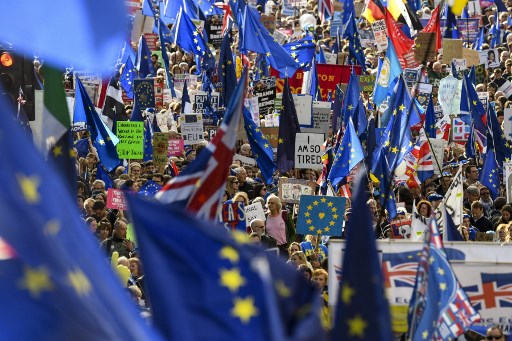
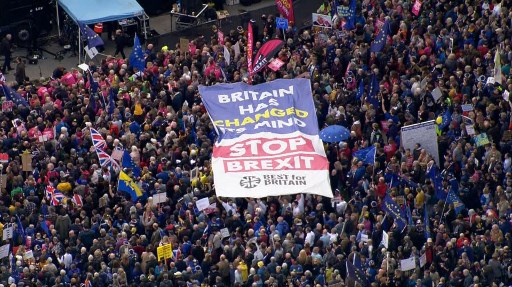
#FinalSayMany British citizens from Spain joined over a million marchers at the #PeoplesVote rally: a day of solidarity, strength, good humour and determination. A day we will proudly recall, in years to come, with the words “I was there”.

For those of us fighting to stay in the EU, it will be remembered as another significant day in which the prime minister, Boris Johnson, was prevented by parliament from rushing through his damaging Brexit deal.

On Thursday October 17th, at the EU summit, Johnson unexpectedly agreed terms for the UK’s withdrawal from the EU. The shock of the 11th hour agreement was followed by news that parliament would vote on the deal on “Super Saturday”, with a view to leaving the EU on October 31st, should it pass. The votes were too close to call as to whether the deal would pass.

Thanks to an ingeniously simple but effective amendment by Sir Oliver Letwin, Johnson withdrew the planned vote on the deal. The Letwin amendment, described as an insurance policy to prevent a last minute “accidental” no deal, passed by a majority of 16.

The news of this monumental defeat for the government was greeted with huge cheers from the crowds in Parliament Square. With the result of this vote, and because of the Benn Act, Johnson would be forced to write to the EU requesting an extension.

Read full article in The Local


For Brits living in Europe, Brexit throws a once clear future into doubt

For Brits living in Europe, Brexit throws a once clear future into doubt

A couple of years ago, Teresa and Kim Sawdy moved from England to Spain to take an early retirement.

Drawn by the beautiful nature, welcoming population, quality of life, and lower costs, they bought an apartment in this sun-kissed town on Spain’s southern coast. Ms. Sawdy first volunteered at a local dog shelter and today teaches English as a foreign language; Mr. Sawdy enjoys his free time.

But like many other Britons living in Europe, the couple say their lives have gotten more difficult because of the fallout over Brexit. They say that with the administrative hurdles they are encountering, it feels as if Brexit had already happened.

Now Mr. Sawdy worries he could have to go back to work, and Ms. Sawdy says she doubts she will “ever get a pension from England.”

From small seaside villages on the coast of Spain, where older British expatriates have found a sunny slice of paradise to retire, to larger cities where younger ones have found a viable professional base, to the European Union more broadly, Brexit and its implications are viewed with genuine concern, if not always great clarity.

Uncertain rights and protections

With the United Kingdom scheduled to leave the EU on Oct. 31, British Prime Minister Boris Johnson and EU negotiators agreed Thursday upon a last-ditch deal on the terms for Brexit. But Parliament still must approve the deal in an extraordinary session on Saturday, and the prospects for success remain uncertain. Should the vote fail, Mr. Johnson would be obliged under the law to seek an extension from the EU – something he has said he would obey, while also promising that the U.K. would leave the EU on Oct. 31 no matter what.

Full story in The Christian Science Monitor


Brits in Spain get ready for Brexit, with one eye on the UK’s new deal with Brussels

Brits in Spain get ready for Brexit, with one eye on the UK’s new deal with Brussels

The announcement on Thursday of a last-minute deal between the UK and the EU came as many British residents in Spain rushed to complete their paperwork to prepare for Brexit.

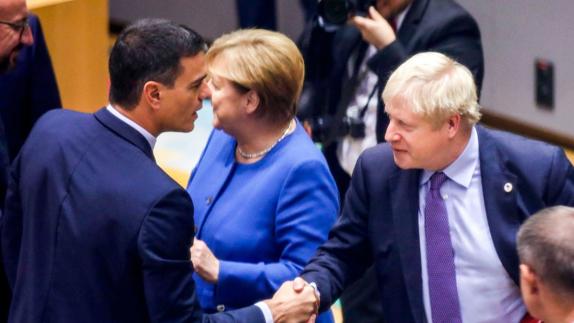
The images of Boris Johnson’s handshakes with European Commission President Jean-Claude Juncker and other EU leaders in Brussels do not mean that British residents in Spain can stop fearing a no-deal exit.

As Sue Wilson, chair of the organisation Bremain in Spain, points out, the deal still has to be passed by parliament. “The only way this will gain support in Westminster is if it is attached to a confirmatory referendum,” she said.

The president of the Costa del Sol-based organisation Brexpats in Spain, Anne Hernández, also expressed her doubts that Boris Johnson would get the support of MPs to pass his deal onSaturday.

Protecting the rights of British residents in Spain is the principal objective of Hernández’s organisation and she pointed out that the part of the new deal related to citizens’ rights has not changed since Theresa May’s deal.

“So we are at least mentioned and to some degree covered but quite how covered I am yet to see,” Hernández told SUR inEnglish on Thursday.

Meanwhile Brexpats representatives are on their way to 10 Downing Street to hand in their petition to demand that citizens’ rights be ring-fenced ad infinitum, regardless of whether the deal gets through or not.

“We moved here understanding the Ts & Cs and now they are all changed. To say pensioners access here to healthcare can only be guaranteed until 31 December 2020 is cruel; many elderly, lonely, confused and infirm are worried sick,” Hernández said.

Full article in The Sur