
enquiries@bremaininspain.com
  • Facebook
  • X
  • Instagram
  • Facebook
  • X
  • Instagram
  • About
    • Bremain History
    • The Bremain Team
    • Members’ Issues & Anxieties
    • Our Mission
    • Our Stories
    • Members’ Gallery
      • Mike Parker’s Story
      • Martin Robinson’s Story
      • Sandra’s Stretton’s Story
      • Mike Zollo’s Story
    • The Local ES
  • Events 2026
  • Bremainers Ask
  • British Embassy Updates
    • Bremain Glossary of Terms
  • Resources
    • Pro-EU Groups
    • How the WA affects you!
    • Government
      • Official Negotiation Links
    • Support & Advice
  • Votes for Life
  • Donate
  • Get in Touch
Bremain in Spain
  • Home
  • About
    • Our Mission
    • The Bremain Team
    • Members’ Gallery
      • Mike Parker’s Story
      • Martin Robinson’s Story
      • Sandra’s Stretton’s Story
      • Mike Zollo’s Story
    • Bremain History
    • Our Stories
    • Members’ Issues & Anxieties
    • The Local Articles
  • Events 2026
  • Bremainers Ask
  • Votes for Life
    • V4L matters because…
  • British Embassy Updates
    • Bremain Glossary of Terms
  • Resources
    • Pro-EU Groups
    • How the WA affects you!
    • Government
      • Official Negotiation Links
    • Support & Advice
  • Join Us
  • Donate
  • Get in Touch
Select Page
Stereotypes of Brits abroad

Stereotypes of Brits abroad

Mar 21, 2021 | Bylines, News

Our Chair Sue Wilson recently wrote this article for Yorkshire Bylines about the stereotypes of the British abroad:

When the British press write about Brits abroad – most especially about Brits in Spain – we’re often depicted as a collection of stereotypes. We play golf or bowls, drink too much, spend all day on the beach and complain about the weather.

I’ll give them that last one – we are British after all, and complaining about the weather is a national sport, no matter where you live. The rest of it is inaccurate and irritating.


The stereotype of Brits abroad is hugely inaccurate

Let’s get some facts straight to start with. If you’ve read an article about us, you could be forgiven for thinking we’re all retirees. In fact, only 20 percent of British citizens living in Europe are pensioners, though that figure rises to 25 percent in Spain. The majority of UK nationals in Europe are younger, working, with families, and well integrated into local society. Many of the children are more Spanish than British, and most are fluent in at least two languages.


The ‘expat’ label

Despite how much the term ‘expat’ is despised by many of us, it is widely used by the media. It’s understandable, as it’s understood by the British public and is an easy shorthand.

Personally, like many of us that would fall into that category, I refer to myself as a British immigrant. Not only is it a preferable description of who I am, but it comes without any connotations of being different, or superior to any other migrant. Until such time as EU citizens in the UK are regularly labelled expats, then I won’t be.


Where does the stereotype of Brits abroad come from?

Of course, stereotypes are not made up out of thin air. If you go to certain parts of Spain, you’ll find gin-drinking, bowls-playing Brits in many an English pub, enjoying their ‘full English’ or Sunday roast.

The Brit-heavy centres of the Costa del Sol and Costa Blanca are favoured haunts of the British press. The rest of Spain, and those of us desperate to avoid that stereotypical ‘expat’ life, are largely ignored by the media.


The role of the media

As chair of Bremain in Spain, I’ve been approached many times by journalists looking for Brits in Spain to interview. They usually contact me with a pre-set agenda and a specific area of Spain in mind.

In the pre-covid days when interviews were conducted face-to-face, that was understandable. Visiting journalists with limited budgets and time chose to focus on areas of high emigrant density. In an effort to talk to as many people as possible, they would visit unrepresentative British-only enclaves. There’s no excuse for that now though, when interviews are conducted by phone, Skype, Zoom or email.

The other issue is the pre-determined criteria. I am often asked to find pensioners worried about their healthcare, as if those were the only people suffering from Brexit, and healthcare the only concern.

Younger, working Brits are not concerned about healthcare – they pay into the excellent Spanish health service. Similarly, pensions are not a worry for them, as they’ll receive a generous Spanish pension, rather than a meagre British one. What concerns them more is how Brexit has affected their employability, and removed their opportunities to live and work in another EU country.

Or the opportunities that have been taken away from their children.


Misleading news accounts

A recent Sunday Times article claimed that, “Tempers fray among expats as Brexit rules cast shadow over Costa sunspots”. The reason for our anger, apparently, is that we’re being asked to apply for residency cards and being forced to switch to Spanish driving licences. As a result, “it has forced many to abandon their sunny retirement and resettle in the UK”.

It’s true that Brexit and third country national rules have forced many with second homes in the sun to decide which country to call home. But anyone previously spending more time in Spain than in the UK, should have already applied for residency, and switched to a Spanish driving licence. Those are not new rules.

What is different now is that those previously choosing to live ‘under the radar’, for whatever reason, will no longer be able to do so.


English exceptionalism

Despite numerous warnings from legal residents, Brexit supporters were largely convinced that Brexit would change nothing. Even now, there are still a worrying number convinced that Spain will turn a blind eye to their lawbreaking, or that the UK and Spain will come to some hastily agreed arrangement to keep everything as it was.

We still hear – too often for comfort – how Spain needs the Brits, and their spending power, more than we need them.

There’s no doubt that British tourists are important to the Spanish economy, and that third country national rules may affect how long visitors stay in the future. But, to suggest that Spain – or any other EU country – would allow UK visitors to stay longer than other non-EU citizens is wishful thinking.

Any European government would much rather, I’m sure, have those staying for more than 180 days a year register as legal, tax-paying residents. Even if tourism income declines, there will be a measure of compensation from those now paying taxes they’ve conveniently, and in many cases deliberately, avoided paying for years.


The real impact of Brexit

Despite media stories to the contrary, I haven’t witnessed a mass exodus of Brits leaving the country. But then I don’t live in a Brit-only enclave on a Costa, described by the Times as a “Brexiteer hotbed”.

For all those whose tempers are fraying over having to register, or switch driving licences, there are tens of thousands of us whose tempers have been fraying for the last five years. For very different reasons.

Whether or not you voted for Brexit, we all have plenty to be angry about. Let’s just make sure the anger is directed at those responsible for our woes. In case you weren’t sure, that isn’t Spain, or the EU. It’s the British government that sold the country a series of lies and promised us a future of opportunities.

Instead, we ended up with less than we had. If that doesn’t make your temper fray, nothing will.

Amazon sales after Brexit: the tale of our first shipment

Amazon sales after Brexit: the tale of our first shipment

Mar 18, 2021 | Bylines, News

Bremain in Spain’s Vice Chair Lisa Burton recently wrote this piece about her company’s post Brexit experience for Yorkshire Bylines:


For many sellers on Amazon, Brexit is causing significant problems. Last week my company decided to attempt our first shipment into one of Amazon’s European fulfilment centres since Britain left the European Union on 1 January 2021.

As I explained in a previous article, the UK’s departure from the European Union means UK sellers are no longer eligible to participate in Amazon’s European Fulfilment Network or Amazon’s Pan-European service. Around 12 percent of our sales came from participation in Amazon’s Pan-European programme.

After three months of lost revenue on those European sales, it was time to face the issues and send a shipment to an Amazon European distribution centre. We picked Germany for our first ‘test’ run. Initial delays seemed to have settled; we had already successfully imported and exported to EU business customers under the new rules, so we had some experience by now of what was required and the possible issues.


Sales to Amazon, prior to Brexit


Pre-Brexit, as an FBA (fulfilment by Amazon) seller, we shipped our inventory directly into Amazon UK fulfilment centres only. We signed up to the Pan-European scheme several years before, which meant we already had tax registration numbers in several EU countries.

Amazon would analyse our stock holding to see what was required and then locate our products throughout their distribution centres in the European Union, opening our products for next-day, Prime delivery to their European customers. Amazon knows their marketplaces best, so for us, there was no effort required once set up except for supplying our tax agents monthly sales reports.


Planning for Brexit and future Amazon FBA sales


Preparing for Brexit was impossible to a point, not just for us but for all businesses involved in importing and exporting. After all, it was only days before the end of the transition period that we had any idea of what the trade deal was going to look like.

My team and I put in many hours of research, reading, speaking with shippers, HMRC, tax agents. We watched Amazon videos, webinars and more, to be as prepared as we possibly could be. From this research, this is what we ensured we had in place.

  • Every item on our stock inventory had to have country-of-origin codes – this required many staff-hours and an IT solution.
  • Tax registration in every EU country we wanted Amazon to hold our products.
  • An authorised tax agent (Required in some EU countries for non-EU based businesses) to handle tax obligations in that country.
  • A UK Economic Operators Registration and Identification number (EORI number). One for our wholesale company and our online company from the UK Government.
  • A European EORI number (EUEORI) obtained from the authorities in the relevant EU countries.
  • A Duty Deferment Account (DDA) as advised by HMRC, this acts like a suspense account where any customs duties, import VAT and excise duties incurred can be added to that account and paid monthly to avoid hold-ups with unexpected costs.

What will sales to Amazon look like post-Brexit?


With all that in place, we had to decide what stock to send. Amazon had always made those decisions for us. Their analytics looked at our stock items. They had access to all the necessary data to move the required stock items to their other EU marketplaces. Amazon’s selling and storage fees are not cheap. Maintaining optimum stock levels in multiple countries is going to be challenging. One we are about to face.

With that done, we moved to the requirements of the shipping invoice. We quickly realised that sending stock from ‘yourself’ in the UK to ‘yourself’ in another EU country, was going to be different and slightly more complex because although it was going to Amazon, they are not the receiver or importer of the goods.


Bureaucratic challenges posed by Brexit


We asked our shipping company representative to look over the paperwork to ensure we had the correct EORI numbers and VAT numbers, and that the seller, shipper and receiver were correctly listed. Amazon takes no responsibility for the importation of the products, so this was vital. He then had to speak to a ‘Brexit expert’ as even for him; this was a first. He came back to me, and the conversation went along these lines:

“You need the address for the IOR” (importer of record), he informed us.

“We are both exporter and importer, so it is our address” was my reaction.

“No, you need a physical address in Germany.”

“But we have a legal tax representative in Germany, is that it?”

“No, your company needs a physical business address in Germany!”

Luckily, I have people I know in Germany. A friend pointed me in someone’s direction, and we manage to get an address. So today, after a week of back and forth, ensuring we had everything in place, our first shipment to Amazon EU left our premises. We now have to repeat the process for France, Italy, Spain.


Widespread difficulties for Amazon FBA seller


150,000 UK Amazon FBA sellers lost easy access to the European marketplace on 1 January 2021* and with that access to a potential 447 million EU customers. As you can tell by this article, it’s not impossible to sell your products FBA in the European marketplace after Brexit.

But as you can also tell, for the vast majority of sellers who used Amazon European Services pre-Brexit, the whole process becomes far too costly and complicated. We now have to consider more staff-hours, higher shipping costs, customs fees, and more accounting time due to more complex VAT submissions.

The sad reality is that all these additional costs will have to be passed on to the consumer, making products more expensive for the customer and the business less competitive.


Exporting to the EU, post-Brexit


I was not surprised by the Office for National Statistics report, that showed exports to the EU plunged by £5.6bn (40.7 percent) in January, with imports down 28.8 percent. It will take a significant amount of time and effort before we know whether replacing these sales will be cost-effective or even successful. I may even be counting my chickens before they have even hatched.

The stock hasn’t arrived in Germany yet, let alone been checked into Amazon’s distribution centre so there is still a lot that could go wrong. Let’s hope that isn’t ‘literally’ another story.

* There are 281,000 UK Amazon sellers in total – 57 percent of Amazon sellers are solely FBA sellers.

Brits in Spain risk being caught out by 90-day rule

Brits in Spain risk being caught out by 90-day rule

Mar 11, 2021 | Bylines, News

Bremain Chair Sue Wilson’s latest piece for Yorkshire Bylines:

When the Brexit transition period expired on 31 December 2020, British citizens lost their EU citizenship status. As a result, we became third-country nationals, with visits to Europe now limited to stays of 90 days in any 180-day period. That’s not just in one EU country, but all of them combined.

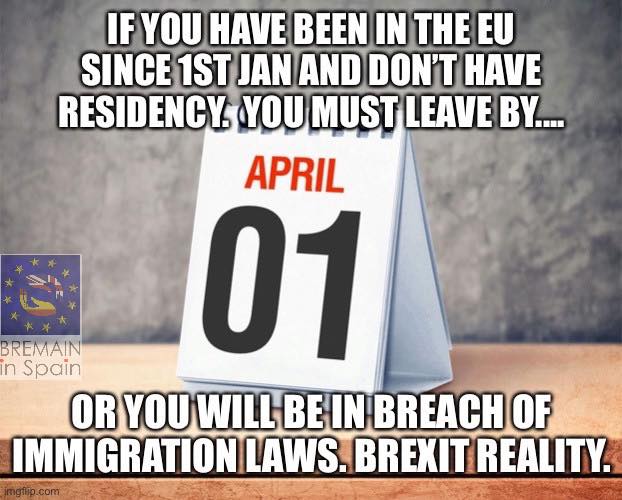
As British holidaymakers come to terms with the new rules, Britons currently on extended stays in Europe are running out of time. On 31 March, their 90 days will be up.

Many of those currently on extended visits have been in Europe since before Brexit was ‘done’. For those that arrived before the end of the transition period, the option of applying for European residency – under pre-Brexit terms – is still viable for the next three months. New applicants in Spain are being encouraged to register as a matter of urgency but are experiencing delays as regional authorities struggle to cope with demand.

The pending arrival of the Brexit deadline last year encouraged many Brits with long-held dreams of emigration to expedite their plans. By doing so, they ensured the avoidance of more onerous and costly EU entry criteria, as well as improving their future rights as residents. Applicants who can prove they were legally living in an EU country prior to 1 January will qualify for protections afforded us by the Withdrawal Agreement (WA). Whilst the WA does not protect all our prior EU citizenship rights, it provides additional security, not least with regard to healthcare and pensions.

‘Swallows’ in trouble

Not all British citizens currently on extended stays in the EU aspire to becoming residents. Many will be holidaying second-home owners – commonly referred to as ‘swallows’, as they migrate south for the winter. Others may be family members of residents of Spain, perhaps visiting parents or children. While some may have planned to stay for weeks, others only intended a Christmas visit but were caught out by Covid restrictions or flight cancellations. They now find themselves in difficult circumstances, perhaps unaware of the full ramifications of their situation.

In normal times, an extension to the allowed 90-day stay is only granted in the event of ill health or accident, but these are not normal times. The European Union is encouraging member states to be flexible and to grant extensions where necessary, but, ultimately, the decision rests with national governments.

Brexit means Brexit

As of 1 April, any non-resident failing to apply for an extension will officially become an ‘undocumented’ immigrant and could be fined or placed under an ‘expulsion order’. If deported, they could face a ban against re-entry – not just to Spain, but to most other European countries – for up to five years.

During the first Covid lockdown a year ago, Spain made special arrangements allowing thousands of third-country nationals to extend their visit. In May 2020, with Spain under a ‘state of alert’, a three-month extension to the 90-day rule was announced. This time around, and with less stringent Covid measures and travel restrictions, no such extension will be granted. The British Embassy in Madrid has confirmed that the grace period for travellers is no longer valid and added, “Any stays beyond the 90 days in any 180-day period will be dependent on the applicable visas and immigration rules for Spain. This may require applying for a visa and/or permit”.

Paperwork and deadlines

Dealing with Spanish bureaucracy can be difficult at the best of times, especially for those without a firm grasp of the language. Forms in quadruplicate, long lists of required documents (some of which have a very limited shelf life) and a shortage of appointments with the relevant authorities all add to the levels of complexity and anxiety.

In order to apply for an extension to your stay in Spain, you must prove your ability to support yourself during that period. This means demonstrating you have additional travel and medical insurance for the period in question. Any medical insurance must include the cost of repatriation in the event of accident or illness. A return ticket is also required, dated within the timeframe of the extension period, as well as documentation proving you have the financial means to support yourself. All documentation must be translated into Spanish, and any application must be made before the 90-day period comes to an end. Whether the authorities will actively seek out those overstaying their welcome remains to be seen, but police spot checks are commonplace, especially during the pandemic.

Third country reality

Many Brits coming close to the end of their allowed 90 days may be lulling themselves into a false sense of security. Perhaps they believe the Spanish authorities’ response to Brexit will be as lackadaisical as the British government’s response has been. If they are relying on the Spanish authorities needing time to adjust to new arrangements, they may be making a serious error of judgement. Third-country rules may be new to us, but they are not new to Spain, or to any other EU country. They have been applying them to other foreign nationals for years. All that was necessary was for the UK to be added to an existing list. Welcome to the slow lane.

International Women’s Day … 8 March 2021

International Women’s Day … 8 March 2021

Mar 8, 2021 | Bylines, News

I’ve always had mixed feelings regarding events or campaigns aimed at a limited, albeit a discriminated against, sector of society. Is it fair or appropriate to celebrate the social, economic and political achievements of women while leaving men out of the picture?

Bremain Chair Sue Wilson writes for West England Bylines for International Women’s Day:

Perhaps the question shouldn’t be about whether it’s fair, but whether it’s necessary. Until such time as global society truly reflects gender parity for all, then events like International Women’s Day will remain both essential and welcome.

The theme of this year’s International Women’s Day is #ChooseToChallenge. The event’s dedicated website states, “We can all choose to challenge and call out gender bias and inequality” and “to seek out and celebrate women’s achievements.” The day marks “a call to action for accelerating gender parity” and is described as “one of the most important days of the year to raise awareness about women’s equality”, or the lack of it.

One of the most obvious ways that women are discriminated against is in the workplace, with regard to remuneration. Although the gender pay gap in the UK has improved over time, there remains a significant median difference between male and female earnings of 15.5% (in 2020), though this varies considerably across the UK, and across different age brackets.

The UK figure is only slightly higher than the European Union average, which is just below 15%. The percentage varies enormously across the EU, with Romania at only 3% and Estonia, at the other end of the spectrum, at 23%. However, a narrower gender pay gap does not tell the whole story, as it often occurs in countries that have lower levels of female employment.

The Covid pandemic, and its economic fall-out, has had a negative impact on gender equality. Not only are women’s jobs more at risk, but the burden of providing unpaid care has increased disproportionately for women. During lockdown, women have largely taken on the additional roles in the home of teachers, nurses and care providers.

In addition, women are at greater risk from the virus itself, as a higher proportion work in the frontline care sector.

According to the UN Women organisation:

“While everyone is facing unprecedented challenges, women are bearing the brunt of the economic and social fallout of COVID-19.”

Despite women being disproportionately affected by the Covid crisis, many have spectacularly risen above the challenges. The world has watched with admiration, and a hint of envy, as leaders like Jacinda Ardern have demonstrated stability, strength and decisiveness in the face of extreme difficulties. At a time when others – not least our own prime minister – were dithering and uncommunicative, Ardern was making tough, effective decisions, and doing so with compassion, intelligence and honesty.

The appointment, in November 2020, of the first female, woman of colour to the Vice Presidency of America was a huge step forward for women’s rights. Even before the US election was over, the media were already talking of the possibility of Kamala Harris becoming the next president in 2024. The breath of fresh air that Harris (and Biden) have brought to American politics has given a sense of hope and opportunity to women everywhere.

Like Covid, Brexit has also seen strong, courageous women taking centre stage, even in the face of significant hostility. In 2019, another barrier was broken when Ursula von der Leyen became the first female President of the European Commission. Angela Merkel, another significant actor in the Brexit debacle, has been German Chancellor for over 15 years. In stark contrast to some of our own politicians, Merkel has demonstrated an incredible ability to communicate intelligently and clearly with the German public that has us gazing in awe. It is difficult to envisage European politics of the future without her.

If one woman has stood out in the UK over the last five years, for me it would have to be the amazing Gina Miller. She has taken the Brexit battle to the courts and provided much of the opposition to the government, and Brexit, that was woefully lacking in Westminster. Not only has she proved an intelligent, determined and forthright champion, but she has done so at huge personal cost, largely due to discrimination of a much darker variety.

Brexit reminded us, in no uncertain terms, that xenophobia and bigotry are alive and well in the UK. There’s a great deal of work to be done to eliminate discrimination, in all its forms, and to call it out at every opportunity. We cannot afford to be complacent or to leave the hard work to others. We can all “choose to challenge”.

When we consider the women who inspire or impress us, we also look closer to home. Our mothers, grandmothers, sisters, aunts, and daughters may not be famous, but their influence on our outlook and behaviour are just as, and perhaps even more so, significant. As is ours on them. Today is a day to celebrate all women – those we know and love, and those we admire and respect. We celebrate those that have fought tough battles to make it in a male-dominated world. We celebrate those that have raise us and nurtured us. We celebrate those that have educated us and inspired us. We celebrate those in the spotlight, and those behind the scenes, and we promise to do the same tomorrow, when it’s not your special day.
Happy International Women’s Day to us all!

Government pledges £2.5m to provide votes for life for Brits overseas

Government pledges £2.5m to provide votes for life for Brits overseas

Mar 6, 2021 | Bylines, News

2019 Conservative manifesto: “We will make it easier for British expats to vote in Parliamentary elections, and get rid of the arbitrary 15-year limit on their voting rights”.

Our Chair Sue Wilson writes for Yorkshire Bylines about the upcoming Electoral Reform Bill and what it means for those UK citizens living abroad for longer than fifteen years:

Overseas campaigners fighting for the restoration of lost voting rights received a pleasant surprise in this week’s budget. Hidden away in the small print on page 48 was a government commitment to “providing an additional £2.5 million to remove the limit preventing British citizens who live overseas from voting after 15 years”.


This news followed on the back of a recent announcement that the government’s manifesto promise – to scrap the 15-year rule – would be included in the forthcoming electoral integrity bill. A Treasury spokesperson said that legislation would be laid before parliament later this year.

Worldwide, over five million UK nationals have been denied their democratic voting rights. The reaction from long-suffering campaigners was a mixture of both relief and scepticism. As many disenfranchised Brits pointed out, we have been here before, only to be disappointed. This time, however, there is an increased sense of optimism that our long wait may finally be coming to an end.

Veteran campaigner, 99-year-old Harry Shindler MBE, has lived in Italy for 40 years and has been campaigning for the return of his lost vote for over two decades. Harry and I have been in regular contact for several years, thanks to Bremain in Spain’s own ‘Votes for Life’ campaign.

On Wednesday evening, it was Harry that first brought the budget news to my attention, following a phone call he’d received direct from Westminster. Harry called to express his appreciation for our support and asked me to “tell everyone that Harry says all your efforts have been worth it”. He told the BBC that “this is an important day for freedom”. Let’s hope his optimism does not prove to be misplaced.

Nothing would give me greater pleasure than to see further substantial progress made in time for Harry’s 100th birthday celebrations this July. Covid permitting, I shall be joining him in Italy to commemorate the special occasion. Next step? Harry casting his vote at the next general election. Now that really will be a day to celebrate, not just for Harry, but for millions of British citizens.

Will those Brits reward the government for finally keeping their manifesto promise? Or punish them for preventing us having a say in the Brexit referendum, that affected our lives so deeply? I guess we’ll find out in 2024. In the meantime, perhaps best to keep quiet, or the government might find a way to wiggle out of their commitments once again.


Open letter to Health Secretary Matt Hancock

Open letter to Health Secretary Matt Hancock

Mar 2, 2021 | Bylines, News

Our Chair Sue Wilson has written an open letter to Health Secretary Matt Hancock for Yorkshire Bylines:

Dear Mr Hancock,

As you seem to have been in the media spotlight recently, I thought I would write to you to offer my support and some well-intentioned advice.

Firstly, I’m not sure how frequently you meet with the prime minister, but it often appears as though the right-hand doesn’t know what the far-right-hand is doing. Whether or not you compare notes, you often seem to be singing from different hymn sheets. Getting your stories straight would be a good place to start, as any good cop or lawyer will tell you.

Working for a boss that takes all the credit when things go well cannot be easy, especially when he makes you deliver the bad news. And to be fair, there’s been plenty of bad news. Still, it’s good to see you holding your own and borrowing from the boss’s methods by taking credit for the work of “your team”. I assume, by that, you mean the wonderful, and massively overstretched, NHS, who have proved themselves time and time again throughout the covid crisis. It’s puzzling that the chancellor doesn’t seem to think they deserve a decent wage after all they have been through. If only you’d seen fit to give the NHS the important task of test and trace, where might we have been now? How is Dido by the way? We haven’t seen much of her lately.

You’ve been getting a lot of stick lately – not least from Piers Morgan and Jolyon Maugham – over the whole ‘contracts for cronies’ scandal. I appreciate that these are times of national crisis, and that normal rules don’t apply, but you need some better excuses I’m afraid. Declaring that breaking the law was in the “national interest”, and that given half a chance you would do it again, was probably not the best of defences.

I’m sure that being taken to court at a time like this must be inconvenient to say the least. Such a shame you didn’t just own up to getting it wrong before it got that far. You could have saved the taxpayer a small fortune, and yourself considerable embarrassment. Instead, it was rather silly of you to claim after the fact that there had never been a shortage of PPE when every nurse and doctor had so much evidence to the contrary!

You could ask your boss for some pointers on how to get away with telling porkies. He’s so much better at it than you. Perhaps you have designs on Number 10 down the road? If that’s the case, I can think of better role models for you to emulate than Mr Johnson. I’m sure he’s a lot of fun down the pub, but these are times when the grown-ups should take charge.

I was pleased to see that you had the good sense to remove a photo of your mate’s pub from your office wall. Better late than never. I did look as though you had replaced it with a cycling proficiency certificate, but I know you’re not that daft! It’s a shame you moved rooms though as, we did enjoy your earlier Zoom sessions. I know having a Union Jack in plain sight is now de rigueur, but I don’t believe any other Cabinet minister went as far as having the Queen’s portrait as background.

My apologies if this all seems like unfair criticism, but I promise I’m only trying to be helpful. I do believe that you are one of the hardest working and most intelligent members of Cabinet, though that is a low bar, I admit. You have it within you to do a better job. You must have, surely.

And I don’t mean to detract from the amazing progress of the vaccination programme. At last, the UK really is world-beating at something, even if it is just the delivery of the first vaccine dose. You are right to hold this up as a fantastic achievement. However, what the country would welcome is some recognition of the terrible death toll, and your government’s part in that. Better yet, a sincere apology wouldn’t go amiss. Furthermore, you are asking the country to take “personal responsibility” to protect themselves against covid. Setting a good example with your own errors would be a good place to start.

I have one final ask. If you could see your way clear to supporting the families of those that have sadly died, that would help mitigate the terrible human cost of covid and government policy. A useful way to start would be to abandon government plans to effectively block families access to justice. Threatening the bereaved with heavy government legal fees is not a good look. Tell your boss!

Finally, I’d like to thank you for wrapping your arms around care homes and around the vulnerable in our society. Consider this letter my return hug. I have sent you a friend request on Facebook, which I hope you will accept. Did I mention I have a nice little company that is ready and willing to work for the government at a moment’s notice? I don’t have any experience of delivering PPE, or tests, or vaccines, but I’m sure we’ll pick it up quickly as long as you can pay in advance!

Yours sincerely,

Sue Wilson

« Older Entries
Next Entries »

JOIN US

https://www.bremaininspain.com/wp-content/uploads/2016/11/Sue_BremainInSpainHandsFlags_01.png

Search Our Site

Translate this Site

Official Partners

european movement

Members of

Grassroots for Europe

Follow Us on Bluesky

Bremain in Spain

@bremaininspain.com

15388 Followers 11720 Following 6746 Posts

A pro-EU campaign group set up to oppose Brexit, protect the rights of British migrants living in Spain/EU & to rejoin. We believe freedom of movement is a force of good; in a democracy free from division & interference; equality.
www.Bremaininspain.com

Latest Posts

Bremain in Spain

@bremaininspain.com

See Bluesky Profile
  • Get to this post

    Bremain in Spain @bremaininspain.com 6 hours

    With Nigel Farage’s party continuing to dominate the headlines as the new year begins, we’ll be doing our utmost to hold them to account and expose how much of a disaster a Reform UK government would be for the country.
    leftfootforward.org/2026/01/5-re...

    5 Reform disasters this week: Your weekly round up of where it’s going wrong for Farage’s party

    Whether it’s their actions in local government, or Nigel Farage’s latest scandal or what their candidates and members are up to, here’s where it’s gone wrong for Reform this week.

    leftfootforward.org

  • Get to this post

    Bremain in Spain @bremaininspain.com 6 hours

    Spain marks 40 years in the European Union
    Four decades after its historic accession to the European community, the country has improved its socioeconomic indicators and its citizens continue to feel comfortable being part of the EU
    www.surinenglish.com/spain/spain-...

    Spain marks 40 years in the European Union | Sur in English

    Four decades after its historic accession to the European community, the country has improved its socioeconomic indicators and its citizens continue to feel comfortable b

    www.surinenglish.com

  • Get to this post

    Bremain in Spain @bremaininspain.com 8 hours

    Come on Nige.😊

    Zack Polanski

    Ball. His court.

  • Data Privacy Policy
  • Join Us
  • Get in Touch
  • Facebook
  • X
  • Instagram
© BremaininSpain.com 2016 - 2026 General Email: enquiries@bremaininspain.com Media: media@bremaininspain.com
Manage Consent

We use cookies to optimise our website and our service.

Functional Always active
The technical storage or access is strictly necessary for the legitimate purpose of enabling the use of a specific service explicitly requested by the subscriber or user, or for the sole purpose of carrying out the transmission of a communication over an electronic communications network.
Preferences
The technical storage or access is necessary for the legitimate purpose of storing preferences that are not requested by the subscriber or user.
Statistics
The technical storage or access that is used exclusively for statistical purposes. The technical storage or access that is used exclusively for anonymous statistical purposes. Without a subpoena, voluntary compliance on the part of your Internet Service Provider, or additional records from a third party, information stored or retrieved for this purpose alone cannot usually be used to identify you.
Marketing
The technical storage or access is required to create user profiles to send advertising, or to track the user on a website or across several websites for similar marketing purposes.
  • Manage options
  • Manage services
  • Manage {vendor_count} vendors
  • Read more about these purposes
View preferences
  • {title}
  • {title}
  • {title}