enquiries@bremaininspain.com
  • Facebook
  • X
  • Instagram
  • Facebook
  • X
  • Instagram
  • About
    • Our Mission
    • The Bremain Team
    • Bremain History
    • Members’ Issues & Anxieties
    • Members’ Gallery
  • Events 2026
  • Bremainers Ask
  • Resources
    • Pro-EU Groups
    • British Embassy Updates
      • Bremain Glossary of Terms
    • Government
    • Withdrawal Agreement
    • Support & Advice
  • Votes for Life
    • REGISTER TO VOTE
    • My Vote Matters
  • Sign Up
  • Donate
  • Get in Touch
Bremain in Spain
  • Home
  • About
    • Our Mission
    • The Bremain Team
    • Bremain History
    • Members’ Issues & Anxieties
    • Members’ Gallery
  • Events 2026
  • Bremainers Ask
  • Votes for Life
    • REGISTER TO VOTE
    • My Vote Matters
  • British Embassy Updates
    • Bremain Glossary of Terms
  • Resources
    • Pro-EU Groups
    • Government
    • Withdrawal Agreement
    • Support & Advice
    • Glossary of Terms
  • Sign Up
  • Donate
  • Get in Touch
Select Page
Climate crisis: action vs hypocrisy

Climate crisis: action vs hypocrisy

Aug 15, 2021 | Bylines, News

Last weekend saw my home region of Spain – the Valencian Community – brace for the first real ola de calor of the 2021 season, writes Bremain Chair Sue Wilson for Yorkshire Bylines. Warm air from the Sahara brought temperatures of over 40 degrees Celsius, with the threat of forest fires raised to ‘extreme’. The heatwave was also responsible for rising humidity levels on the coast, affecting atmospheric conditions and damaging air quality.

The threat of wild fires ravaging the countryside is a very real one, and not just in Spain. Recent fires around the world, such as in Greece, America and Australia, have highlighted the urgency of climate change action, and the dangers of inaction.

July saw extreme weather conditions across the globe, including unprecedented levels of flooding and landslides. On 11 August, Syracuse in Italy recorded the highest temperature ever experienced in Europe – 48.8 degrees C. This was beaten only by the highest temperature ever recorded on the planet – 54.4 degrees C (130 degrees F) – in Death Valley, USA in July (source National Centers for Environmental Information).


COP26 climate change conference just 10 weeks away

In ten weeks’ time – from 31 October to 12 November – the UK will host the UN Climate Change Conference of the Parties (COP26) in Glasgow. A glossy brochure, entitled ‘COP26 explained’, starts with a quote from Prime Minister Boris Johnson:

“Securing a brighter future for our children and future generations requires countries to take urgent action at home and abroad to turn the tide on climate change. It is with ambition, courage and collaboration as we approach the crucial COP26 summit in the UK that we can seize this moment together, so we can recover cleaner, rebuild greener and restore our planet.”

The brochure describes climate change as “the greatest risk facing us all”. Many would agree. They may, however, disagree with the claim that “the UK has a lot to be proud of when it comes to acting on climate change”.


COP climate goals

The stated goals of COP are to:

  • Secure global net zero and keep 1.5 degrees within reach
  • Adapt to protect communities and natural habitats
  • Mobilise finance
  • Work together and deliver

COP president, Alok Sharma, says that the UK is “leading the way” on climate action. He told the Observer the world is “dangerously close” to running out of time adding, “we can’t afford to wait two years, five years, 10 years – this is the moment”.

However, Sharma has recently been criticised for travelling by plane to over 30 countries in the last seven months. The aim of the visits was to discuss climate change commitments with world dignitaries, but to do by plane when he is supposed to be leading on environment policy was labelled ‘hypocritical’ by many. And to do so in the midst of a pandemic, and then choose not to quarantine on his return, only added insult to injury.

Despite warning that the consequences of failure would be “catastrophic”, Sharma insisted that the UK would persevere with its plans to license new oil and gas fields.


Greta Thunberg not impressed

Following the publication of a recent “dire” report by a US science panel, environmental campaigner, Greta Thunberg announced her intention to attend COP26. She said she hoped the report would be “a wake-up call”. It would take massive pressure from both the public and the media, she said, for appropriate action to be taken.

Thunberg has long been critical of the inactions of governments around the world to tackle the growing climate crisis. Previous scientific warnings have seemingly been ignored, and actions have failed to live up to the hype.


“I expect them to go out and have big speeches, or press releases, or posts on social media where they say the climate crisis is very important and we are doing everything that we can”, Thunberg said. “As it is now, nothing is changing. The only thing that’s changing is the climate.”


In an interview with @Reuters, climate activist @GretaThunberg called for action to fight climate change after a dire report on global warming was released by the U.N. science panel https://t.co/jJipEZK8xd pic.twitter.com/lI6oRSbcA2

— Reuters (@Reuters) August 9, 2021


The environment bandwagon

I don’t doubt that many government ministers around the globe are genuinely concerned about the climate crisis we face. But, I suspect there are many more that have jumped on the environment bandwagon simply because they can no longer avoid it, or think it’s a vote-winner with the young.

As for our own government, it seems a regular occurrence for them to be hot on the rhetoric, but cold on the follow through. Whether on Brexit, covid, or climate change, our political representatives are all mouth and no trousers.

We are increasingly used to seeing them follow a different set of rules to the rest of us, and to putting their own interests ahead of the needs of the country, or the planet. How can we have any confidence that they will take the necessary tough steps to reverse, or even slow down, the damage that we are inflicting on the world?

Denying care to the elderly? Age is just a number

Denying care to the elderly? Age is just a number

Aug 3, 2021 | Bylines, News

In five weeks’ time, I will celebrate being 68 years old, or young, depending on your outlook, and probably your own age. Brexit and covid aside, I am the happiest, most contented I have ever been in my life, and probably the fittest and most active too, writes Bremain Chair Sue Wilson MBE for Yorkshire Bylines.

Do I enjoy the pastimes expected of your average 67 year old? Probably not, but then who gets to decide what anyone of any age should be doing, wearing or saying?

Age has always been relative. My 90-year-old mother does not regard herself as old. She has an active brain; old people are those with more years on the clock, and less faculties, than she has. This has been the case, in her mind, for the last 40 years. But to me, she is elderly, as she’s the oldest member of our family, and older than me. Similarly, those under 30 would, I’m sure, regard me as old, but they’d probably say the same of those ten years younger than me too.

Plan to deny care to the elderly

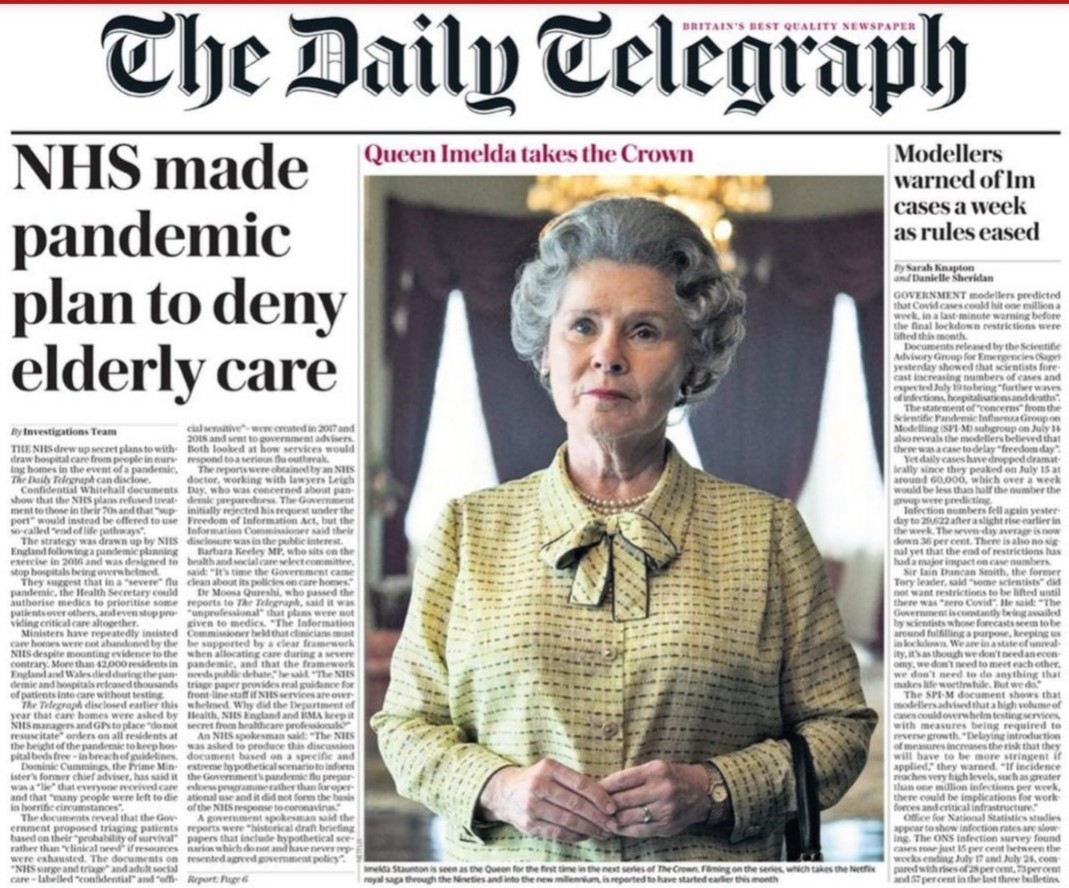
So, when I read the report last week in The Telegraph, saying that the government had made plans for people in their seventies to have treatment withdrawn in favour of “end of life pathways” in certain circumstances, I was rather taken aback. How could my government – and let’s be clear, this was a government discussion, far more than an NHS one – consider treating me and my peers differently based solely on when I was born?

Although the response from Number 10 was that this proposal “never represented agreed government policy”, it rather begs the question – how close did it come to being policy?

The documents in question relate to government planning for a flu-like pandemic under Exercise Cygnus. According to Dr Moosa Qureshi, who obtained them, these plans were a surprise to medics who were kept in the dark. Dr Qureshi has long campaigned for ‘pandemic transparency’, having recently succeeded, after a lengthy legal battle, in securing the release of government documents.

Two documents relating to the Government's planning for a flu-like pandemic under Exercise Cygnus have finally been disclosed following a long-fought legal challenge by @DrMQureshi who is represented by Tessa Gregory and Carolin Otthttps://t.co/4re1jSgneT pic.twitter.com/FyGo90F5ik

— Leigh Day (@LeighDay_Law) July 31, 2021

A “scandal of monumental proportions”

The plans referred to in article, suggesting elderly care home residents should be refused hospital care, were created in 2017/2018. They were discussed as proposals for action – or rather lack of it – in the event of a pandemic.

How this played out in practice, with the horror stories from 2020 of elderly hospital patients being sent to care homes without covid testing and without treatment, is still fresh in our memories. Between March and June of 2020, a staggering 28,186 ‘excess deaths’ were recorded in care homes in England alone.

Amnesty International described government decisions, which put tens of thousands of older people’s lives at risk, as “shockingly irresponsible” and a “scandal of monumental proportions”. Amid government failures during the pandemic, older people in care homes had been “abandoned to die”, while 400,000 other care home residents – many extremely vulnerable – had been put at greater risk


Triple lock on pensions under threat

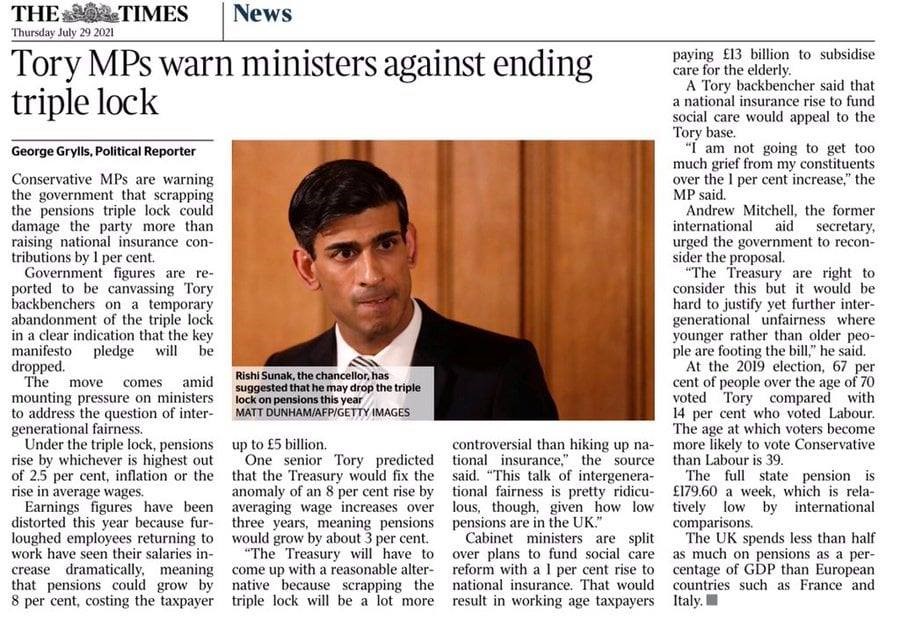
The elderly have always been an easy target, and perhaps a popular one, for any government wishing to save money. Even now, a row is brewing in government over the triple-lock on pensions.

The triple-lock guarantees the state pension will increase each year in line with:

a) the cost of living, as measured by the Consumer Price Index

b) increasing average wages, or

c) 2.5 percent – whichever is the highest.

Average earnings are expected to be the highest of the three options by some considerable margin, perhaps as high as 8 percent.


Maintaining the triple lock is a government manifesto promise, but Chancellor Sunak has hinted at its suspension, despite government ministers warning of potential damage to the party. Good to know they are thinking of themselves, rather than the pensioners that would suffer as a result of any cut.

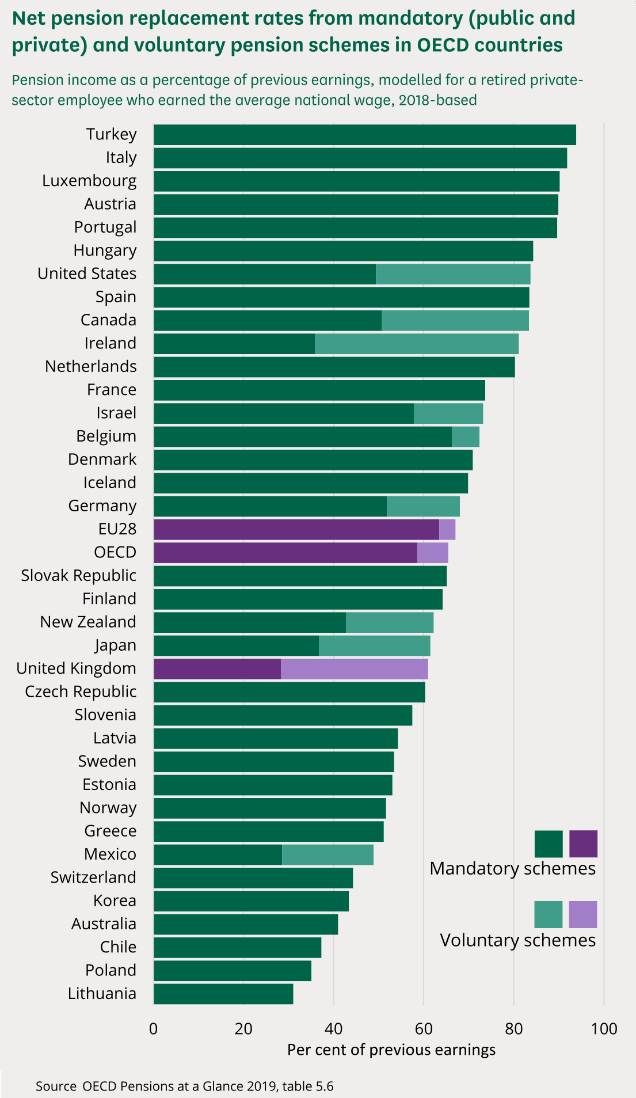
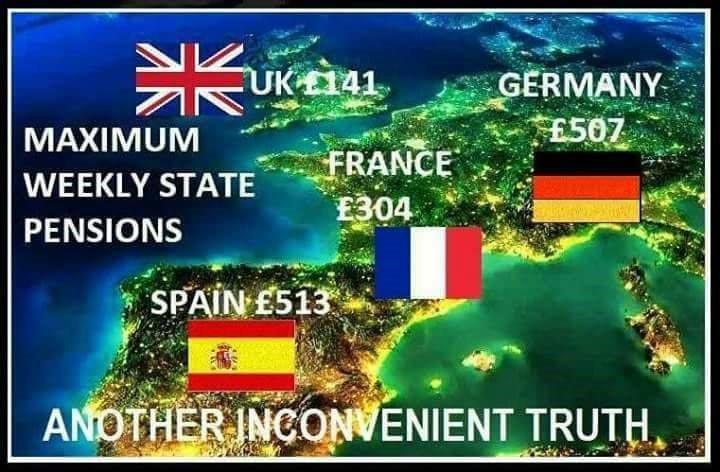
Has the government even looked at the international pension figures lately? The UK is certainly not world beating on the pension front, with one of the lowest rates in Europe


It’s not called National Insurance for nothing

I get that the young have it tough, whether as a result of years of austerity, Brexit, covid or government policy in general. I get that they might believe that anyone of a certain age has had the best years of their life and that the young shouldn’t have to carry the financial burden.

But there are two sides to this. Pensioners are not all wealthy. Those – like myself – living solely on a state pension are living on low incomes, having worked hard for decades to pay for that income. Or at least, that’s what we were led to believe all our working lives.

I always regarded paying my taxes, and especially paying National Insurance contributions, as my paying my dues and funding my future protection. It’s not called National Insurance for nothing, and as with any ‘insurance’ policy, I expect it to come good when it’s needed.

Who gets to decide when my life is considered no longer worth protecting or, indeed, saving? Where do you draw the line? No more care once you’re over 70? 80? 90? What about the disabled, or the mentally ill? There would be uproar (or at least I hope there would be), should the UK government decide that certain people with certain long-term illnesses should have their care removed.

The withdrawal of anyone’s care, for whatever reason, should be entirely the choice of the individual, their families and the medical professionals directly responsible for their treatment. It should not be the responsibility of governments to decide who is too old or too sick to get the care they need or deserve.


Age should not define us

Treating the elderly differently, solely based on their age is the thin end of the wedge. What next? Deny treatment to the overweight, those with unhealthy lifestyles, the drinkers, the smokers?

I might be old enough to be your mum, or your gran, but my age doesn’t define me, or the life that I lead. Whether I choose to take part in activities that would be considered inappropriate for my age is nobody’s business but my own.

Age is so much more than a number. It’s about knowledge, experience, maturity, wisdom and caring less what others think. None of that may matter to the government, but they should think twice before upsetting a growing sector of the population that have largely supported them in the past.

This country has seen enough division over the last five years to last a lifetime. Let’s not add age to the list of topics that divide us.


Travel farce: anger from British nationals in Europe

Travel farce: anger from British nationals in Europe

Aug 1, 2021 | Bylines, News

Thursday last week, the UK government made the long-awaited travel rules announcement: from 4am on 2 August, European citizens who were fully vaccinated would no longer have to isolate for ten days if travelling to the UK from amber list countries, with certain requirements of course, writes Bremain Vice Chair Lisa Ryan Burton.

This news was particularly celebrated by British nationals living in Europe who are desperate to see family. However, true to form and within a few hours, it was then announced that there would now be an amber+ list, and that Spain may be placed on that list. Several hours later, more news emerged that in fact France was to be placed on the amber+ list and not Spain.


Travel rules mixed messaging

Here we go again. As a resident in Spain myself, I have not seen two of my children for 18 months, the other for 11 months, and this is not uncommon. Plans have had to change multiple times and this utter confusion and mixed messaging is now becoming infuriating. I reached out to fellow Brits in Spain for their thoughts on the latest news and the difficulties they face. Feelings are certainly running high. People are hurt, disillusioned, and desperate to see loved ones.

Hilary Walker told me:


“I haven’t seen my 93-year-old mother (widowed) since last August, when I managed to squeeze in a quick visit. She’s understandably not in the best of health and I desperately want to visit. Good news that double-vaxed people such as myself are now quarantine free – but I still can’t book anything as Spain might still go to Amber Plus.”

For some time now, EU countries have been recognising NHS vaccine documents and allowing double-vaccinated British tourists to come into Europe. When they arrive back in the UK, there is only a test on day two and no isolation required.

Different travel rules for British nationals in the EU

For British nationals living in the EU however, it has been a very different story. The British government have for some reason been unable to reciprocate these arrangements to EU citizens and therefore even if they’re fully vaccinated, they would be required to isolate if travelling to the UK. This has been a source of anger, anxiety, and deep concern to British nationals living in Europe.

CA (who wished to remain anonymous) said:


“When my only brother was dying and given just weeks to live, I was unable to visit to say goodbye. I had had my 2 vaccinations here in Spain but because they were not UK vaccinations, I was unable to travel to the UK as quarantine was not possible. I still do not understand why people who had the same (Pfizer) vaccination from the NHS were allowed to travel to the UK without having to quarantine but I was not.

“My brother died a couple of weeks ago and I was unable to go to his funeral. They are now changing the rules but too late for me. I will still go to see my brother’s widow, his children and grandchildren but I will never forgive the UK government for this meaningless rule.”

The impact of isolation

One of the pandemic’s main trials for humanity was isolation, particularly from family. Everyone felt the effects to some degree but for those who are separated from family because they happen to live in another country, it has been even more challenging. Many British living in Europe haven’t seen their families since the beginning of the pandemic. Feelings are running high in these communities and frustrations are growing.

HJ (also anonymous) told me:

“Like many, I have elderly parents and my mum has been unwell for some time, including catching covid when she was in hospital in January. I did manage a trip to see them last October, for which I am very grateful. I couldn’t go over when she was very ill this winter because of all the travel restrictions, and I’ve been watching and waiting to see what happens since then.

“The constant changes make it impossible to plan. Quarantining with my parents is complicated as they have carers and medical visitors coming to the house. Renting an Airbnb or going to a hotel is prohibitively expensive right now.”

Contrast in messaging between EU and UK

For many living in EU when we look over to Britain, it is not a pretty sight. Measures here in Europe, certainly in Spain, have been clear and concise throughout. Most of us feel that there has been a high level of social responsibility and seriousness from the government.

When we look at our home nation, we are dumbfounded by what is going on. While variants happen and no country should be entirely blamed, let’s face the facts. Europe’s third wave was caused in the main by the Kent (Alpha) variant. It was far more transmissible, originated there likely because measures were so lax, and it quickly spread to Europe.

Julie Ley Gibbs talked of the stress and confusion, and the feelings of missing family:

“We can’t afford isolation or time not working to visit England, and family in England can’t afford isolation when returning. Tests for a family of 4 can cost almost as much as flights. Basically, stuffed whichever way we turn. If that wasn’t enough. The government can change rules at any given second, throwing us all into a further expensive and time-consuming turmoil.”

Rise of the Delta variant

Spain, France, and other countries are now seeing dramatic rises in the Delta variant. The Delta variant originated in India yes, but it is widely accepted that the reason 99 percent of infections in the UK are now the Delta variant is because Boris Johnson thought more of a trade deal with India than the health of his nation and did not place India on the red list when it should have been.

Rita Vost told me, “We haven’t seen our family since June 2019 and it’s killing me BUT I have just read that a huge percentage of people arriving from Spain are testing positive. How the hell can this be true when everyone has to have a PCR test before travel? I don’t believe this Government!”

While everyone has had to put up with covid restrictions and rearrange plans, it is clear from elements of the British media that the UK seems to expect to be treated differently to the rest of the Europe. Every time Europe even considers bringing in tougher restrictions on British travellers there is an immediate backlash, which ultimately seems to take on a form of ‘Brexit revenge’ when in fact Britain’s nickname ‘plague Island’ should give the reality away


Brexit games?

The Daily Express wrote on Friday 30 July : Europe “is poised to trigger a new travel war as revenge for Lord Frost’s Brexit hard balling”. Please, the only Brexit games being played are by the British government and their right-wing supporting media. Their childishness and exceptionalism seem to know no bounds. The UK government is far more likely to implement policy based on jingoism and sheer incompetence. When you have been used by your government as political pawns for years, the behaviour becomes easy to spot.

France being placed on the amber+ list has added to the mistrust. On GISAID – a database that collates genetically sequenced Covid-19 samples from around the world – 14.2 percent of Spanish submissions and 1.9 percent of French submission were the Beta variant. It again makes no sense.

Grazia B said:


“We in France feel unduly punished. There is no reason for it to be the only EU/EEA country to have to undertake quarantine. The issue with the so-called South African variant is tiny in comparison to other countries and based on infection figures in La Réunion, a department thousands of kilometres away in the Indian Ocean. Treating France like this smack of nastiness and pettiness, with no obvious reason why. As a friend in Britain said yesterday, Agincourt was a long time ago, get over it…”

Bitterness and disappointment

So, while British nationals living in Europe are delighted that eventually the UK government seems to have got its act together and reciprocated to EU citizens what it should have done weeks ago, the whole fiasco has left a lot of bitterness and disappointment.

There is very little trust that the government guidelines are thought through, follow data and science, and are not based on political gameplay rather than practicality. Of course, every country has to make health decisions based on what is best for its citizens. But this doesn’t seem to be what the UK government is doing.

To many from the outside looking in, we see Britain as the sick man of Europe who hasn’t been able to get a grip on the pandemic at any point. And for that we are all being made to pay the price.

Frost’s command plan for the Northern Ireland protocol

Frost’s command plan for the Northern Ireland protocol

Jul 22, 2021 | Bylines, News

Bremain Chair Sue Wilson MBE writes for Yorkshire Bylines about the ongoing UK issues with the Northern Ireland Protocol:

Over the last few days, rumours have been rife as to the UK’s plans to resolve issues surrounding the Northern Ireland protocol. Rhetoric from Lord Frost – the UK’s Brexit negotiator – has been ramping up over recent weeks.

Would the new proposal – the ‘command plan’ – be more constructive, or just more UK government sabre-rattling?

At the beginning of the month, Frost described the truce between the EU and the UK, in the so-called ‘sausage wars’, as merely a “sticking plaster”. As a direct response, relations with the EU were said to be deteriorating, following Frost’s “strange” remarks, with European Commission vice president, Maroš Šefčovič, warning that the EU may step up plans for legal action against the UK.


Accepting responsibility for Brexi

The government’s denial of responsibility for the consequences of Brexit is not new. Frost in particular has washed his hands of any blame for the failings of his own – once touted – Brexit deal. That blame is being laid firmly at the EU’s door, with claims of EU inflexibility and purism.

Not one to be left out of any EU Brexit bashing, Prime Minister Johnson joined in the blame game attacking the EU over the Northern Ireland protocol, and providing a committee of ministers with a list of the issues. Not quite the ‘oven ready’ deal that he persuaded parliament to support, it would seem.

By the second week of July, Frost was promising answers on the Northern Ireland protocol before summer recess, accusing the EU of dodging the “heart of the problem” in post-Brexit trade.

While Frost continued to insist the protocol was the cause of all problems, the EU disagreed. On a recent trip to Dublin, European Commission president, Ursula von der Leyen, said the protocol was the “only solution” to the problems caused by Brexit.


Pump up the volume

Prior to Wednesday’s big announcement, the scene was being set with Frost talking of deviating from the Brexit deal and “pumping up the volume”. The expectation was that the UK would invoke Article 16 of the protocol, which allows either party to take unilateral action if the application of the protocol “leads to serious economic, societal or environmental difficulties that are liable to persist”.


By Wednesday morning, more supposed details of the government’s command plan were beginning to emerge. In a conversation between Boris Johnson and Irish Taoiseach, Michael Martin on Tuesday evening, Johnson said the Northern Ireland protocol was “causing significant disruption”, according to a Downing Street spokesperson.

Johnson called on the EU to “address the serious issues that have arisen” with Brexit in Northern Ireland. Sources described the proposal as “meaningful” and “a significant piece of work”, saying the move to eliminate border checks represented a “wholesale change of approach”. It was also anticipated that alongside the plan would be a threat – to suspend the Northern Ireland protocol altogether.

Brandon Lewis and David Frost will unveil the government's new thinking on the Northern Ireland Protocol tomorrow afternoon

It's a "significant piece of work," a UK source says

EU is bracing itself for a bold statement. "It probably won't make us happy"https://t.co/z6Gp0eB3zn

— Adam Payne (@adampayne26) July 20, 2021

Brexit expert David Henig commented in a Twitter thread that any ‘new thinking’ or indeed just ‘thinking’ would be welcome from the UK government”, but added that expectations were “low”.

To be honest 'new thinking' or indeed just 'thinking' would be welcome from the UK government with regard to the Northern Ireland protocol, as compared to the usual shallow analysis, reheated leftovers and empty threats. Expectations low. https://t.co/BYEGI8Y07X

— David Henig (@DavidHenigUK) July 20, 2021

Henig added that the idea of the proposed “honesty box” approach at the border had not been considered by other nations, perhaps because it was a “completely ridiculous” idea. He went on to point out that any mention of Article 16 should come with the warning that any measures taken are both “limited and open to retaliatory measures”


Frost’s command plan

When the plan was finally announced on Wednesday afternoon, it brought no real surprises, other than the government stopping short of the triggering of Article 16. Apparently, “now is not the right moment to do so”. Frost said the proposals would require “significant change to the Northern Ireland protocol” – a step he said the UK would not “shy away” from. That significant change is, no doubt, expected to come only from the EU side of the debate. Frost added:


“The difficulties we have in operating the Northern Ireland protocol are now the main obstacle to building a relationship with the EU”.

Many commentators and onlookers may disagree with that assessment, citing Frost and Johnson as the main barriers to a strong, mutually beneficial partnership between Britain and Europe.

It is clear that the battle between Europe and the UK is set to continue, with the EU having the upper hand and international law on its side

The UK plan will have come as no surprise to the EU, though will likely have caused considerable irritation. The EU, like us, is used to the UK government failing to recognise the realities of Brexit, or indeed of international trade. The government has yet again proved it doesn’t understand the workings, or perhaps even the aims, of the European Union.

I had expected the EU to give the UK government’s latest proposal due consideration, before they said no. As they were bound to. Because they have no choice. It’s a ridiculous plan with no hope of success. But they immediately poured cold water on the idea. Šefčovič said, “we will continue to engage with the UK, also on the suggestions made today. We are ready to continue to seek creative solutions, within the framework of the Protocol, in the interests of all communities in Northern Ireland. However, we will not agree to a renegotiation of the Protocol”.


The Brexit fantasy

When asked in the House of Lords on Monday to name the benefits of Brexit, Lord Frost replied:


“Brexit will be hugely in the interests of everybody in this country as we take forward the exciting opportunities to reform our own rules, take back control of our legislation and run our own country as we wish”.

He proved then, as he proved again today, that his Brexit is a fantasy. This isn’t a plan, command or otherwise. It’s sabre-rattling nonsense of the highest order. And the country deserves better.

Football may be coming home, but we’re not

Football may be coming home, but we’re not

Jul 10, 2021 | Bylines, News

Here’s Bremain Chair Sue Wilson´s latest article for Yorkshire Bylines:


When Transport Secretary, Grant Shapps, announced that quarantine measures would soon be lifted for fully vaccinated Brits, the news was largely welcomed. Until Brits abroad looked at the small print. The new measures would only apply to British citizens in the UK, vaccinated by the NHS, and not to British citizens abroad.

Labour MP, Ben Bradshaw, immediately raised this issue in parliament. Bradshaw pointed out that, even for countries on the government’s green list, travel this summer was more restricted than last summer, despite the vaccination programme. He said reciprocity with other countries was “absolutely vital” and the lack of immediate reciprocity meant other countries were “less likely to open up to us any time soon”. He asked Shapps, “why when so many European countries already accept our vaccine passport are we incapable of accepting theirs now?” While Shapps acknowledged that reciprocity is “very important”, he said negotiations were ongoing, and that the government would move “as quickly as possible”.


While today's travel announcement is welcome, it still leaves us more restricted than last summer, when we didn't have the vaccine & it lacks reciprocity, which other countries have already. My question to @grantshapps #speakupfortravel #SaveOurSummer pic.twitter.com/KL0ZMSv5zH

— Ben Bradshaw (@BenPBradshaw) July 8, 2021

Shapps later told LBC that he was expecting to strike a deal with EU countries “within weeks”, to allow the UK to recognise EU Covid vaccine certification – the EU Digital Pass.

Transport Secretary Grant Shapps tells LBC he expects to strike a deal with EU countries “within weeks” to recognise other nation's Covid jabs – meaning people who got double jabbed on the continent could travel to England without quarantining.@TomSwarbrick1 pic.twitter.com/mysZbzYq7T

— LBC (@LBC) July 9, 2021

With Spain currently on the government’s amber list, all travellers arriving in the UK are required to quarantine for 10 days. They also need to have a negative test result before leaving Spain & have two further tests on day 2 and day 8 of isolation. These measures, and the not inconsiderable costs attached, are preventing many from visiting family and friends in the UK. Many have not seen family members – parents, children, grandchildren – for over a year. When those family members are elderly or infirm, there is always the worry they may never see them again.

Bremain in Spain members were quick to voice their anger and frustration. Lorna Cage said, “I’m utterly bereft. I really can’t take much more of this. My mother is 92 and I haven’t seen my children for 18 months. We are inoculated with a drug licenced by the UK and we are British citizens. This is political game playing at our expense”.

Just had daughter on the phone in tears. I’m furious. She has a valid EU vaccination certificate. Apparently Wembley & Wimbledon can be packed with fans but British citizens who happen to live in an EU country can’t visit their family without quarantining. 🤬🤬🤬

— Roaring Meg #makevotesmatter (@Megthelibraria1) July 8, 2021

Ruth Woodhouse said, “as of 1 July, the EU has had a fully-functioning digital Covid certificate scheme in place. Therefore I see absolutely no reason why the process should not be extremely simple”. She described the measures as “discriminatory” and “heartbreaking”


The pain of quarantine for separated families

Helen Johnston expressed the difficulties for those who cannot quarantine with family members, saying, “Grant Shapps says he has sympathy for families kept apart by Covid, but the government has, it seems, given no thought to the circumstances of people who live abroad. Returning holidaymakers have a home to go to, but many of us have nowhere suitable to stay, and so are obliged to stay in hotels. With holiday accommodation in the UK scarce and priced at a premium this summer, the government’s refusal to reciprocate on recognising EU vaccine certificates is effectively making it impossible for us to see our families”.

Although some families will be reunited thanks to the lifting of quarantine restrictions, not all Brits abroad can rely on their families travelling to see them. Apart from some very real fears about any travel during the pandemic, not everyone is able physically or financially, to visit family in Europe.

Michael Soffe shared sentiments familiar to many, saying, “I am furious about this as all I want to do is visit my 92 year old parents without having to go into quarantine. I cannot be away from Spain for 10, 12, 14 days!”


Brits living in Spain ‘furious’ that new quarantine exemption doesn’t apply to those vaccinated outside UK

These are exactly the same vaccines administered by sophisticated healthcare systems

This is Brexit politics not public health policyhttps://t.co/B0WZuLRCWa

— Green💚Molly (@GreenPartyMolly) July 9, 2021

A lack of reciprocity in quarantine arrangements?

Vaccinations used across the EU are the same as those used in the UK. Not only that, they are produced using the same production methods, and often the same production facilities. The EU covid certification is recognised widely, not least by the 27 EU member states, and EU countries widely recognise the UK NHS system. There seem to be no legal or scientific reasons for the UK government decision, so we can only assume – as with all things EU related – that the decision is purely an ideological one. Certainly, as with so many things involving our government and covid, logic and common sense play little part in the decision-making process

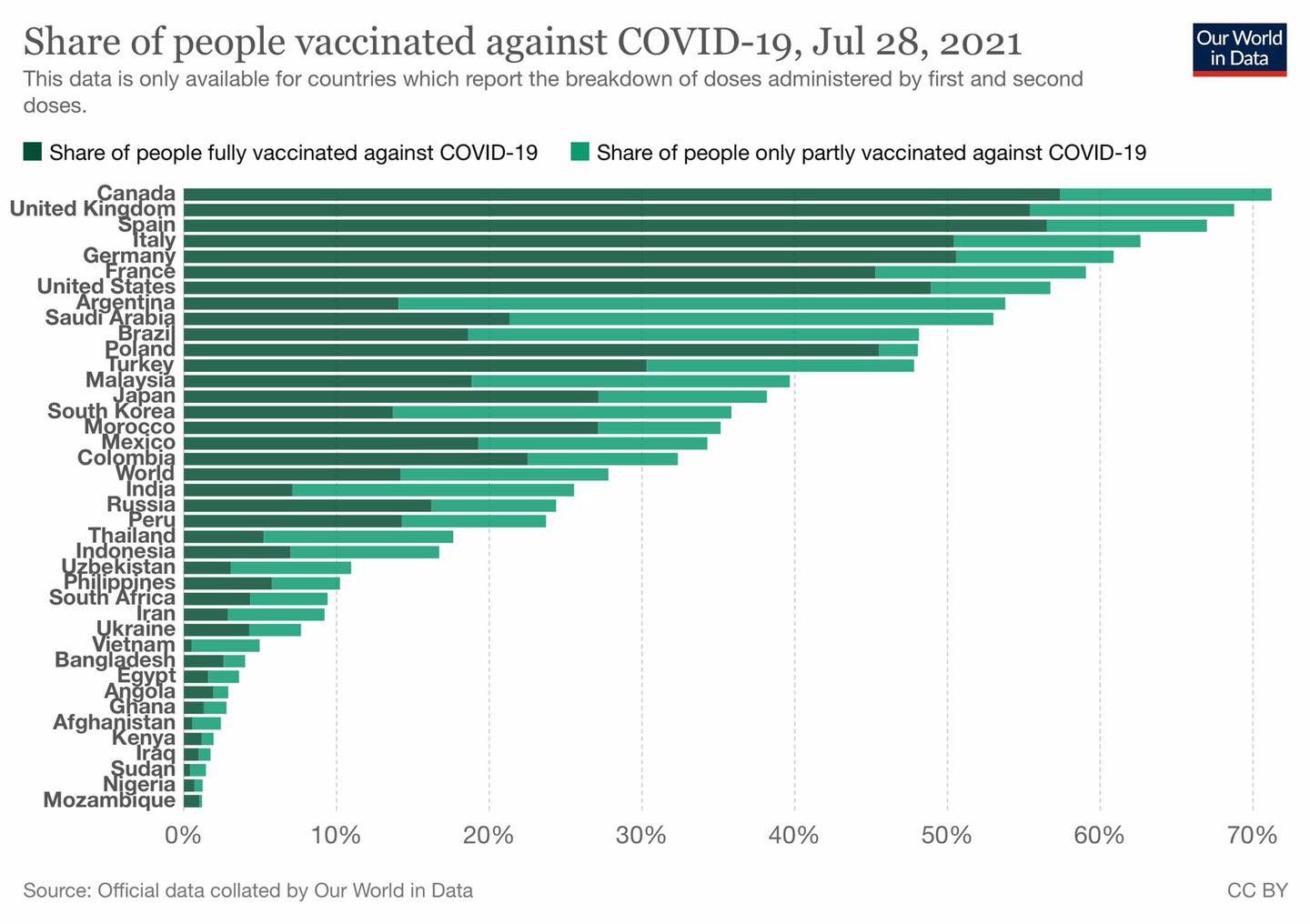
Covid cases in the UK are at their highest level for many months. Meanwhile, the vaccination programme that the government have been so proud of, and have seemingly regarded as the cure to all covid ills, has slowed down considerably. The speed with which the EU has rolled out their own vaccination programme – both doses – is starting to look more efficient by comparison, despite a speedy UK start.

Vaccination levels in the UK are now at a considerably lower level than earlier in the year, with the number of first doses on 7 July at 86,953, compared to 752,308 at their peak on 20 March (source: government website). It would therefore seem that decisions about the effectiveness of covid measures by other countries are not being made based on scientific data, but on politics.


Thanks to @BenPBradshaw for raising this issue with the "transport" secretary.
Brits in EU want to travel to see family in UK too! Some haven't seen family for over a year, & elderly parents in UK can't make the journey.
Yet again excluded by our own government.@BremainInSpain pic.twitter.com/Vw031a41gV

— Sue Wilson (@Suewilson91) July 8, 2021

As Bradshaw pointed out, most of Europe should have been on the green list weeks ago, and if Europe can recognise our vaccine passports, why can’t the UK government recognise theirs?

Learning to live with Covid

Learning to live with Covid

Jul 10, 2021 | Bylines, News

Bremain Chair Sue Wilson writes for Yorkshire Bylines about her personal experience during the pandemic:

It’s been nine months since I last saw my mum. Having been used to monthly visits, covid measures have prevented me – like so many others – from spending precious time with family.


Taking precautions with covid

I live in Spain, my mum lives in a care home in Oxfordshire. My last visit was a week after her 90th birthday, which I missed, thanks to being stuck in quarantine.

As I write this, I am doing a further period of enforced isolation, though this time for 10 days, not 14. I say 10 days, but as the count doesn’t start till the day after arrival, it’s really 11. Leaving me three days out of my two week trip to visit mum, by appointment only, and time limited.I don’t mind the precautions the care home is taking, even the daily testing. In fact, I welcome them. I rather wish the whole country, not least the government, were half as cautious over covid.


Covid travel measures

I thought long and hard before making the decision to visit the UK, weighing up convenience, cost, and safety.

It was anticipated that on “Freedom day” in June, many covid restrictions would be lifted. Instead, any revisions were postponed for four more weeks. With Spain on the government’s amber list, and no immediate signs of that changing, travelling to England was going to mean isolation. But the alternative could mean waiting until after the new Freedom Day – expected on 19 July.

With quarantine measures expected to be dropped from amber list countries, this could mean a considerable increase in demand for flights – both into and out of the UK – and no doubt a hike in prices. With more people, comes more risk, even for those of us fully vaccinated, and on balance, I chose to come earlier and quarantine.

Although my decision has cut the time I will be able to spend visiting mum, you can’t put a price on feeling safe. Though there seem to be plenty of companies willing to take our money. My pre-flight test in Spain was quick, painless, and relatively cheap. For 40 euros, I was tested by a laboratory assistant in a white coat, and had my results fully documented in an email within two hours.

I have just posted the first of two UK tests – self-administered – during quarantine. The two tests combined cost me £175, and all that is guaranteed is that I will have the results within 48 hours of the provider receiving them in the post.

I was officially allowed to break quarantine in order to go to the nearest priority post box to return my test. The logic of that escapes me, but then the logic of many of the government’s covid measures have that same effect.


Mask wearing

With social distancing about to be scrapped, and the wearing of masks left up to the individual, you could be forgiven for thinking that it’s perfectly safe to return to normal life. But will the British public continue to wear masks when the matter is left to their own discretion?

Wearing masks has always been about protecting others, not ourselves. Behavioural Scientist, Professor Stephen Reicher told the BBC, “I agree that people have to exercise responsibility – but not just personal responsibility, social responsibility”.

Speaking of circumstances when personal freedom affects the freedom of others, he compared mask wearing to driving. He added, “my freedom to drive fast affects your safety”, adding that the freedom not to wear a mask similarly affects the safety of others.

Speaking for transport industry union Unite, Bobby Morton said any lifting of requirements for the wearing of face coverings on public transport would be “an act of gross negligence”.


Covid is not like the flu

The new Health Secretary, Sajid Javid, seems keen to put freedom and wealth before health. He does know he’s not Chancellor anymore, doesn’t he? By all accounts, we all now have to “learn to live” with covid – like we live with the flu.

But covid is not the flu, and nobody, to my knowledge, has been seriously ill for months on end, or suffered long-term damaging effects, from “long flu”. I also don’t remember the entire population being recommended to be vaccinated against the flu or having to self-isolate.


👇🏼 New UK health minister saying COVID is like flu. Same position 18 months into the pandemic. 😩 We didn’t have to vaccinate the entire adult population against flu, or do mass community testing, or have lockdowns bc hospitals full. I don’t understand this analogy. https://t.co/2w15dwpuYE

— Prof. Devi Sridhar (@devisridhar) July 4, 2021

The fact that covid is spreading amongst the younger, unvaccinated population, or that case numbers are the highest they have been for many months, is nothing for us to be concerned about apparently, at least according to Javid or the prime minister.

Despite rising hospitalisations, they point to the low number of daily deaths, comparatively speaking, as if that is the only measure worth consideration.

"I don't think we can do anything but conclude that this government is seriously carrying out its herd immunity policy through natural infection, through school children."@Zubhaque #IndependentSAGE pic.twitter.com/lsTNCQ2hXU

— Independent SAGE (@IndependentSage) July 2, 2021

It may be the case that the vaccination programme is having an impact on the relationship between case numbers and deaths. We certainly hope so. But isn’t it too soon to know for sure? Have the government given up any pretence and decided to carry out its earlier, and supposedly soundly rejected herd immunity policy.


Learning to live with covid

Though not quite what the government had in mind, I am learning to live with covid measures. Measures that will restrict my movement, my proximity to others and my freedoms. I shall continue to wear a mask, not for my own benefit, but for the benefit of others.


There is nothing very promising about the covid data.

We're about three quarters of the way through the vaccine programme and they're giving up – let the rest just get it.

Dangerous and wrong in my view. https://t.co/XxzzeAsUsv

— Prof. Christina Pagel (@chrischirp) July 4, 2021

We are going to have to learn to live with covid, say the government – even as it mutates and becomes more dangerous. Not easy, but perhaps not as tough as learning to live with this government – even as it mutates and becomes more dangerous.

« Older Entries
Next Entries »

Search Our Site

Sign Up to our Newsletter

Translate this Site

Official Partners

european movement

Members of

Grassroots for Europe

Follow Us on Bluesky

Latest Posts

  • Data Privacy Policy
  • Sign Up
  • Get in Touch
  • Facebook
  • X
  • Instagram
© BremaininSpain.com 2016 - 2026 General Email: enquiries@bremaininspain.com Media: media@bremaininspain.com
Manage Consent

We use cookies to optimise our website and our service.

Functional Always active
The technical storage or access is strictly necessary for the legitimate purpose of enabling the use of a specific service explicitly requested by the subscriber or user, or for the sole purpose of carrying out the transmission of a communication over an electronic communications network.
Preferences
The technical storage or access is necessary for the legitimate purpose of storing preferences that are not requested by the subscriber or user.
Statistics
The technical storage or access that is used exclusively for statistical purposes. The technical storage or access that is used exclusively for anonymous statistical purposes. Without a subpoena, voluntary compliance on the part of your Internet Service Provider, or additional records from a third party, information stored or retrieved for this purpose alone cannot usually be used to identify you.
Marketing
The technical storage or access is required to create user profiles to send advertising, or to track the user on a website or across several websites for similar marketing purposes.
  • Manage options
  • Manage services
  • Manage {vendor_count} vendors
  • Read more about these purposes
View preferences
  • {title}
  • {title}
  • {title}