
Strengthening The Institutions We Rely On

Strengthening The Institutions We Rely On

by Helen Johnston for Yorkshire Bylines

A new report finds that the UK’s arm’s length public bodies are highly vulnerable to politicisation.

Earlier this month, we reported on a talk by Professor Christina Pagel of University College London (UCL) at a Grassroots for Europe  webinar about the Trump Action Tracker project, documenting the systematic dismantling of democratic institutions in the United States by the Trump regime.

Now, a new report, ‘Strengthening the institutions we rely on’ by Pagel and her colleagues Luke Flynn and Martin McKee at the UCL Policy Lab and the London School of Hygiene and Tropical Medicine (LSHTM) respectively, finds that the UK’s top scientific institutions, from the Met Office to the UK Health Security Agency, have inadequate institutional defences to prevent potential political interference.

Learning from the US experience

The tracker shows that under Donald Trump, independent institutions in the US have been systematically attacked in a number of clear areas:
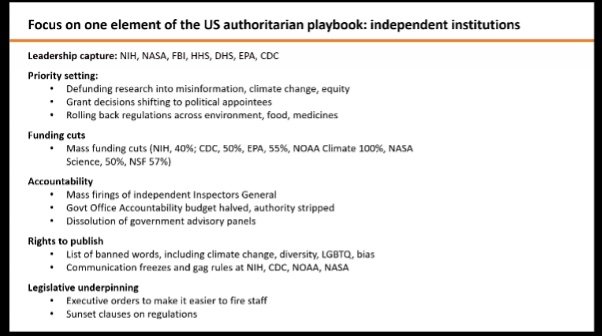
With its populist, far right, nationalist agenda, the Reform Party is on the rise. We can see only too clearly how Nigel Farage is reading, and following, the Trump playbook. Professor Pagel explained that, as she watched events unfold in the States, she began to wonder: “What can we do that is a bit more positive than just tracking this kind of doom spiral. Do we need to protect British institutions if a right-wing populist government came into power here in four years’ time?” Her ANCHOR (Advancing National Commitment to Health and Science, Open Data & Resilient Oversight) project examines how UK institutions can be protected by understanding the US experience.

Identifying weak points

By mapping the independence of 24 arms-length bodies (ALBs), specifically involved in producing or publishing evidence or holding governments to account, the project aims to identify and counter potential vulnerabilities. Results for eight key bodies are shown below (taken from the Report’s executive summary).
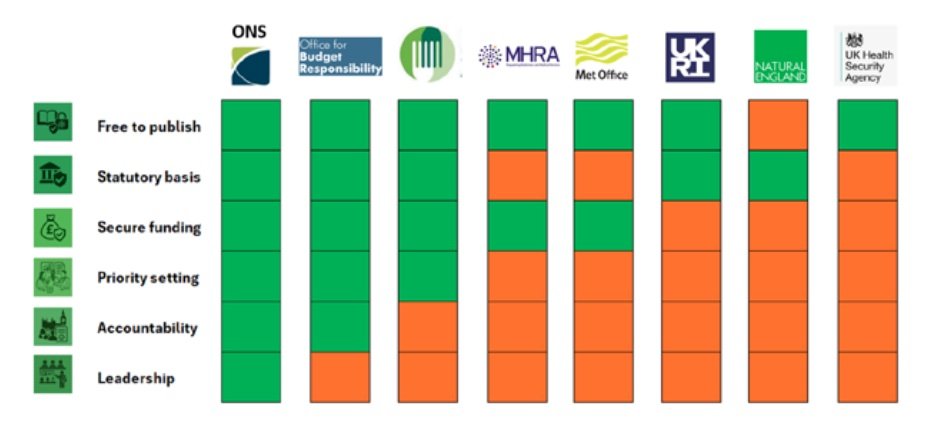
Reassuringly, they show that the Office for National Statistics (ONS) is already substantially protected from interference. But some other vital bodies have very little independence. The UK Health Security Agency has the right to publish without interference, but it could be abolished rapidly, with no parliamentary oversight. This is effectively what the Tories did to its predecessor, Public Health England, in the middle of the pandemic.

The most vulnerable aspect across all the ALBs studied is that of independent appointments. The 2015 Grimstone Review significantly weakened the powers of the Commissioner for Public Appointments. Independent panels draw up a shortlist of candidates, but the new rules allow ministers to override their recommendations and pick whoever they want:

“Given what’s happened in the US, I think we can all see where that can go wrong.”

There is already evidence of interference in the independent functioning of some key bodies. While acknowledging the limitations of the UK’s parliamentary sovereignty, Pagel believes strengthening public accountability mechanisms can at least ensure parliamentary and public scrutiny of proposed changes to remit, funding or leadership, and so slow or prevent potential authoritarian shifts. “There is obviously a democratic argument that ministers should set overall strategy, but within that, ALBs should have the ability to set priorities on how to meet that strategy.”
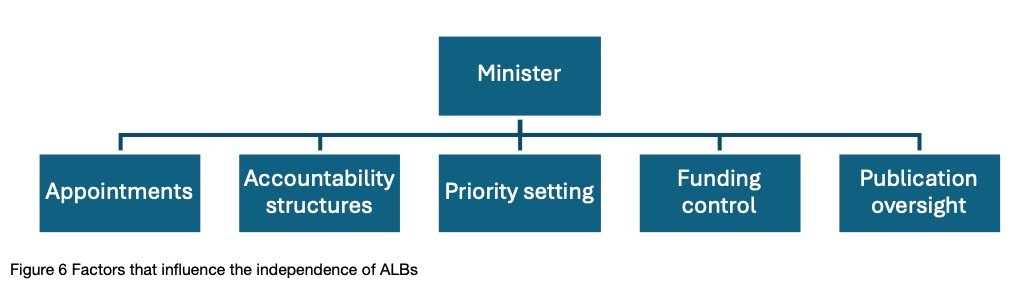
How populists exploit vulnerabilities

The UCL Policy Lab report published today examines how the resilience of these key bodies can be strengthened to protect them from a populist government. According to Pagel: “We only need to look across the pond to the actions of the second Trump administration in the USA to see how a coordinated attack on institutional guardrails can rapidly undermine the independence of federal agencies and diminish evidence-based governance. This was not done through sweeping, time-consuming legal reform, but through the calculated exploitation of a series of structural vulnerabilities.

“We’ve seen how the replacement of agency leadership, purges of internal watchdogs and legal re-engineering have been weaponised in the USA, not to mention the slashing of funding and the suppression of research, and it is vital the UK learns lessons from this before it is too late.” 

The report highlights how around one-third of the independent bodies studied lack statutory status, meaning their existence, powers and functions are not defined and authorised by an Act of Parliament, leaving them at risk of being redefined or even abolished behind closed doors.

Co-author Professor Martin McKee (LSHTM) says: “We compare the current situation to a castle with open gates and holes in its walls. This may not matter when there is peace but, when a threat arises, these weaknesses really matter.”

The report recommends: 

  • Increasing legal and statutory protection – Parliament should expand statutory underpinning where needed, especially for ALBs involved in regulation, scrutiny, or advice. It should protect against ministerial overreach.
  • Supporting independence in leadership – The Civil Service should adopt appointment procedures that limit the direct involvement of ministers beyond setting the strategic direction of a post.
  • Resilient funding models – Sponsoring departments should safeguard medium-term funding by expanding multi-year funding settlements to support sustainability and delivery and build on experience with existing practice.
  • Strengthening accountability – Parliament should strengthen accountability by requiring ALBs to produce parliamentary accountability reports, which the National Audit Office would review.
  • Setting priorities and safeguarding operational autonomy – Priority setting must reflect a balance between democratic oversight, the public interest and institutional independence.
  • Protecting the freedom to publish – Legislation should protect the right of ALBs involved in scrutiny, regulation, or public health to publish independently, without needing the prior consent of ministers.
  • Framing the national conversation – Ministers should publicly support the ALBs for which they are responsible and avoid using pejorative language or creating politically motivated bodies.

There is broad public agreement for these principles: polling for the report, carried out by More in Common, found 71% of Britons said it is more important for ALBs to be independent of the government, rather than controlled by it. Across all demographics, the public agreed that a key argument in favour of independent ALBs is that “politicians aren’t experts in many areas”.


Fighting back

The other participants in the webinar where Pagel introduced the ANCHOR project wholeheartedly endorsed the ideas behind it. Tom Brake of Unlock Democracy noted that, in opposition, Labour was very much in favour of restoring, for example, the independence of the Electoral Commission. Now it is in power, it prefers to leave the Tory changes on the statute book. “There are many examples of things that the government could be doing now to try to defend defenders better, should there be a change of government to one which seeks to do exactly the sort of things that Trump is doing in the US.”

Mike Galsworthy, chair of European Movement UK, agreed: “More democracy needs to happen in terms of empowering citizens’ voices, so that citizens can comment on, organise on, and resist power structures in politics … I think ANCHOR is a fantastic start to buttress the system”.


Original article by Helen Johnson for Yorkshire Bylines: https://yorkshirebylines.co.uk/politics/strengthening-the-institutions-we-rely-on/

Helen Johnston is a freelance translator who has lived in Spain for over two decades. She is on the council of the Bremain in Spain, and is the ‘Europe outside the UK’ member of the Grassroots for Europe Council.
Proud to work closely with the British Embassy to keep you informed

Proud to work closely with the British Embassy to keep you informed

Check in regularly for all the latest information for British citizens living in Spain or just visiting.

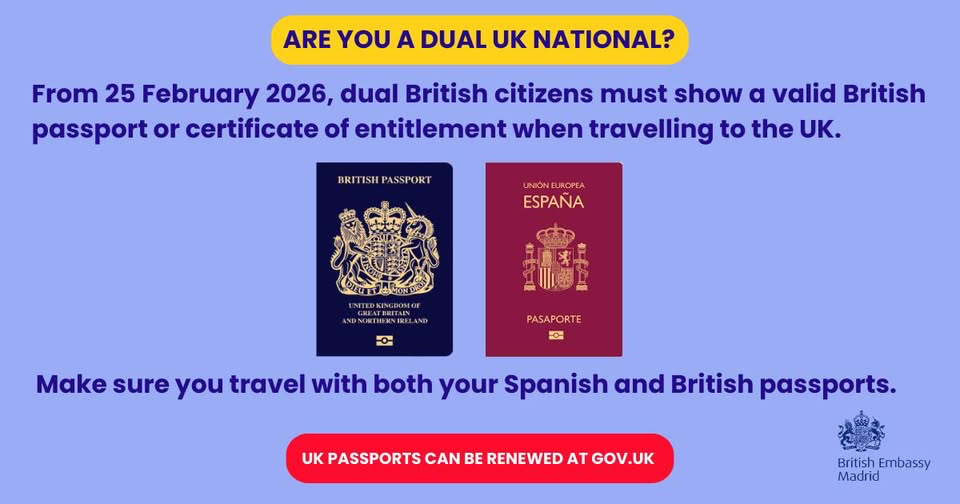
New UK rules of entry for dual nationals


New UK government rules require all British citizens – including those that hold dual citizenship – to show a valid British passport or a ‘certificate of entitlement’ when travelling to the UK.

Statement from the British Embassy: “As indicated by the Spanish Foreign Affairs Ministry, dual British-Spanish citizens can travel on their Spanish passport but will have to carry their British (or Irish) passport with them or have a certificate of entitlement linked to their Spanish passport.”


Useful links:

  • Renew your UK passport here  
  • Apply for a certificate of entitlement here
  • Further information for dual British citizens here 
  • For children born in Spain, check qualification for British citizenship/need a British passport to travel here
  • Find out more on how ETA enforcement affects dual British-Spanish citizens here
  • Read recommendations made to the Home Office by ILPA, the 3 Million & British in Europe here

The European Entry System

On 12 October 2025, the EU introduced the new border checks system, which will be  phased in over the next six-months. In Spain, the first test checks were carried out in Madrid Barajas on 12 October and the system went live in Malaga airport on October 20.

Once the system is fully up and running, there will be no more manual stamping, but until April next year, your passport may still be stamped.

  • Visitors – Your fingerprints and photo may be taken at the EU border. This might take a few minutes, so be prepared to wait at busy times.
  • TIE holders – If you’re a UK national living in Spain with a TIE, you do not need to register in the EES.
  • Green certificate holders – Apply for a TIE as soon as possible. Otherwise, you might be treated as a tourist when entering the EU and asked to register in the EES.

For more information:

Entering Spain as a resident

All about the EES

Spain’s EES implementation plan

Please note that the British Embassy in Spain is aware of the difficulties in getting appointments in many regions to swap green certificates for the TIE or renew temporary TIEs, and is talking to the Spanish Government.

Bremain in Spain will continue to monitor the situation and keep you updated as the EES system rolls out to new airports and ports. 

ENTRY/EXIT SYSTEM (EES) Implementation date confirmed

The date for implementation of Europe’s EES for non-EU travellers, including British tourists, has been confirmed as 12 October this year.

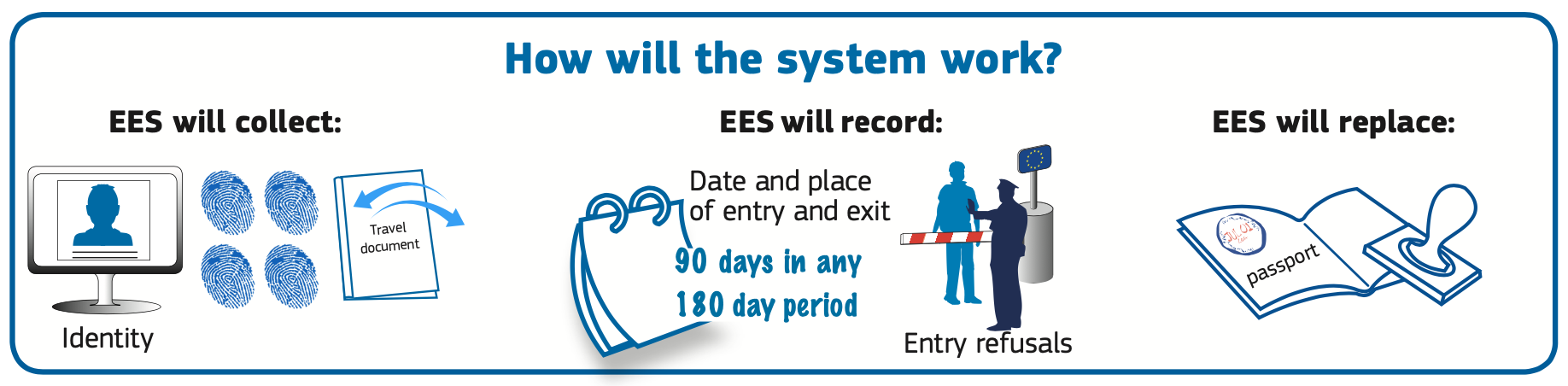
The aim of the system is to digitise border crossings so that all non-EU citizens can be more closely monitored. This will help identify suspected criminals and allow policing of the 90 days stay in 180 days.

The system – which will require facial biometrics and fingerprints – will be phased in over a 6-month period and will be fully operational from 10/4/26.

Bremain attended a meeting with representatives of the Embassy and the Foreign, Commonwealth & Development Office to discuss forthcoming changes affecting travel between the UK and the EU.

ENTRY/EXIT SYSTEM

The introduction of the EES will require UK-based British citizens, as 3rd country nationals, to create a digital record, submit fingerprints and have a photo taken for facial recognition purposes when travelling to the EU.

Implementation of the EES is scheduled for October 2025 and a launch date should be confirmed very soon. The system will be rolled out over a 6-month period.

UK nationals resident in Spain who are in possession of the TIE will be exempt (see below).

More information here

ELECTRONIC TRAVEL AUTHORISATION (ETA)

When travelling to the UK, EU citizens need to apply for an ETA.

Any UK national who has not renounced their British citizenship, will be recognised as British by the UK authorities. Therefore, those currently without a British passport are encouraged to re-apply for one as soon as possible, to avoid the necessity of applying for an ETA.

More information here

TIE (Foreigner Identity Card)

The number 1 priority for all British residents in Spain, who are still in possession of the old green residencia document/card, is to switch to the TIE. Only those that can prove their residency with the TIE will be exempt from the forthcoming EES system – something both the Spanish and British authorities agree on.

More information here and on our TIE webpage

Update from Embassy 14 May

In October 2024 (date still tbc), the EU is introducing a new scheme for non-EU citizens (including British Nationals) entering an EU country for a short stay. The EU Entry/Exit System (EES) will require non-EU tourists to provide their name, passport details & biometric data (fingerprints and facial images) & will replace the current stamping of passports at the border. Details will also need to be provided regarding the date and place of entry and exit.

Details will be kept on file for 3 years meaning that, for example, any British citizen making repeat visits to Spain during that 3-year period would not need to go through the same registration process each time.

Exemptions for British residents in Spain: Residents will need to show their TIE biometric card in order to be exempt from EES registration. Therefore, the British Embassy & Bremain in Spain strongly recommend that all British residents in Spain apply for a TIE before the EES comes into force, including those currently using the Green Certificate.

Update from Embassy 23 November

Bremain attended a webinar with the Embassy today to discuss the pressing issues of Driving Licence exchange and local voting rights in Spain.

DGT

Driving licence exchange – the discussions have progressed & the next steps are legal checks & political processes. While the timeline is out of the Embassy’s control, further information will be forthcoming as soon as it is available.

For the latest information of the conclusion of the two outstanding issues, watch the video from the Ambassador here

Local elections Spain – the Municipal elections will take place on 28 May 2024. UK nationals are eligible to vote as long as they are registered on the Padron and have been resident in Spain for 3 years.

It is advisable to check beforehand that you are on the Padron, with the correct address, ahead of the date window for registration on the electoral roll – 1/12/22 – 15/1/23. For more information visit the Living in Spain website here

Update from Embassy 11 June

Following the ruling by the European Court of Justice (ECJ) regarding EU citizenship and voting/standing in local elections, the Embassy would like to confirm the rules with regards to Spain.

The ECJ ruled that with Brexit, we lost our EU citizenship rights and the right to vote and stand in local elections under EU law. However, this does not affect UK nationals’ right to vote and stand in local elections in Spain. This is because a bilateral agreement exists between Spain and the UK which allows UK nationals who have lived in in Spain for more than 3 years to vote and stand in local elections.

More information on voting rights in Spain (and the treaty, signed in January 2019) is available in the Embassy’s Living in Spain guide.

Update from Embassy 23 February

The latest update from the Embassy includes information on a variety of subjects, including an extension for the use of UK driving licences in Spain.

For all the latest information, click on the relevant PDF below for all the latest details and useful links.

  • Driving Licence PDF
  • Access to regional employment services PDF
  • Residence registration PDF
  • Voting rights and registration on the electoral roll PDF

Update from Embassy 22 December

As the year comes to a close, the Embassy have provided an update on the issues that are still concerning UK nationals living in Spain.

RESIDENCY

Following a negative outcome on a residency application, some UK nationals have received an instruction to leave Spain within 15 days. While discussions between the relevant authorities are ongoing, the Embassy have put together some information for those finding themselves in this position. Open the Residency PDF for further details.

DRIVING LICENCES

Ambassador Hugh Elliott has recorded a video message for UK Licence holders living in Spain, which has been posted on the Brits in Spain Facebook channel. Negotiations are “progressing” but have yet to reach a conclusion. An extension to the current grace period has been asked for, and is expected to be granted, before the end of the year. Open the Driving Licence PDF for further details.

PASSPORT STAMPING

UK travellers are still experiencing inconsistencies at the border, with some Withdrawal Agreement beneficiaries being stamped despite presenting evidence of their residence status, and some visitors being stamped only on entry and not on exit.

For the second group – the travellers who are concerned that they received an entry but not an exit stamp –  the Embassy have recently updated their travel advice page with information in line with the Schengen Borders Code. This information currently sits under the subheading ‘visas’ on the page. We advise UK travellers to carry evidence of when and where they last entered and exited the Schengen Area when travelling in the future as you can ask a border guard to add this information into your passport. Acceptable forms of evidence can include boarding passes and tickets.

TAXATION OF OCCUPATIONAL OR PRIVATE UK PENSIONS

In response to issues raised in this regard by Bremain in Spain, the Embassy have put together some information. Open the Pensions PDF for further information.

Update from Embassy 13 November

The Embassy are often contacted for assistance in areas they are unable to assist with. To clarify where they can help, and to point people in the right direction where they can’t, a guide has been produced to explain the services they provide. Click here to open the guide

For visas for those wishing to move to Spain, please contact the Spanish consulate in the UK

To contact the Embassy in Madrid by phone or online, or for more information click here

Update from Embassy 27 October

DRIVING LICENCE EXTENSION

The Spanish government has today announced that valid UK licences will continue to be recognised for driving in Spain until 31 December 2021.

Negotiations are ongoing, and the Embassy will continue to provide information as and when any developments happen.

Independent of those ongoing negotiations, UK Nationals who successfully registered their intent to exchange their licence before 30 December 2020, will be able to exchange it for a Spanish one without having to take a practical test up until the end of this year. The Embassy understands that some people who tried to register their intent have subsequently found out that they were unsuccessful in doing so. If this is your situation and you are unclear as to why, you should contact the DGT directly to discuss further. https://www.dgt.es/es/contacto.shtml

If you moved to Spain after 1 January 2021, your UK licence is valid for six months from the date of your TIE or until 31 December, whichever is later.

Update from Embassy 12 October

UK national stakeholder event with FCDO Minister for Europe and the Americas

On Thursday 30 September, Wendy Morton, FCDO Minister for Europe and the Americas, met with 14 representatives from ten organisations that work closely with the UK community in Spain, as part of her visit to Madrid.

The meeting was an opportunity for the Minister to hear of the main concerns and issues affecting UK nationals in Spain, following the end of the transition period on 31 December 2020, ahead of her meetings with the Spanish government later that day. The issues raised included: registration/residency applications, visa processing, the stamping of passports, immigrations status, moving back to the UK and many more.

The Minister assured representatives she would be raising issues, such as the registration of UK nationals in Spain and driving licence exchange, in her meetings with the Spanish government, and that ensuring smooth visa processes was also a priority. Citizens’ rights remains a priority for the UK government and the British Embassy in Madrid continues to engage with the relevant UK and Spanish authorities on the various issues that were raised.

Bremain in Spain was ably represented by Vice Chair, Lisa Ryan Burton and Council Member and Newsletter Editor, Helen Johnston.

For further details regarding the topics discussed, view the PDF

Update from Embassy 27 September

Earlier this year, the Embassy carried out a series of Healthcare focus groups throughout the EU. Some of the most popular questions and concerns were about NHS access and S1 registration, with participants wanting more detailed information.

As a result, the Embassy have produced the following series of infographics. Click on the relevant PDF for more information:

  • The S1 form (an explainer on what the S1 is, who can apply etc) PDF
  • How to access the NHS if you are a UK national living in the EU PDF
  • How to access the NHS if you are a registered S1 form holderPDF
  • How to register your S1 form in SpainPDF

Registering your S1 with the INSS

The INSS has recently updated its online portal.  The process has been revised, and there’s a specific link for S1 form holders who wish to register online.  There is a dedicated page on gov.uk which outlines the process for registering your S1 online, and which has been updated to reflect changes made.

Please note that, at present, the page is only in Spanish and it has an additional series of instructions to ensure you confirm your identity.


Update from Embassy 25 June

Starting today, the Embassy Health Team are offering one-to-one calls with UK nationals on the last Friday of every month, continuing throughout the summer.

How does it work?

You can book a 10-minute slot to speak to one of the health team about your individual circumstances, relating to healthcare access. Click on the link here to book your appointment.

What can people call about?

The objective is to help those who are still struggling to register or are having issues with accessing healthcare. Unfortunately, the Embassy will not be offering advice or assistance with anything related to provision of care, or the Covid-19 vaccine – both of which fall outside the remit of the team.

Future sessions will be advertised on the Brits in Spain Facebook page a few days before the event.

Update from Embassy 23 June

CHANGES TO DEADLINE RE DRIVING LICENCE EXCHANGE

On Tuesday 22 June, the Spanish Consejo de Ministros agreed an extension to several measures in their end-of-transition period Royal Decree.  One was on the recognition of UK driving licences in Spain.  The announcement in English can be found here.

The deadline for the exchange of driving licences, for those who were resident in Spain prior to the end of the transition period, has been extended. For full details of the changes, read our PDF here

 You can also find further details re driving licences, for those who did not register details/intent before the 31/12/20 deadline, in the PDF.

Update from Embassy 27 May

On Thursday 27th May, Bremain in Spain Chair, Sue Wilson and Vice Chair, Lisa Ryan Burton attended an update meeting with British Embassy staff to discuss:

  • Driving Licence Exchange
  • Travel – including the much discussed ‘carta de invitación´
  • Residency
  • Votes for life – government press release

To read all about those discussions and get the latest information, click on the PDF here.

Update from Embassy 21 May

In response to members’ concerns about entry requirements to Spain – especially in relation to visitors to our homes – the Embassy have provided the following update and helpful links.

Following recent discussions with the Spanish authorities, the relevant Embassy webpages have been updated, and further clarification will be available in due course.

The following websites are recommended by the Embassy as the best sources of information:

There is further information direct from the Embassy in the PDF

Update from Embassy 21 April

On Tuesday 20 April, our Chair, Bremain in Spain Chair, Sue Wilson took part in a meeting with representatives of the FCDO (Citizens’ Rights department) and British Embassy staff from Madrid and Paris. The meeting was also attended by representatives of citizens’ rights groups from 7 EU countries.

The meeting involved discussions around the misrepresentation in the media of recent coverage of events regarding UK nationals, most especially in Spain. Other topics included communications, information and support being provided for Brits abroad, followed by a question and answer session.

To read more about the meeting, open the PDF

Update from Embassy 16 April

There has been some confusion over the rules for visiting other Schengen countries when legally resident in Spain. We asked the Embassy to clarify how long you are entitled to visit, and whether the rules are different for those with temporary residency to those with permanent residency.

Open the PDF for confirmation of:

  • Length of stay for visits
  • Requirements for extended stays for work
  • Length of time you can be out of Spain without affecting your residency
  • Differences between temporary & permanent residency rights (where they exist)
Update from Embassy 4 March

In response to recent concerns our members raised over access to Spain’s vaccination programme, we approached the Embassy directly and received this response:

“The Spanish Government’s Vaccination Strategy sets out that all people living in Spain will be eligible for the vaccine, regardless of nationality or residency status.  The Vaccination Strategy is updated regularly to include new priority groups as the number of doses available gradually increases.  You might be interested to see this question and answer from the Spanish government’s FAQ website, which highlights that all people in the priority groups, irrespective of their nationality or type of sickness insurance cover, are being vaccinated.

Those UK nationals who are already registered in the public health system should be contacted by their regional health authority to arrange an appointment.  The Spanish authorities are asking insurance companies to coordinate with regional health services in order to provide vaccines to their customers.  The Spanish authorities are also considering how to contact people who are not registered on the public system nor with a private insurer.  Ultimately, our advice to UK nationals living in Spain remains that they contact their local health centre and/or insurer for more information.”

The Embassy will provide further updates as and when further information is available, and the issue will be followed closely by the Embassy communications team.

Update from Embassy 26 February

The Department for Health & Social Care has today provided healthcare updates, and potential solutions to difficulties being faced by UK nationals when registering S1 forms.

Open the PDF HERE for more information on the following, plus some useful links:

  • Continuation of S1 scheme
  • Sending medication via courier from the UK to Spain
  • S1 registration issues
Update from Embassy 16 February

There has been plenty of information available recently regarding applications for Spanish residency. To date, that information has related to those that arrived in Spain before the end of the Brexit transition period.

What are the requirements for those moving to Spain from 1 January 21?

UK nationals moving to Spain post Brexit (and who are not joining close family members under WA family reunification rules) will need to meet the same requirements as other third country nationals.

In most cases, this will require starting the process via the Spanish consulate in the UK, before traveling to Spain.  The requirements will differ depending on the visa/residence permit the person is applying for (e.g. a residence and work permit, a non-lucrative visa, etc).

UK nationals requiring further information about visas/residence permits should consult with the competent authorities for Spain:

For the Spanish Consulate in the UK visa FAQ page, click here

For the Ministry of Inclusion, Social Security and Migration page, click here

Update from Embassy 10 February

The Embassy has produced an essential guide explaining your citizens’ rights as covered by the Withdrawal Agreement. The guide contains information of the following topics, as well as many useful links:

  • Living & working
  • Healthcare
  • Driving
  • Education
  • Voting
  • Travel
  • Pensions

You can view/download the guide HERE or click on the image below. Hard copies are available from the Embassy directly.

Update from Embassy 27 January

 On Wednesday 27 January, our Bremain Chair, Sue Wilson & Vice Chair, Lisa Burton attended a meeting with British Ambassador, Hugh Elliott & his Embassy team.

The Ambassador & his team spoke to a number of issues – many of which are being compounded by both Brexit & Covid. Prior to the meeting, our members raised a number of important concerns with us.

The topics covered were:

  • Vaccination programme in Spain
  • Stamping passports
  • S1 registration delays
  • Driving licences
  • Lack of appointments for TIE
  • Authorities holding your documentation (while waiting for residencia)
  • Increased bank charges
  • Buying property in designated military areas
Hugh Elliott
For answers to all of the above issues, & to access many useful links to additional sources of information, read our PDF here

 Thank you for bringing these important issues to Bremain’s attention, and to the Embassy for their knowledge, support and efforts on behalf of all Brits in Spain.

Update from Embassy 23 January

Spanish Bank accounts & the TIE

The Spanish government has produced a public document which explicitly confirms the continuing validity of the green residence certificate as proof of a person’s rights under the Withdrawal Agreement and therefore their residence rights/status in Spain.

Embassy Letter
In a recent article, it was suggested that banks in Spain would require all British customers to be in possession of a TIE. Whilst a bank may well be within their rights to ask that customers keep their details and personal identification documents up to date (e.g. their passport), they should not insist that a holder of a green EU residence certificate exchanges it to a TIE in order to prove their residence rights and continue banking with them.  If you are asked by your bank to do so, please direct them to the above document.
Update from Embassy 4 January

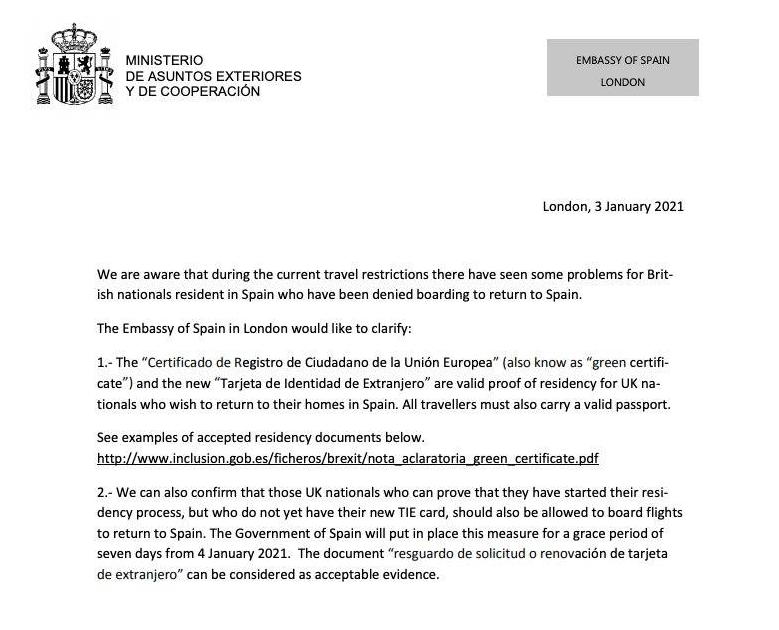
In response to the recent travel issues experienced by British nationals returning to Spain, the Spanish authorities, in conjunction with the British Embassy, have issued a statement clarifying the position.

An example of the accepted residency documents can be found here

For details on entry requirements into Spain please see the Consulate General of Spain update here

Embassy Letter
Update from Embassy 2 January

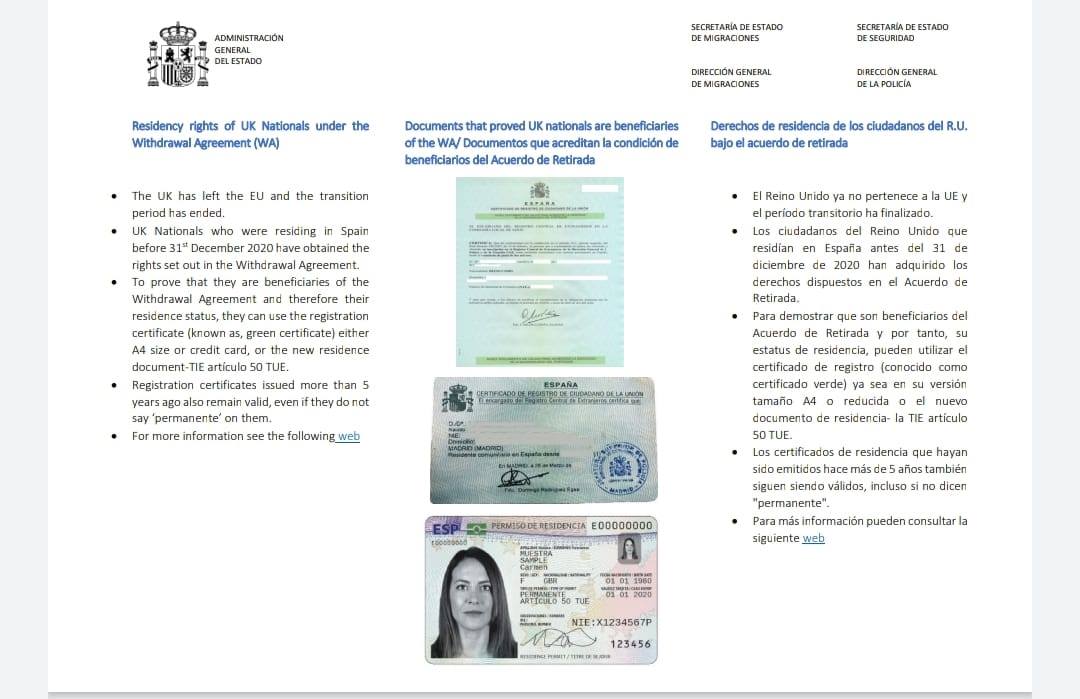
The Spanish Ministry of Migration have updated their website to include two really helpful pieces of info:

  • An updated version of the FAQ document, which includes many of the questions we supplied to the Embassy and which they have been feeding into them on our behalf. These include what to do if you’ve exchanged your green residence certificate for a TIE but want to change it to a permanent card before the original TIE expires – see p.37
ministerio
ministerio
  • A bilingual, informative note on the documentation that UK nationals can use to evidence their residence status and that they are a beneficiary of the WA. Notwithstanding the Spanish government’s clear recommendation for UK nationals to get the TIE, this confirms the validity of the green certificate, even if it is older than 5 years and doesn’t say ‘permanente’.

The Embassy and officials at the Spanish Migration ministry hope that UK nationals will be able to print off or point to this second document should they have any problems in exercising their rights or accessing services in Spain.

The English version of the ministry website and the Embassy’s own Living in Spain guide should be updated with this information shortly.

Update from Embassy 15 December

Bremain joined other stakeholders for an online Embassy conference call, to discuss current issues affecting Brits in Spain.

We raised a number of issues that our members brought to our attention beforehand, & you can read full details of those in our PDF here

Topics covered included: travel, residency/TIE, EHIC, driving licences & more.

webinar
Update from Embassy 25 November

Bremain held its first webinar in conjunction with Lorna Geddie from the Embassy. The 63 Bremain members attending raised questions on a wide range of topics, including travel, visa requirements, pensions, banking, residency, healthcare/EHIC, swallows rights, driving licences & dual citizenship.

Many thanks to Lorna for her valuable input & to all those that took part.
In response to all the issues raised, Lorna has kindly put together a PDF especially for Bremain in Spain members. (Last update: January 2021)

“I am very grateful to Sue and the Bremain in Spain team for setting up the webinar and it was great to see so many members on the call. It is so useful for the Embassy to hear and understand the questions and concerns of UK nationals in Spain, as it helps us with our citizens’ rights work going forward. I would urge anyone who hasn’t already done so to check out the information available via the Living in Spain guide on gov.uk and to sign up for email alerts to ensure they keep up to date with all the latest developments.” 
Lorna Geddie, British Embassy
Lorna Geddie - photo

“My thanks to Sue, Matt and Lisa for organising the webinar, and very especially to Lorna who was clear, knowledgeable and very generous with her time” – Richard Lander

”Thanks very much for organising an excellent meeting & to all involved” – Mel Slater


“A wide range of topics were covered. Very interesting, informative & inclusive” – Sue Scarrott

”Thank you to everyone at Team Bremain for making this happen” – Jacqueline Davison


Update from Embassy 17 November

The Embassy have provided us with updates relating to:

  • British bank accounts for Spanish residents
  • DGT latest protocol re driving licences

To read the latest information re banking, click on the PDF HERE

To read the latest information re driving licence applications, click on the PDF HERE

 You will also find a post on the subject on the Embassy “Brits in Spain” Facebook page here


Bank
DGT
Update from Embassy 11 November

The government have introduced a new portal to improve the process of applying for a European Health Insurance Card (EHIC).

If you are eligible for a new card, for use after the end of the Brexit transition period, you can apply using the link below.


EHIC
In addition to a wealth of information about the EHIC, including eligibility post-Brexit, the Embassy have also compiled a list of FAQs on the subject – just click on the PDF HERE

To apply for your new UK EHIC via the new portal, click HERE


Update from Embassy 6 November 2020

The Embassy’s dedicated healthcare team have provided an update on exportable benefits. The policy review – which applies to those wishing to make a new application for an S1 form from 1/1/21 only – affects those who are in receipt of:

  • Personal Independence Payment
  • Disability Living Allowance
  • Attendance Allowance
  • Carer’s Allowance
2020_DHSC
NB. this policy change does not affect the following groups:

  • those who qualify for an S1 form on the basis of another benefit, such as a UK State Pension
  • those receiving benefits from an existing S1

To read the Embassy update on exportable benefits in full, click on the PDF HERE

The healthcare team have also responded to your queries regarding EHIC cards. You can read their update PDF HERE (Updated 9/11/2020)

If you have any further questions, you can contact the dedicated health team by email at: healthcare.spain@fcdo.gov.uk


Update from Embassy 16th October 2020 – Your questions answered

Bremain in Spain members submitted a number of interesting questions to the Embassy, regarding residencia, driving licences, Withdrawal Agreement rights & much more. Open the PDF for your questions & the Embassy’s answers HERE or select FAQs image right. Further questions on healthcare have been submitted to the specialist team & will be answered in due course.

The Embassy also provided some useful Spanish authority links for further information:

FAQs
Update from Embassy 9th October 2020

 Driving Licences

The Embassy has been in touch with the Dirección General de Tráfico (DGT) regarding the difficulty in getting driving licence appointments. The Embassy are working with the DGT to improve the process for British citizens resident in Spain. For all the latest details, open the PDF, where you will also find updates regarding registration issues.

DGT
Specialised Committee on Citizens’ Rights (SCCR)

The SCCR met on 8 October for the 3rd time – the agenda included social security coordination, registration and support for the most vulnerable. You can read the joint statement from the UK and EU, issued following the meeting here

For details open or download the PDF HERE or select image above.


Update from Embassy 23rd September 2020 HMA video for UK Nationals

With 100 days until the end of the Transition Period, HMA Hugh Elliott has recorded a message for UK Nationals – providing reassurance about citizens’ rights under the Withdrawal Agreement and reinforcing the importance of being legally resident.

Updates from Embassy on 22nd September 2020 re potential bank account closures

Thousands of British citizens living in the EU have been contacted by UK banks warning of potential account closures due to Brexit.

Following concerns raised by members, Bremain contacted the Embassy for an urgent update.

Please open or download the PDF HERE or select image right for the Embassy’s swift response.

Banks
To receive the latest updates direct from the Embassy, we recommend you sign up for the Embassy email alerts. You can select your preferred frequency of alert here


Updates from Embassy on 18th September 2020

Read updates from the British Embassy regarding:

    • The Internal Market Bill
    • TIE
    • Driving Licences
    • Dates for LIVE Facebook events
Embassy Spain Advice
For details open or download the PDF HERE or select image above.


On Friday 11 September, Bremain in Spain Chair, Sue Wilson took part in an Embassy Stakeholder meeting. Topics discussed included:

  • Internal Market Bill
  • TIE applications
  • Communications
  • Stakeholders input
  • UKNSF government funded support programmes
  • Healthcare

For more information, download the PDF HERE or select image right.

Living in Spain after Brexit
A few outstanding queries have yet to be answered, but on receipt of any further updates from the Embassy, we will pass on any additional information.


The Embassy welcome direct contact from members of the public, with general or more specific, personal enquiries. Please use this LINK to make direct contact as it will generate an online form & provide a reference number.

You can also contact the consulate in your area – a list of consulates can be found here

You will receive a direct response in due course.


The Embassy provide regular updates, including live Q & A sessions, on their Facebook page here

The Embassy website has a wealth of information on a variety of topics, including details of how things will change after the end of Brexit transition period here

You can also follow them on Twitter: @BritsliveSpain

Elections 2024: Conservatives Ramping Up Disinformation Campaign

Elections 2024: Conservatives Ramping Up Disinformation Campaign

As the mayoral and council elections loom, evidence mounts of disinformation tactics to smear the opposition.


All across England, local elections for 2600 councillors and 10 mayors are looming, and the Conservatives are terrified. With Labour polling at 43% (23% ahead), they are right to be concerned, not only about the forthcoming general election, but about local elections too.

In an effort to stem the tide, the Conservatives are treading on treacherous terrain with their latest attempts to spread fear and disinformation about the opposition. The main focus – and likely no surprise to those living north of Watford – seems to be on London; the main target, London mayor, Sadiq Khan.

The Disinformation Disease

Disinformation in political campaigning is hardly new. In fact, we’ve become sadly familiar with lies and untruths being spread by certain political candidates, especially during and following Brexit. It’s a disease that is spreading, and not just in the UK. You only have to look at Donald Trump in America, or those in British politics aiming to emulate him, for plenty of examples of truth-twisting.

Worrying as the spreading of disinformation is, it raises other serious concerns. If we are surrounded by disinformation, we can easily become inured to it. It becomes the new normal. Worse still – and clearly this is the aim of these campaigns – people will be tricked into believing the untruths and treat them as facts. Sadly, some will be too lazy, or too indifferent, to bother to check for themselves. A fact, no doubt, that the Conservatives are relying on. After all, it worked superbly with Brexit.

https://twitter.com/AntacsB/status/1777261324956762190

False Leaflets, False Claims

The London Conservatives have been engaging in a campaign aimed at spreading fear around Khan’s supposed policies. A leaflet being put through Londoners’ doors warns of the Labour mayor’s proposed policy to further tax drivers with a ‘pay-per-mile’ scheme – a policy that has been repeatedly denied.

More fuel has been added to the fire by right-wing media – the Telegraph and the Daily Mail – who claimed that Khan was investing £150mn in “secret” technology aimed at facilitating a pay-per-mile scheme. However, Khan has declared that “as long as I am mayor”, there will be no such charges.

Conservative candidate for the London Assembly, Callum McGillivray, described the non-existent pay-per-mile scheme, in a video on social media, as “the final deadly blow to motorists, carers, small businesses and tradespeople”. Had he been talking about the Conservatives themselves, his statement would hardly have needed any fact-checking.

The Conservative candidate for London mayor, Susan Hall, is not averse to a little misrepresentation herself. A regular critic of Khan’s ultra low emission zone (ULEZ), Hall describes the supposed pay-per-mile scheme as ULEZ 2.0 and a “disaster for London”. Not only would it drive families and businesses “into debt” but it could force them “out of London” altogether. While Hall may have strong feelings about a non-existent Labour mayoral policy, surely that doesn’t justify sharing a ‘photo’ of a non-existent road sign – depicting a non-existent pay-per-mile zone – on social media. As of the time of writing, the tweet in question is still showing on Hall’s timeline, albeit it with a ‘readers added context’ warning of the inaccuracy.

https://twitter.com/SueScarrott/status/1776295988614894012


Disinformation: Facing The Facts

Full Fact, a team of independent fact finders (with 229,500 followers) have expressed concerns about Conservative Party claims in their leaflets. “Deceptive campaign practices”, they say, “can mislead the public during elections and that’s not on”.

Full Fact are also concerned that political parties are dressing up their leaflets to look like local newspapers. So concerned, in fact, that they have started a petition demanding improvements to the rules around the transparency of campaign materials. Perhaps someone should draw their attention to the Conservatives replacing their usual blue leaflets with green ones, in an effort – it would seem – to disguise the party the candidate actually represents.

The Full Fact petition – Stop politicians from pretending to be your local newspaper – aims to end these deceptive practices, which are “misleading the public and undermining trust in our institutions”. Perhaps they could also come up with a campaign to stop politicians pretending to put the country first.

When things get as bad for the country as they have over recent years, it’s not uncommon for the public to be turned off politics completely; to believe that nobody is listening, our leaders are only in it for themselves and that all politicians are the same. Yet despite all the damage, the waste of taxpayers’ money, Brexit, political scandals and more, the polls would strongly suggest that the public can differentiate between the two main parties. We can only hope that they use this last opportunity before the general election to give voice to those feelings.

Just 18 months ago, Rishi Sunak became the latest unelected Conservative leader/prime minister. In his inaugural speech to the country, he pledged a government of “integrity, professionalism and accountability at every level”. The country, still reeling from the Boris Johnson and Liz Truss eras, were desperate to believe every word. They don’t anymore. Hopefully they won’t believe a word of the latest propaganda campaign either, and they’ll consign the misleading leaflets, and the Conservatives, to the bin.

Sue Wilson MBE
A Rose by Any Other Name?

A Rose by Any Other Name?

Multi-millionaire, Richard Tice, has got his knickers in a twist over the definition of Reform UK, formerly known as the Brexit Party. Reform UK – or to give it its official Companies House title, Reform UK Party Limited – has been labelled as a far-right party, a description Tice says is both “defamatory and libellous”.

The BBC has been forced to apologise after labelling Reform UK a ‘far-right’ party in a recent news report. Honorary President and major shareholder, Nigel Farage, told GB News that he “hopes no other media outlets make the same mistake”. Whether Tice’s threat of legal action will extend beyond Britain’s shores to challenge any international media using the same label – such as Le Monde in France – remains to be seen.

Far-right definition

Wikipedia describes far-right politics, or right-wing extremism, as “a spectrum of political thought that tends to be radically conservativeultra-nationalist, and authoritarian”, often with “nativist tendencies”. The site equates the far-right with fascism and Nazism, and includes the National Front, Britain First and the British National Party (BNP) on a list of far-right groups.

While all three groups have faced bans on social media, Tice’s concerns regarding Reform UK’s description are more likely of a financial nature. He fears that the far-right label could affect the party’s access to bank accounts, loans and mortgages.

MA rose by any other name?

While Tice may not like the characterisation by some of his party as far-right, his policies bear a striking resemblance to other groups that satisfy that description. It’s a familiar list that includes anti-immigrant rhetoric, low taxes and patriotic slogans – the “Let’s Make Britain Great” catchphrase being remarkably similar to the National Front’s “Make Britain great again”.

Of course, many of these kinds of policies, and this kind of language, can be heard even from our own government. On occasion, the Tories themselves have been labelled a far-right party, and there are certainly factions within government actively and deliberately pushing the party in that direction.


Splitting the populist vote

After Lee Anderson’s recent defection from the Conservatives to Reform UK, no doubt Tice & co. will be looking to encourage more like-minded populists to jump ship. Claims that he has been offering financial incentives to Tory MPs have been strenuously denied by Tice who said he was merely offering Anderson (back in November 2023), “the chance to change the shape of the debate”. A supposed offer – a guaranteed matching of MPs salary for five years – that Anderson refused at the time.

Tice clearly believes that the way to electoral success is by fighting the government on a populist front. With Reform UK now third in the latest Westminster Voting Intention polls on 14%, and Tories on just 20%, they must believe their plan is working. It may even result in them achieving an electoral first -something they never managed as the Brexit Party – representation in the House of Commons.

In a recent YouGov poll in January, the Conservative Party was “seen as being as right-wing as UKIP was” between 2014 and 2016. Between 2017 and 2019, UKIP was perceived as moving further to the right, with scores rising from 67 to 69 points. The Conservatives – having moved seven points more to the right when Boris Johnson took over – scored 62 points. As at October 2023, Reform UK scored 68 points, “notably to the right of the Conservatives”.

In the run up to the election, the Tories and Reform UK will no doubt continue to battle each other for the populist vote. With policies almost indistinguishable from one other, they’ll be unwilling to call out extremism from within their own ranks, while hypocritically denouncing it in each other. Both will likely at times be branded right-wing or far-right, whether they accept the characterisation or not.

If Reform UK, and the Conservatives, aren’t far-right parties, then what are they? Centre-right? Perhaps. Or at least, that’s what they would like the country to believe. As to which is the more right-wing of the two, you pays your money, you takes your choice.

Meanwhile, as the Tories and Reform UK focus their attentions on battling each other, Keir Starmer will be counting his lucky stars and enjoying the ride all the way to number 10. Hopefully, for the sake of the country, very few far-right-wing politicians will making that same journey to Westminster.

Sue Wilson MBE

Brexit cost us our global reputation

Brexit cost us our global reputation

The government can continue to stick plasters over Brexit, but the damage it has done to Britons abroad is undeniable, writes Bremain Vice Chair Lisa Burton for The New European.

We Brits love to emigrate, with almost one in ten living overseas. Yet, the portrayal of British migrants living in the EU is awash with stereotypes, principally due to the UK media’s insistence on referring to us as ‘expats.’ TV programmes like ‘Bargain Loving Brits Abroad’ don’t help, neither does their insistence on reporting from British enclaves whenever seeking our views on Brexit. The truth is however, we are as diverse as the British population itself. There are 1.3 million of us officially resident in the EU; on average, 79% are of working age and below.

An estimated 3.4 million UK citizens living overseas are disenfranchised. In 2016, at the time of the Brexit referendum, 60% of us residing in the EU had no vote, even though it would strip us of our EU citizenship. The issues we face post-Brexit are broad, complex, and far-reaching due to the loss of freedom of movement. Yet our own government cheered and celebrated, stripping these rights from not just us but every one of our fellow compatriots.
If you are wealthy, you can obtain the relevant visa and move to another country with some time, effort, and money. But it is no longer an option for most British people. If you have a low-income job or a state pension, forget it. Even though the cost of living is far cheaper in Spain, to qualify for a non-lucrative visa, the minimum income requirements are €2,400 per month, almost double the current UK state pension.

In 2018, I was still angry about how the UK government dealt with Brexit, but I felt my geographical position meant I could do nothing about it. Then, I found the citizens’ rights group Bremain in Spain. I immediately got in touch, became a member, and started campaigning. It allowed me to channel my frustrations and put them to good use.

Bremain works closely with dozens of Pro-EU groups across the UK and the EU. We give evidence to Parliament and Lord’s Select Committees. We worked closely with the British Embassy team in Madrid, reporting back to them on the issues British nationals were facing on the ground. We campaigned for ‘Votes for Life’ to end the arbitrary 15-year limit on overseas voters. It was a massive win for all those who campaigned and is part of The Elections Act 2022, which received Royal Assent on the 28th of April 2022. While we now must engage in information campaigns to inform and encourage people to vote, any British person overseas should be able to vote in the next General Election.

It’s a game-changer, and we are currently collaborating with New Europeans, the True and Fair Party, Lib Dems Abroad, France and EU, Unlock Democracy, and many others on a campaign for overseas constituencies so Brits abroad have dedicated MPs and representation in parliament. We recently had our first collaborative meeting with the EU Commission’s Specialised Committee on Citizens’ Rights, the committee in which the UK and the EU can raise concerns and issues with the other party on their implementation of the Withdrawal Agreement, and we are members of the Make Votes Matter Alliance.

I am now Vice-Chair of Bremain and their representative on the European Movement UK national council. We campaign because we are patriots, and we, above all, understand more than anyone the incredible gift that freedom of movement was because we are living proof of it. 

This September 23rd, I will speak on stage at the National Rejoin March in London. I will bring a positive message about freedom of movement. Our politicians can put sticking plasters on Brexit as much as they like, but as pro-Europeans, we are not going away until every person in the UK, no matter their wealth or social class, have the same rights and opportunities as 450 million of our European neighbours. Not until British people can live, love, travel, study and retire freely across this incredible continent once again. 

Lisa Burton is Campaigning to Rejoin the EU from Spain.  For all the info, go to www.MarchForRejoin.co.uk