Earlier this year, we reported on a talk given by Professor Christina Pagel of University College London (UCL) at a Grassroots for Europe webinar about the Trump Action Tracker project, documenting the systematic dismantling of democratic institutions in the United States by the Trump regime. Bremain Treasurer Helen Johnston writes for Yorkshire Bylines.
On 9 December, in a webinar attended by activists and policy-watchers, Professor Pagel presented a bleak update, making it clear that the Trump regime’s actions are reshaping global norms, with consequences that Europe and the UK can no longer ignore. Her Trump Tracker has recorded over 2,000 individual actions since January and the picture that emerges is one of a relentless, systemic campaign to capture institutions, reward allies, and punish enemies at home and abroad.
The populist, authoritarian playbook
From violating democratic norms through to weakening civil rights, corruption, personal enrichment and nationalism, Pagel argues that it’s truer now than ever that Trump has embraced a populist right wing authoritarian playbook.
Pagel points to deregulation and government contracts designed to benefit friendly companies, especially in technology, cryptocurrencies and fossil fuels. Disaster relief money has been openly steered towards red states, while Democratic ones are left to struggle.
A wave of pardons has favoured donors and loyalists, while legal cases that were started under Biden against powerful firms have been dropped. Meanwhile, Trump and his family have found many ways to personally profit from office, whether by buying government bonds whose value they influence, striking foreign property deals, or cashing in on crypto, even selling Trump-branded phones and perfume from the White House itself.
Then there is his appetite for personal glorification. The US Institute of Peace has been renamed the Trump Institute of Peace, US national parks now offer free entry on Trump’s birthday but not on Martin Luther King Day, and FIFA has awarded him its first ‘peace prize’. Institutions are learning that currying favour brings rewards.
Destabilising the global order
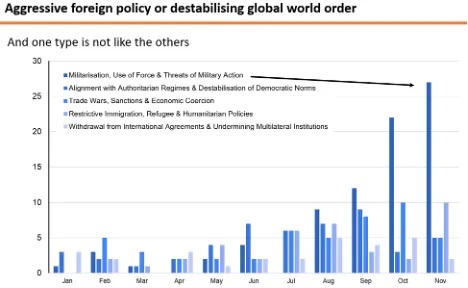
The Trump Tracker has logged 265 actions relating to US foreign policy since January, including the systematic undermining of international institutions, economic coercion and threats of force. Threats have been targeted at Greenland, Panama, Canada and Gaza and, since September, military action against Venezuela has escalated, with one recent incident labelled a war crime by international lawyers.
Alongside direct force, the US is deploying trade wars, tariffs, sanctions, and aid blackmail: threats to cut off aid to states such as Argentina unless it backs Trump-aligned candidates; sanctions on Brazilian judges, ICC lawyers, and South Africa. There are real-world consequences for those targeted, from frozen bank access to travel bans.
The same authoritarian logic is applied to immigration, asylum, and aid. Visa applicants will be vetted for ‘anti-regime’ social media, and anyone who has ever worked in fact-checking, misinformation research, or content moderation may be banned. Travel bans have been imposed on 19 countries, with proposals to extend to more than 30. Asylum has effectively been halted, with the notable exception of white South African farmers. US support for major global health and humanitarian programmes has been withdrawn, including USAID projects and funding to combat HIV and the GAVI vaccine alliance, with devastating results.
Europe can no longer pretend the US is a protector
In September, Pagel warned that Europe could no longer treat the US as a reliable protector. Events since then have only confirmed and sharpened that warning. Trump’s rhetoric about Europe has become more openly hostile: Europe is “decaying”, its leaders “weak”, and EU rules on climate, human rights and tech regulation are framed as intolerable constraints on US interests.
The Trump regime repeatedly claims free speech is under attack in Europe. But Pagel would argue that the true threat to free speech comes from the US. It’s not just visa applicants being policed: under new rules, US citizens’ social media posts, protest attendance, and other activities will come under surveillance for evidence of views deemed critical of the US or its government.
“One really simple test to tell if you’re in an authoritarian regime is whether you can oppose the government without consequence. I think it’s pretty clear that you cannot do that in the US.”
And now, of course, Trump has turned his sights on the BBC, bringing to Europe the brutal legal tactics he uses to intimidate and punish non-compliant media in the US.
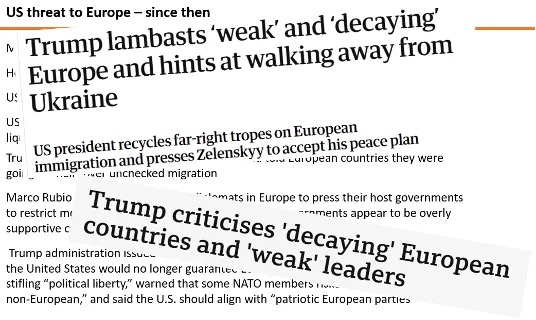
Most alarmingly, a new official US National Security Strategy openly states that the US will no longer guarantee Europe’s security, claiming that “…within a few decades at the latest, certain NATO members will become majority non-European” – a barely-coded reference to race. Accusing the EU of ‘stifling political liberty’, the strategy paper states that US interests will be served by backing “patriotic” (ie, far-right) parties to victory in Europe. As Pagel says:
“If this was the 1930s, the equivalent would be an American government openly supporting Hitler and Mussolini and so forth, and talking about immigrants in exactly the same kind of language that they used in the 1930s. That’s where we are.”
Are UK institutions ready for a similar assault?
Pagel recently worked with Professor Martin McKee on the independent agencies that generate evidence, regulate sectors and hold the UK government to account. Their report examined key ‘arm’s-length bodies’, identifying areas where they are vulnerable to state capture and offered a series of recommendations for defending democratic infrastructures.
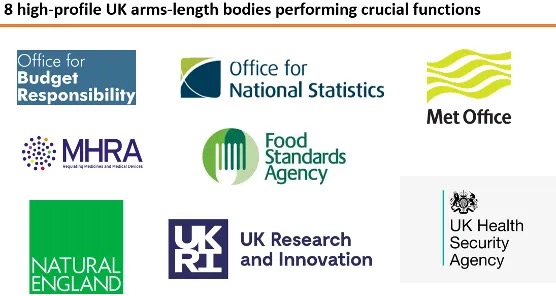
Drawing on this work, Pagel asks: could what has happened to US institutions happen here? Her conclusion is alarming: the UK is at least as vulnerable, and in some respects more so. Some organisations, such as the Office for National Statistics (ONS), have considerable embedded independence guaranteed in law. Others, such as the UK Health Security Agency (UKHSA), have almost none: they sit wholly within a department, lack a firm statutory footing, and could be reorganised or abolished almost overnight, as happened to Public Health England during the pandemic.
Strikingly, the leaders of the majority of these bodies are effectively minister-appointed. Ministers can override independent selectionpanels either by forcing a process to be re-run until the ‘right’ candidate emerges, or by directly appointing someone the panel considers unsuitable. The long saga of attempts to install Paul Dacre at Ofcom, Pagel suggests, is a warning of how this power can be abused. “You can get away with these kinds of vulnerabilities when no one is actively trying to exploit them,” Pagel warns, “but by the time you realise you need safeguards, it’s too late.”
It can happen here
In this respect, the rise of the populist right is deeply worrying. Reform has already announced plans to undermine institutions along the lines of Trump’s DOGE; to hollow out our institutions and politicise our judiciary and civil service. Farage’s recent attacks on the BBC, parrot Trump’s threats against the broadcaster, while pushing channels such as GB news. The Tories have also been talking about activist judges and lawyers in language that Pagel finds “quite scary”.
Meanwhile, some of the world’s richest men are increasingly willing to use their platforms and fortunes to interfere in other countries’ politics. If, on top of the Russian disinformation and interference we have already seen, Musk and others start pouring billions into UK, German or French elections, it could destabilise those processes. Terrifyingly, “the best hope for the UK is that Musk seems to think Farage is too soft, and really wants Tommy Robinson.”
Pagel is a health systems researcher who, during Covid, saw at first-hand how politics and disinformation can cost lives, so “If you’re literally seeing the most powerful country in the world fall into fascism, I feel like you have to do something.” Her message to Europeans is stark: stop assuming that “it can’t happen here” and stop assuming that the USA is on our side.
The vulnerabilities are real, the threats are explicit, and, if democracies want resilient institutions, they must strengthen them now, before they come under the sort of sustained assault already visible across the Atlantic.