
We asked 6 former Bremainers Ask contributors to tell us their hopes and fears for the new year. In December, we heard from Gina Miller, Zoe Gardner and Naomi Smith. Now it’s the men’s turn …….
Anand Menon – Professor of European Politics and Foreign Affairs, Director of UK in a Changing Europe
Hopes for 2026 must, above all, be for those outside our country facing war and consequent unspeakable hardship. For all the problems we have in the United Kingdom, they are nothing to the fear and uncertainty of those facing domestic unrest or foreign interference.
And talking of international politics, this remains the potential deus ex machina that could render everything I say below ridiculous. A rupture with the Americans – and at the time of writing Europeans are figuring out how to respond to the threat of tariffs linked to the situation over Greenland – would change everything and make a rethink of relations with the EU imperative.
But to turn back to the situation at home, I must risk annoying readers by saying ambitious new plans intended to tighten links with the European Union are not a priority. This is for several reasons. One, I’m not convinced that there is any such scheme that is acceptable to both sides. Pick and mix alignment, as Keir Starmer seems to want (and on which some of the recent economic modelling we’ve heard so much about has been based), will doubtless be rejected by the EU.
Equally, rejoining the single market isn’t something the UK Government is willing to consider. Perhaps a case could be made for freedom of movement in a context of rapidly falling legal immigration (it’s not beyond the realms of possibility that some might make the case based on the preferability of European versus ‘other’ kinds of immigrants). Be that as it may, a Government that has struggled so hard to come to terms with the idea of a youth mobility scheme is not one that is about to make that case.
So, we are left with the contents of the ‘reset’ to date. These are far from trivial. But it remains to be seen whether potentially contentious talks over not only youth mobility but also the extent of alignment necessary for SPS and ETS deals can get over the line. And of course, we’ve got to hope that the more militant member states see sense over SAFE, at a moment when Europeans need to work together to improve their military capabilities more than ever.
As for the rest, even if this government, potentially under a new leader, decides to go further and faster, negotiations will take time, and the EU has shown no signs of a willingness to do the UK any favours. Talks will be tough and, particularly as the EU begins to negotiate its 7-year financial settlement, any deal will doubtless carry a hefty price tag. Not only this, but any benefits will likely not materialize for some time – certainly not ahead of the next General Election in 2029.
Rather, the focus for the next year must be on much needed domestic reform. It is still not too late for this moderate centre-left government with its whopping majority to address at least one of the severe problems – social care, over centralization, a regressive and growth-unfriendly tax system, the lack of adequate taxation of wealth (particularly property) to name but a few – that have dogged us for so long.
Now clearly, it is not too much to expect that our government should be able to walk and chew gum simultaneously. That is to say, there’s no reason why an ambitious domestic reform agenda should not be accompanied by equally energetic attempts to reinforce links with EU partners. My point here, however, is that, in terms of domestic politics at least, and with the proviso that Donald Trump may well change all that, the emphasis should be on the former rather than the latter.
The collapse of the political centre in the UK is the single greatest threat that faces our country domestically. Preventing that will involve not only showing genuine improvement in the issues the public cares about – notably the cost of living and the state of the NHS – but also addressing the structural barriers that have led to such anaemic economic progress for so long. The government’s priority should be to get its act together and come up with an agenda that genuinely fosters growth and addresses the long-term sapping of faith in politics that has afflicted us for so long. Focusing on the ‘reset’ is simply not the best way to do this.
David Henig – Leading authority on UK trade policy post Brexit
International rules, cooperation, and trade are under evident strain from a US President increasingly seeing his role as extortion. In this situation survival with limited damage becomes the first and in some ways only priority for countries across Europe who have been deeply allied if never entirely aligned with the US for 80 years. Overly excitable commentary about standing up to or jettisoning the US can best be seen as more attention-seeking than serious short-term politics.
Hope number one, then, is that this too will pass, that Trump’s powers will wane as mid-term elections approach, even if his ability to damage all of us remains worryingly high. There are some positive signs, trade has held up far better than many expected, and Ukraine has not been forced to concede to an invasion, close though both of these have seemed at times. US economic coercion seeking to change UK and EU regulations in return for lower tariffs is going to continue though, and governments need to continue what seems the right approach of ducking and weaving, however inelegant this may look.
Sensationalism is unfortunately the dominating operating model of European politics and media. This weakens the ability to respond to a world order clearly changing even before this US administration doubled down on its mobster mentality. Hoping this will change is sadly more ambitious than the idea of surviving Trump, but it would be nice if we saw more writers dealing with the world that is, rather than succumbing to the many alternatives including misplaced nostalgia, overegged terror, or simplistic immediate solutions.
Or perhaps I’m still scarred by a former commissioning editor for a respected political magazine telling me that there’s no market for serious policy analysis. Suffice to say I didn’t agree.
This then leaves to last the substance of how the UK and EU should be building an ongoing response to a world in which our role is diminishing. In broad terms there are well known answers which involve deepening partnerships in support of our values and using these, plus our continued economic strengths, to maintain relevance. Equally obvious are the obstacles that include the ongoing strength of national populism particularly destructive to the centre-right of politics, a related belief that traditional manufacturing or farming should be the priority, and leaders unable to convince their way through a complex policy landscape of multiple, often conflicting objectives and stakeholders.
Ideally, we would see a revival of politics as the method by which tough decisions are debated and made rather than pretended away. This would mean for example that those wanting closer UK-EU relations stop talking about a Customs Union as the latest simplism and address the key issues of contribution, shared vision, and movement of people. Or that counterparts in the EU try to move on from the scars of divorce and understand this relationship is not going away.
I’m neither particularly confident nor in a great position to help as a non-politician. Hopefully some of my work may help a little.
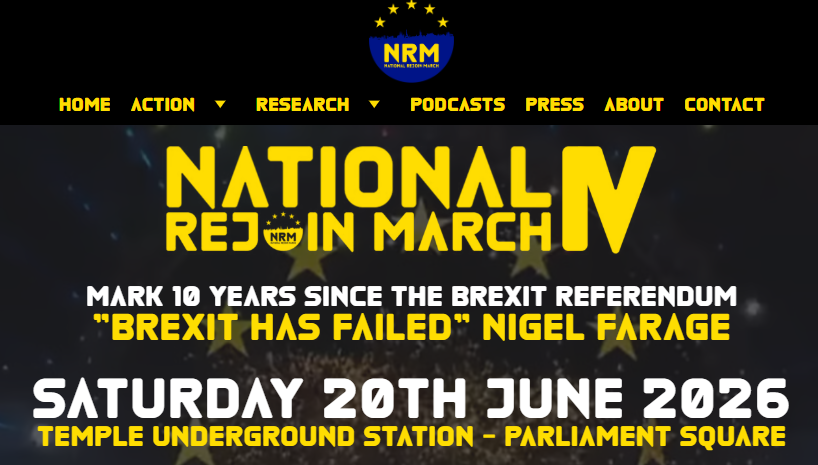
Peter Corr – Director and Founder of National Rejoin March
Going into 2026, I feel like a lot of people do: tired, frustrated, and still somehow stubbornly hopeful. Which is probably the most British political mood there is. Politics isn’t some abstract thing anymore. It’s in your food bill, your heating bill, and that quiet sense that things just don’t work as well as they used to — but we’re all expected to pretend this is fine.
In the UK, Brexit is no longer the shouting match it once was. It’s worse than that. It’s background noise. A constant drag. Less trade, less influence, less opportunity — and a political class that mostly wants to stop talking about it and move on. My fear is that we let them. That we quietly accept a smaller, poorer, more isolated country because reversing a bad decision would apparently hurt a few egos.
What gives me hope is that people aren’t buying it like they used to. The slogans wore off. Real life kicked in. And once people notice that the “sunlit uplands” look suspiciously like a lay-by off the hard shoulder, it’s hard to unsee it.
That’s why the Rejoin Ramble matters so much to me. Walking from London to Brussels isn’t about nostalgia or waving flags for the sake of it. It’s about saying, plainly and physically, that millions of people in the UK still believe cooperation works better than isolation. Delivering messages of hope to the EU from pro-Europeans here is a reminder that Brexit didn’t magically change who we are or where we belong. You don’t walk hundreds of miles unless you really mean it.
And then there’s the National Rejoin March in London on Saturday 20 June. I want it to be the biggest yet — and not just louder, but smarter. Confident. A movement that’s done apologising for existing. One that says: we were right to question this, and we’re right to want better.
Beyond the UK, the world feels… unstable, to put it politely. Trump-style politics rumbling back, complete with ego, grievance, and the sort of ideas you’d expect after three drinks — like casually talking about buying Greenland. It’d be funny if it wasn’t backed by real power and real consequences. My fear is that spectacle replaces seriousness again, and everyone else pays the price.
And then there’s Ukraine. A war that shouldn’t need explaining anymore. My hope for 2026 is simple: that Ukraine survives free and intact, and that Europe doesn’t lose its nerve. My fear is fatigue. That people confuse being tired of hearing about a war with the war somehow being over.
So yes, I’m angry. And worried. But I’m also hopeful, because hope isn’t passive. It’s walking, marching, organising, arguing, and refusing to shut up when you’re told it’s time to “move on”.
If 2026 is going to matter, I want it to be the year we stop whispering and start saying it clearly: Britain can do better. Europe matters. And together still beats going it alone.

Next month: David Knopfler
We are delighted to announce that our featured commentator in February will be the founder and former guitarist of the legendary Dire Straits rock group. Since leaving the band in 1980, David has embarked on a solo career as a singer-songwriter. He is also a regular political commentator on social media.
You can follow David on Facebook, X, Bluesky and Substack and read his latest newsletter on ‘Institutional MAGA racism’ here.
If you wish to submit a question for David, please email us no later than noon on Sunday 8 February.