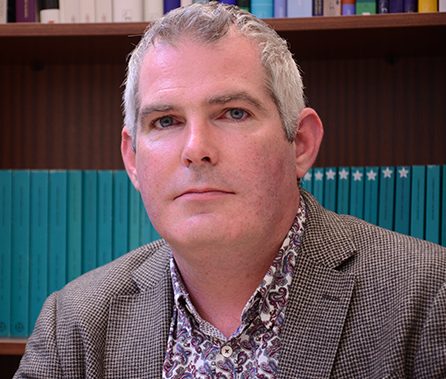
Bremainers Ask….. Michael Dougan, Professor of EU Law University of Liverpool
The latest of our Bremainers Ask…. feature, where Bremain in Spain members ask topical questions of prominent individuals involved in the European Union debate, is with Michael Dougan – Professor of European Law and Jean Monnet Chair in EU Law at the University of Liverpool.
He is an established academic authority on EU constitutional law and Joint Editor of Common Market Law Review – the world’s leading scientific journal for European legal studies. Michael’s work has also contributed to wider public and political debates about European law, e.g. through written evidence to numerous UK Parliamentary enquiries, as an expert witness before various Parliamentary select committees and external advice to a range of UK public bodies and Union institutions. Michael’s public engagement activities, including videos of his lectures before and after the 2016 UK referendum, received extensive public and media attention and he continues to be a popular authority on the matter for individuals and groups all around the world.
Pat Kennedy: What would your solution to the Irish Border be?
Prof Dougan: The Irish border problem is entirely of the UK Government’s making. After the referendum, the Government announced that the UK would be leaving the Single Market and the Customs Union. That inevitably means having a customs and regulatory frontier with the EU – including the Republic of Ireland. But the Government also promised there would be no return to a hard border on the island of Ireland – which the Government has consistently defined as having no physical infrastructure or indeed related checks and controls. The only feasible way to deliver that promise is for Northern Ireland to remain (de facto) within the Customs Union and at least parts of the Single Market (even if the rest of the UK does not). Yet the Government repeatedly insists that Northern Ireland will be leaving the Customs Union and the Single Market along with the rest of the UK and there will be no new trade barriers erected within the UK itself – a prospect the Government describes in increasingly apocalyptic terms as an existential threat to British constitutional integrity. However, the only way to avoid that prospect is… for the UK as a whole to remain within the Customs Union and the Single Market – so we’re right back where we started! In other words: the UK Government has been promising irreconcilable things to different groups of people. The only real question is: who is going to end up being disappointed by the eventual outcome? The most obvious solution to the whole mess is to cancel Brexit, of course. Otherwise, the Government could drop its ideological “red lines” and agree for the entire UK to stay within the Customs Union and Single Market – not because I think that is a sustainable model for the UK in the long term, but because it solves the Irish border problem while also making it much easier for the UK to rejoin the EU as quickly as possible. By default, we have the EU’s proposal for Northern Ireland to remain within the Customs Union and related elements of the Single Market – while trying to find ways to minimise the need for and visibility of checks between Northern Ireland and Great Britain. For its part, the UK Government has still failed to publish any more developed or credible alternative plans for the backstop. Recent statements from the UK Prime Minister do at least give us some insight into the Government’s thinking: for example, even the backstop should be defined in terms which cover the entire UK territory (not just Northern Ireland); but there should be an option to extend the post-withdrawal status quo transitional period (as an alternative to triggering that UK-wide backstop); though either such model would then have to contain provisions allowing for its termination (since any more indefinite UK-wide backstop or transitional period would remain utterly unacceptable to Leave supporters). The problem is: the UK Government is floating those ideas on the assumption that a solution to the Irish border problem can be and will soon be found at the level of the overall future EU-UK relationship – so that both the backstop and an extended transition are guarantees that might only be needed for a few months (if they are ever needed at all). That assumption flies in the face of every rational analyst’s view – that frictionless trade (of precisely the sort required to avoid a hard border in Ireland) is simply not possible once the UK leaves the Customs Union and the Single Market; no alternative future relationship, no matter how close (and certainly not the fantastical “Chequers Plan”), can deliver the same result. At some point very soon, the conundrum will have to be solved. Because as the EU has made clear: without a workable and acceptable backstop, the entire negotiations could break down. And if that happens: it means no withdrawal agreement; no transitional period; and the prospects for a reasonably prompt negotiation on the future EU-UK relationship set back considerably. Yet such a “no deal” scenario is perhaps the worst possible outcome for Northern Ireland and the Republic – since it risks precisely the prospect of an immediate customs and regulatory border and a direct threat to economic, social and political stability – something the UK’s contradictory promises in the Joint Report of December 2017 would then do precious little to help.
Ruth Woodhouse: You address a lot of student bodies. What is the mood amongst young people on Brexit?
Prof Dougan: It’s true that an important part of my current activities is knowledge exchange – sharing the results of my ongoing research around Brexit not only with my fellow academics but also with wider public and policy audiences. In particular, I give a lot of public talks: the University of Liverpool estimates that I’ve delivered or participated in face-to-face lectures, Q&As, panel debates etc for over 15,000 people across the UK since February 2016. I try not to refuse any bona fide invitation to speak from a citizen group or NGO – and the University of Liverpool are very generous in covering my travel and accommodation needs – though I have had to introduce a “two per week” rule (albeit not always rigorously enforced) just to limit the amount of time I spend on trains and in Premier Inns. But funnily enough, not many of my invitations are for student events or indeed to address younger audiences. I usually speak to audiences largely made up of middle aged (and often but certainly not entirely middle class) citizens: angry, knowledgeable, motivated and impassioned – but certainly not young! Of course, there is absolutely nothing wrong with that. Far from it: informing the public about Brexit, let alone fighting Brexit, requires engagement with / the mobilisation of every section of society. And my experience is just that: we know there is a lot of student interest in and younger activism around Brexit. That was evident from even a glance around the national march in London on 20th October 2018.
Alex Kennedy: Professor Catherine Barnard, another prominent expert on EU law, is also from Northern Ireland. Is there something about EU law which is particularly attractive to Northern Irish academics?
Prof Dougan: In December 2017, Leiden University organised a major conference to celebrate the 60th anniversary of their Europa Institute for the study of (what is now) EU law. Due to a last minute change in the programme, I was asked to offer a few comments on the position of Ireland in the whole debate about Brexit as well as wider EU reform. I made two introductory points: first, Ireland’s record as a fundamentally stable democracy fully engaged in the institutions of European cooperation is second to none; and secondly, Irish citizens (from the North as well as the South) have made an incredible contribution to the study and practice of EU law and indeed continue to work prominently (even disproportionately, given the relatively small population) at the forefront of such an international discipline. It would be an interesting research project for a social scientist to explore why that might be the case. It might be that people from smaller countries (especially those which have been on the receiving end of the imperial ambitions of their larger neighbours) understand and appreciate more readily the limits of “national sovereignty”, the value of rules-based international cooperation and the potential for collective action to expand the possibilities of national influence. It might well be that it is easier for the smaller participants in a multi-national union to feel more comfortable with complex, multiple, overlapping and mutually enriching identities: after all, I can happily feel like a Belfast boy, Northern Irish, Irish, British, Scouse and European – all at the same time, each one providing a unique and important part of my own sense of identity. It is also quite possible that, for many people from Northern Ireland, European integration provides such a successful model for overcoming historical legacies of conflict and division through peace building and finding ways for different communities to live and work together harmoniously and productively. Or there might be other explanations. And we need to wonder: are such features and qualities unique to Ireland (North or South)? And what should we make of the fact that Northern Ireland is also home to some of the most ideologically fanatical and delusional Europhobes of all, i.e. in the form of the Democratic Unionist Party?
Sue Scarrott: With timescales tight, how can we engage with those suffering from Brexit ‘apathy’ or those who believe Brexit won’t affect them?
Prof Dougan: It’s easy to understand why people feel apathy towards Brexit. I often feel it myself. But I find the best cure is to recite the main reasons for regarding the 2016 referendum and its aftermath as the most idiotic and self-damaging act any developed country has inflicted upon itself since 1945. 1) The referendum campaign itself made a mockery of the UK as a mature and responsible democracy.
2) The genuine risk that the UK might experience systematic regulatory and administrative malfunction upon withdrawal, particularly if we end up with no transitional period to protect us from the Government’s own woeful lack of preparations.
3) Even without any such short term disasters: Brexit is so self-evidently a disastrous act of long term and profound national diminishment – squandering our leadership and influence within one of the most important international organisations on earth, and through it, an important part of our leadership and influence in the world at large.
4) The vast waste of time and energy and money and resources that is being poured – not into trying to improve our country and the lives of its people – but simply into trying to limit the self-inflicted damage that Brexit will bring (is already bringing).
5) For millions of people now and into the future, their life choices and horizons have been diminished: many of the freedoms and opportunities and protections and aspirations that I have taken for granted throughout my entire life will no longer be open to you, or to your children, or to your grandchildren.
6) The stirring up of deep seated bigotries and long-lasting social division that will tarnish our collective morality and undermine our social cohesion for years to come.
7) Even if there were no other cause for concern, no other cause for complaint: the very fact that millions of people, here and across the rest of Europe, have seen their lives and futures thrown into uncertainty and anxiety is an unforgivable act of cruelty for which the Leave Campaign deserves to be called out as utterly morally bankrupt.
8) The damaging legacy of what happens when a democracy normalises, legitimises and indeed actively rewards and encourages systematic dishonesty by its political leaders.
9) Last but not least: for many of the leading Leave Campaigners, leaving the EU is not just an end itself. It is merely a means to further their ulterior political objectives: ill-defined and confused, but still very dangerous, hard right dreams of some sort of political, economic, social and cultural revolution in the UK. Let’s not forget the depressing correlation between many of the leading Leave campaigners and other politically and socially regressive ideologies: from climate change denial, to the return of capital punishment, opposition to equality legislation, the final destruction of the welfare state, and other hard neo-liberal economic preferences – all reflecting their natural affinity with the hard American right. And let’s not forget that Brexit hasn’t just fuelled support for anti-rational, socially divisive, politically aggressive movements in this country but elsewhere too. In America and all across Europe, Brexit has become an inspiration for nationalists and populists. See what can happen when you lie big, when you play on people’s fears, when you offer up enemies rather than solutions? You can win too! So any time I feel tired or bored or fed up with Brexit, I remind myself: this isn’t just about Brexit. It’s also about the fundamental values that we want our country to respect and represent. And for the fundamental values that we want to see reflected in the world around us. That usually works.
Sandra Stretton: Does Brexit detract from the work you were doing prior to the Referendum?
Prof Dougan: I’m an EU constitutional lawyer. By its very nature, EU constitutional law is a broad but also very fast changing subject: at any given time, there might be dozens of developments going on across the legal system which are of potential constitutional interest; and in the blink of an eye, entirely new fields of enquiry can appear out of nowhere (or indeed disappear into history). The challenge for myself and my colleagues in the discipline is to decide which developments to concentrate on studying in greater detail versus which ones we should just be aware of and keep an eye on. Whichever choices we make, the objective is always the same: to know how the EU system fits together, to understand the dynamics which are shaping its development, to draw out the key patterns and themes and to critically assess their significance for the overall system of European cooperation. From that perspective, Brexit isn’t a distraction or detraction at all: it’s one of several contemporary developments with significant implications for EU constitutional law – alongside, e.g. the continuing programme of Eurozone reforms, the serious “rule of law” problems in Poland and Hungary, debates about the changing nature of Union citizenship and free movement rights, contentions around the legal and policy responses to third country migration and the operation of the Schengen system etc. My only choice was whether to pay Brexit close attention versus whether just to keep an eye on it and concentrate on some other major development/s. Obviously, I chose the former – though the choice was certainly not a purely intellectual one. Perhaps the most important factor influencing my decision to spend a lot of time researching around Brexit was, of course, the fundamental importance of Brexit for the future of the UK and its people. I feel very strongly that it’s important for academics to offer their expertise and skills to help better inform their fellow citizens and (as far as possible) political leaders about such crucial decisions. That is particularly true when the leading proponents of Brexit – a contemptible gang of charlatans and demagogues if ever there were one – have employed tactics and arguments which (in their sheer dishonesty and cynicism) are the complete antithesis of the basic principles of scientific research and evidence-based, rational policymaking which lie at the heart of my own profession.