
Votes for Life – Improving representation for Brits abroad
Throughout its history, Bremain has been dedicated to improving the democratic representation of all UK nationals living abroad. For many years, British citizens who had been living outside of the UK for more than 15 years lost their right to vote in UK elections.
Alongside campaigners across the UK and Europe, Bremain worked tirelessly for the reinstatement our democratic voting rights, including working closely with seasoned campaigner, Harry Shindler OBE.
Thankfully, in April 2022, our full voting rights were restored by the Elections Act and millions of overseas voters were once again able to register to vote in UK general elections from January 2024.
In an effort to continue to improve representation for Brits abroad, our Votes for Life campaign is now focused on two areas:
Overseas Constituencies
Working with Unlock Democracy and New Europeans, Bremain continues to campaign for overseas constituencies and dedicated MPs that understand the issues we face as UK nationals living abroad. (You can read more about this campaign by scrolling down this page to the Update on 19 February 2025).
We will be closely watching the progress of the Elections Bill – officially known as the Representation of the People Bill – regarding any developments that have a bearing on our rights.
UK nationals abroad voter registration
Having fought so hard for the restoration of our voting rights, the number of UK nationals that took advantage of the change in the law was very disappointing. To ensure that more people register ahead of the next general election, we have put together a guide to the process.
Please don’t wait until an election is announced to register as you may run out of time.
Register now and get the ball rolling. It’s your democratic right to vote – use it!
VOTES FOR LIFE – Campaign History & Background
Improving registration for overseas voters
The Ministry of Housing, Communities and Local Government (MHCLG) is developing a new service to enable Britons voting in UK elections from abroad to renew their voter registration digitally.
To ensure user satisfaction, and identify any possible improvements to the system, a trial has been conducted across a number of constituencies, with over 1000 responses. To date, over 90% of those taking part have expressed their satisfaction, and an independent auditor has rated the service of ‘high standard’ for use by those with disabilities.
This new service will be available to overseas voters in 2026.
CAMPAIGN FOR OVERSEAS CONSTITUENCIES
In conjunction with New Europeans, Unlock Democracy and other campaign groups – and following the return of our democratic voting rights – Bremain is campaigning for dedicated MPs to represent Britons living abroad.
On January 15 2025, our chair Sue Wilson attended the Citizens’ Rights APPG in Westminster to discuss the Overseas Constituencies campaign with parliamentarians. Since then a parliamentary briefing has been sent out to all MPs and peers outlining the rationale for Overseas Constituencies.
We would like to acknowledge the role of the Bremain Lobby Team in extensively lobbying parliament in this regard. Thank you!
The rationale for dedicated MPs for Brits abroad
- UK based constituency MPs understand little of the issues faced by Britons living abroad, and quite naturally focus their attention on local constituency matters
- Britons abroad are more likely to be engaged with national UK matters than with constituency-specific issues
- Dedicated representation by MPs who understand the issues would ensure the voices of overseas voters would be heard
- Better representation would likely result in increased numbers of Britons abroad registering to vote in the UK
- At least 17 countries – including EU countries such as France, Italy, Croatia, Romania and Portugal – already have fully functioning overseas constituencies

If you have yet to register to vote, you will need to act quickly, as the deadline for the receipt of registration applications is Tuesday 18 June – 12 working days before the poll. As applications in some constituencies are taking up to 4 weeks, please act now to avoid disappointment.
You can Register to Vote online – the process is simple & straightforward & should only take 5 minutes.
We strongly recommend using a proxy if you are unable to vote in person. Applications for a proxy vote close on Wednesday 26 June (6 working days before the poll). You can apply online or by post but you must be registered to vote before starting the process.
For further details re the requirements for registration & proxy voting, please read on.
We’ve waited long enough for the return of our democratic voting rights, so act now & make your vote count!

Voting by Proxy
Now our voting rights have been restored, it’s time to consider how to cast your vote as a British citizen abroad.
If you are unable to vote in person in the UK, then we strongly recommend voting by proxy as postal voting has proved very unreliable in the past & your vote may not arrive in time to be counted.
How to apply & what you need
Once you have registered to vote, there are 2 ways to apply for a proxy – online or by post.
Before you start the process, you will need your:
- N.I. number or other ID, e.g. birth certificate
- Details of your Proxy: name, address, contact details
- Digital signature (a photo)
The government have produced as Easy Read Guide that explains the process in more detail.
Who can act as your proxy?
You need to appoint someone you trust to act as your proxy who is:
- 18 years or over
- Registered & eligible to vote
Further information is available from the Electoral Commission: How to vote by proxy
If you are unable to find a friend or family member to act as your proxy, you can approach your local political party. They have a vested interest in finding someone to act on your behalf.
Important note: If you applied for a proxy vote before 31 October 2023, this expired on 31 January 2024 so you need to apply for a new one.
Tens of thousands of Brits abroad have already registered to vote, according to the government’s Register to Vote Dashboard.
If you are not one of them then please read on for all the relevant information on how & where to register. Please don’t wait until an election is announced as the registration process alone is taking up to 4 weeks in some constituencies.
Effective from 16 January 2024, you will now be able to register to vote in UK elections, regardless of how long you have lived abroad. British citizens, eligible Irish citizens and citizens of Crown Dependencies can register as overseas voters as long as they:
- were previously registered to vote in the UK or
- were previously resident in the UK
Get ready to register
Before starting the process of registration, you will need to have access to proof of your ID and your former UK address.
To prove your ID you will need to provide your National Insurance (NI) number and your date of birth. If you have a British passport (current or expired), you will need to scan it for ID purposes. If you have lost your NI number, you can search for it here
To prove your address you will need to provide documentation containing your full name and address details. Acceptable documentation includes:
- a UK driving licence (current or expired)
- correspondence from HMRC or the Dept. for Work and Pensions
- council tax statement/demand
- credit card statement
- utility or mobile phone bill
- letter from an insurance company
- P45 or P60 form or payslip
- bank/building society passbook
- local authority rent book
In the event that you are unable to provide satisfactory evidence of your ID and former UK address, you will have the option of providing an attestation. You will need to ask someone (not a close family member) to attest to the details you provide. Your attestor must be over 18 and registered to vote in the UK, but they do not need to be a UK resident.
How to register
You can register to vote from overseas online on the government website here
When applying to register, use the last address where you were registered as a UK resident. If previously registered to vote at more than one UK address, use the most recent address at which you were registered.
Any eligible voters that previously resided in the UK, even as children, but have never been registered to vote, can apply using their last UK address.
Details provided will be verified by local authorities who are responsible for the electoral role in their area.
Once registered to vote, you will need to renew your registration every three years (previously annually), before 1 November.
An easy read guide on the registration process is available here
Feedback
We would be very interested to hear about your experiences in registering to vote using the government website. The process will be straightforward for some and more complex for others, but it is important that we understand how it works for you, and any issues that need resolving. Any feedback, good or bad, of your experiences of the registration process can be emailed to us at: enquiries@bremaininspain.com. We will be sure to feed back any issues to the DLUHC and the Electoral Commission in order to improve the process.
With a general election looming over the horizon, please do not wait to get yourself on the electoral register. The return of our democratic voting rights has been a long, hard-fought campaign, and the UK has never needed a new government more than it does right now. So, exercise your democratic rights and register to vote now!
Useful links
Electoral Commission: Overseas Voters- Resources for British Citizens Overseas
British Embassy – Living in Spain – Voting
LibDems Abroad: Brits Abroad and Brits Abroad Q&A
British in Europe: Get ready to vote – your FAQs
The “15 year-rule” will effectively be removed – for those previously registered to vote, or previously resident in the UK – as of 16 January 2024, from 12.30 a.m. – via the Register to Vote website.
In the meantime, we recommend that those who are currently disenfranchised from voting start collecting their proof of ID (NI numbers, passports etc) and proof of their last UK address/electoral registration and scan them ready for upload to the government website.
Further detailed instructions on the process, and the acceptable documentation, will be available here nearer the time.
Once your form has been downloaded and completed, it is then sent off to the Electoral Registration office for England, Scotland or Wales or for Northern Ireland
If you are living in the UK, you can download the application forms here
For those living abroad, apply online here
If you have not exceeded 15 years abroad, then you can also use the above link to register/re-register to vote. Those that have exceeded the 15 year period should be able to register to vote in January 2024 when the secondary legislation is finalised.
On 23 October, the government published the Statutory Instrument on overseas voting regulations. These now require the approval of parliament before being signed into law, and will be considered by both House of Commons and House of Lords committees. The process usually takes no more than 8 weeks, so is expected to be finalised by early January 2024.
The next step will then be registration for disenfranchised overseas voters, likely to start before the end of January, as scheduled.
- The department is still on track to progress the necessary secondary legislation this Autumn
- The legislation will be laid & debated with the intention that the necessary changes to overseas voting rights come into force in January
- Voters who are currently eligible can continue to register as usual, and from January onwards
- Newly eligible voters – that were previously denied a vote under the 15-year rule – will be able to apply to register from January onwards
Votes for Life – Overseas Electorate Roundtable
On 21 June 2023, Bremain Chair, Sue Wilson, attended a meeting with Baroness Scott of Bybrook, Parliamentary Under Secretary of State for the Department for Levelling Up, Housing and Communities (DLUHC). The online meeting was also attended by officials of the DLUHC Elections Directorate, who Sue had met with earlier this year.
Speaking on behalf of the disenfranchised overseas electorate were representatives from a variety of campaign organisations, including Conservatives Abroad, LibDems Abroad, Labour International and British in Europe.
Secondary legislation
Before parliament can approve the new legislation, there will be a consultation with the Electoral Commission, who will provide further scrutiny of the plans and processes. The expectation remains that the secondary legislation will come into force in January 2024, enabling the registration process to begin.
Registration process
Changes are being made to:
- ID verification process
- Franchise criteria
- Application forms
Each change is aimed at making the process easier and quicker for existing and new overseas voters, and to maintaining the integrity of the electoral process. These changes will apply to all UK parliamentary elections, including any bi-elections.
Renewals & Absentees
When re-registering to vote (every 3 years in future, rather than every year as at present), the process will allow for concurrent re-registration for proxy or postal voting. A reminder will be issued in advance to those already on the electoral register, and a new “light-touch” renewal declaration will speed up the process.
A new process for postal/proxy voting applications will be available online. For postal voting, pre-paid “international business response” envelopes will be supplied by Royal Mail – these envelopes are suitable for all international use and widely recognised abroad.
Following the meeting, Sue said, “it was reassuring to learn that the plans outlined to me in March are progressing well, and the previously quoted timescales still stand. It was a pleasure to meet Baroness Scott and her team who are clearly dedicated, well informed, and efficient. It is clear that all concerns raised by Bremain, and other campaign groups, have been listened to and acted upon. Restoration of our democratic votes rights is now well under way.”
A further roundtable meeting will be held in the Autumn.
For further information, read the earlier updates or visit the government website: Overseas electors: Delivering ‘votes for life’ for British expatriates
The meeting was with officials from Elections Directorate at the DLUHC in Westminster.
The purpose of the meeting was to discuss the next steps, the process and to establish the timescale. This is what we learned ……….
Secondary legislation
In order to restore full voting rights following the passing of the Elections Act by Parliament, secondary legislation will be necessary.
This will take place in the Autumn session of parliament 2023 with the intention of delivering ‘votes for life’ ahead of the next General Election. The secondary legislation to deliver the overseas electors change is expected to be made and come into force in January 2024.
Improvements to the registration process
To facilitate voting arrangements, the process of registration will be made simpler, and the frequency of re-registration will be extended from 1 year to (up to) 3 years. An online registration service will be complemented by the introduction of an online absent vote (postal or proxy) application process.
As soon as the changes come into force, newly enfranchised electors will be able to apply to register to vote. We will then be encouraging our members to act quickly, rather than wait until an election is announced.
The franchise of eligible voters will be extended to include all of the following British citizens, regardless of how long they have been living abroad:
- those previously registered to vote in the UK
- those previously resident in the UK
In addition, those that left the UK before they were old enough to register to vote will no longer have to rely on the registration status of their parents/guardians.
The verification process
The process will require the verification of both personal identity and a previous UK address.
Regarding identity verification, this could be established, as now, via a check of applicants’ details (including NI number) against DWP records, or if that is not possible, via documentary evidence, such as a UK passport. Failing that, an attestation (a declaration that certain facts are true) from a suitably qualified elector (not a close family member) would be acceptable.
Re address verification, if it is not possible for an Electoral Registration Officer (ERO) to verify an address by a register check, other options will be available, such as documentary evidence from a bank, building society, utility company, tax office or a variety of other organisations. A full list is available online (see below). Failing that, an attestation – as with ID verification – would be acceptable.
Following the meeting, Sue said, “I came away from the meeting impressed with the level of detail provided, the comprehensive nature of the planning and preparation, and the understanding of the issues we face as overseas voters. I was impressed with the knowledge and abilities of the people I met and with their willingness to engage with us and to listen to our concerns. Now, bring on the next election, but not before next spring, please!”
For further information, go to the government website: Overseas electors: Delivering ‘votes for life’ for British expatriates
In response to an enquiry regarding overseas voters’ measures in the Elections Act, the Electoral Commission said, “The Government has not yet made the legislation necessary to bring these changes into force, and we do not expect them to come into force before summer 2023. More detail on the implementation of these measures is expected to come from the government in the coming months.”
You can read the Government’s announcement re the passing of the Elections Act here
You can read an article written by Bremain Chair, Sue Wilson, on the passing of the Elections Act here
On 22 September, the Committee stage began, and is scheduled to continue on 19 October. You can watch the latest proceedings on Parliament TV here.
We asked our members why their vote was important to them and used many of your testimonies in our report. Many thanks to all those that contributed. You can read about our presentation of evidence to the committee here, in an article by our Chair, Sue Wilson. To read our evidence report in full, click here
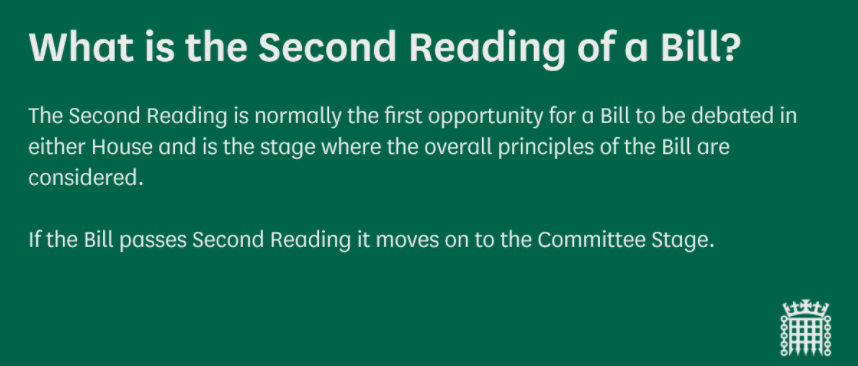
The second reading is the first opportunity for MPs to debate the general principles of the Bill. At the end of the debate, MPs will vote on whether they think the Bill should proceed to the next stage – the Committee Stage.
You can follow the progress of the Bill here
You can watch the debate live on Parliament TV, or watch a recording after the event here
The bill includes government plans to introduce voter ID at polling stations, the aim being to “protect the integrity of elections”. However, many campaigners have argued that election fraud is extremely rare, and the bill is a solution to a problem that does not exist.
Committee Chair William Wragg said:
You can read more about the proposed enquiry here
You can read more about PACAC here
If you wish to submit evidence to the committee, you can do so here. The deadline is 31 August 2021.

On 17th July 2021, he celebrated his 100th birthday. Bremain could not let this occasion pass un-noticed, so we asked our members and other campaign groups to join us in sharing our good wishes.
Bremain members contributed to our birthday book. You can view the book & read our members’ comments here
Campaign groups across the UK & the EU contributed to our dedicated video, which you can view here
We wish Harry a very happy birthday, & many more to come.
“To increase participation in our democracy, the Bill will deliver the longstanding commitment to remove the arbitrary 15 year limit on overseas electors voting in UK Parliamentary general elections.”
The Elections Bill is proving controversial, though not because of the scrapping of the 15-year voting rule. The cause for concern is the planned introduction of voter ID, which threatens to disenfranchise many further voters, and is regarded by many as undemocratic and unnecessary.
Bremain will be following the passage of the new bill with great interest, and will provide regular updates.
More information on the Elections Bill is available on the official government website here.
Overseas electors will also be able to reapply for a postal vote or refresh their proxy vote at the same time as renewing their voter registration, streamlining the process and helping to ensure they have appropriate voting arrangements in place ahead of an election. These changes, which will form part of the Elections Bill will come into effect in time for the next scheduled General Election in 2024.
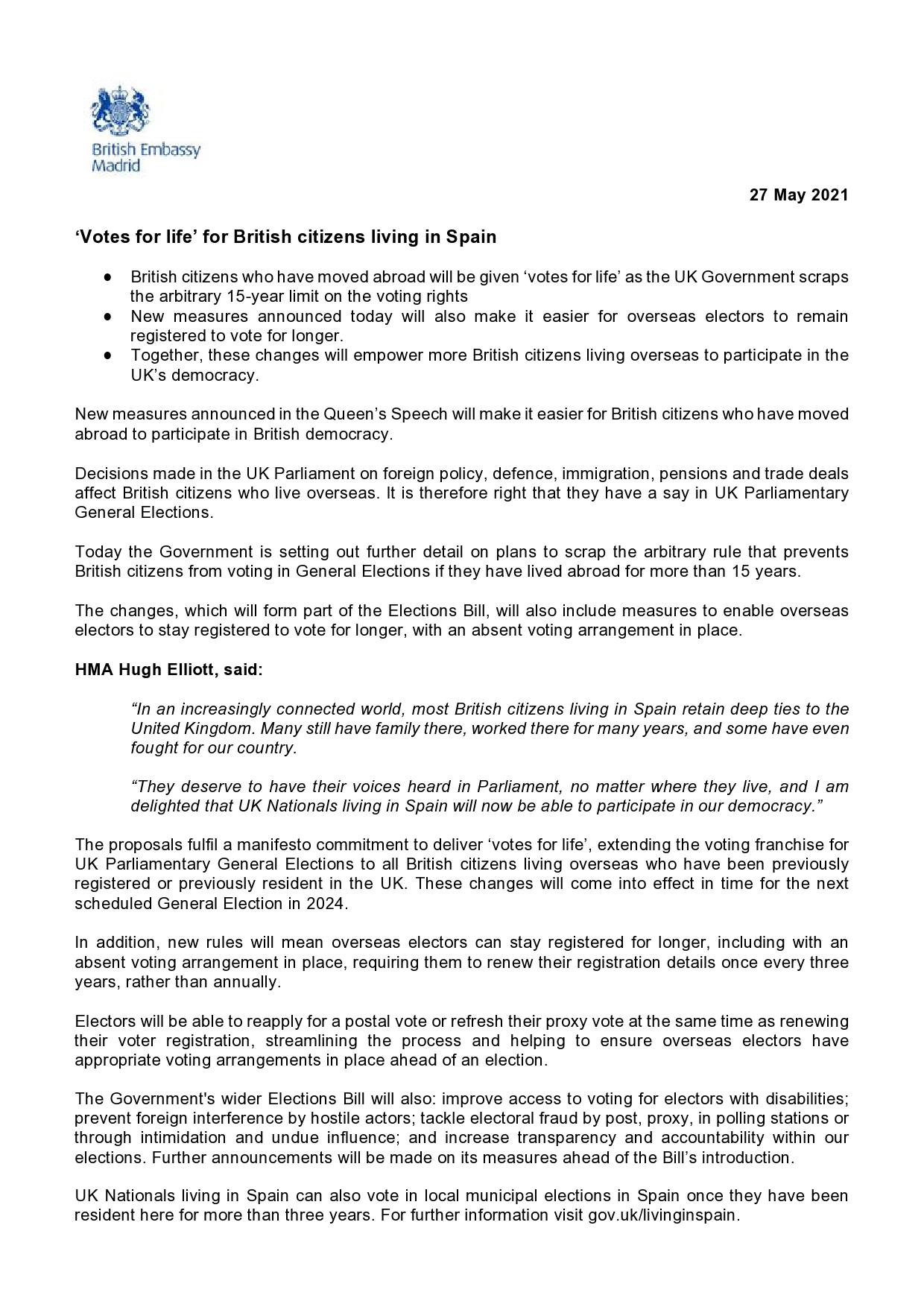
In yesterday’s Queen’s Speech, as part of the Electoral Integrity Bill, the commitment to remove the fifteen year rule was announced.
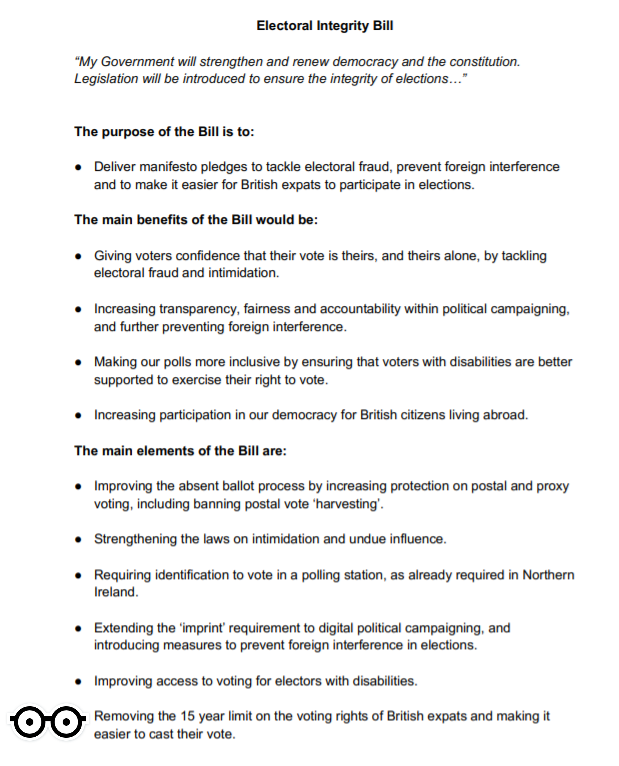
The Electoral Integrity Bill – which includes the restoration of the democratic voting rights of millions of Brits abroad – will form part of this spring’s Queen’s Speech.
There was further good news in the Budget yesterday. If you look closely at the small print on page 48, you will find reference to additional funds set aside expressly for the purpose of securing our #VotesForLife
2.41 Overseas Electors – The government is providing an additional £2.5 million to remove
the limit preventing British citizens who live overseas from voting after 15 years.