
There have been many legislative and administrative changes since Brexit, and keeping up to date with the terminology can be difficult. Here, we have put together a Glossary of Terms which we hope will make things easier to understand and to refer to if needed.
We hope you will find it useful.
You can find the Glossary Terms below, or you can download them as a PDF HERE
EES (Entry/Exit System) is a new digital border system being introduced by the European Union to register non-EU travellers each time they cross the external borders of participating European countries. It will replace manual passport stamping by electronically recording a traveller’s name, passport details, biometric data (such as fingerprints and a facial image), and the date and place of entry and exit. The system is designed to improve border security, speed up checks over time, and automatically monitor how long a visitor has stayed in the Schengen Area to prevent overstaying. More information can be found here.
EFTA Member States – Iceland, Liechtenstein, Norway and Switzerland.
ETIAS (European Travel Information and Authorisation System) is a pre-travel authorisation required for travellers visiting most EU and Schengen countries for short stays (up to 90 days in any 180-day period). It is not a visa, but an online security screening completed before travel. Applicants provide personal and passport details, answer security questions, and pay a small fee. Once approved, ETIAS authorisation is electronically linked to the traveller’s passport and is valid for multiple short visits over a set period. It is due to come into force at the end of 2026. More information can be found here.
EU Member States – Austria, Belgium, Bulgaria, Croatia, Republic of Cyprus, Czech Republic, Denmark, Estonia, Finland, France, Germany, Greece, Hungary, Ireland, Italy, Latvia, Lithuania, Luxembourg, Malta, Netherlands, Poland, Portugal, Romania, Slovakia, Slovenia, Spain and Sweden.
Frontier worker – a person who is resident in one state but regularly works in one or more states as an employed or self-employed person.
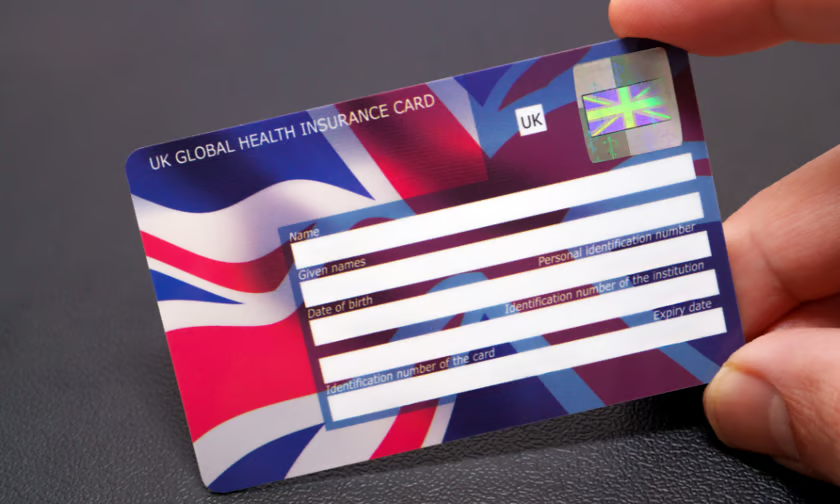
GHIC – The Global Health Insurance Card (GHIC) allows UK residents, regardless of nationality, to access state-provided healthcare during temporary stays in the EU under the UK-EU reciprocal healthcare agreement. It replaces the EHIC but is not valid in the EFTA countries of Norway, Iceland, Liechtenstein or Switzerland.
EU residents who previously qualified for an EHIC (e.g. S1 holders) also qualify for a GHIC. However, like the EHIC, it cannot be used in your country of residence.
The GHIC is available to UK residents and S1 form holders registered from 1 January 2021. For all the details on eligibility, applications, and coverage, see here.
Lawfully resident – an EU citizen or a UK national lawfully resides in the host state in accordance with free movement law before the end of the transition period. This includes the right of residence, irrespective of whether it is a permanent right of residence, its duration (e.g., an arrival in the host state one week before the end of the transition period and residing there as a job-seeker is sufficient and irrespective of the capacity in which these rights are exercised (as a worker, self-employed person, student, job-seekers, etc).
NIE – a fiscal (tax) number that is necessary to carry out legal activities in Spain. It is a white A4-sized paper, and you retain the same number for life (just like your British social security number). The NIE number should not be confused with the Spanish green residency document or the new TIE card (Tarjeta de Identidad de Extranjero), which includes the NIE number (see ‘Residencia’ and ‘TIE’). Having only an NIE certificate or number does not make you a legal resident of Spain, and it does not provide healthcare coverage. You will need an NIE number to buy property, buy a car, or connect to utilities, etc.

Posted Worker (or ‘Detached Worker’) – an employee sent by their employer to carry out a service in another country on a temporary basis.
Padrón – an abbreviation of ‘empadronamiento’, a padrón is a certificate obtained from your local town hall (ayuntamiento), that provides proof of residence in the municipality and the habitual residence therein, etc.
Everyone living in Spain must be registered on the local “Padrón” of the current place of residence. If you live in several locations, you should only register in the place where you live the most. The document has a short shelf life and should be renewed regularly, especially if your residencia document does not include your current address.

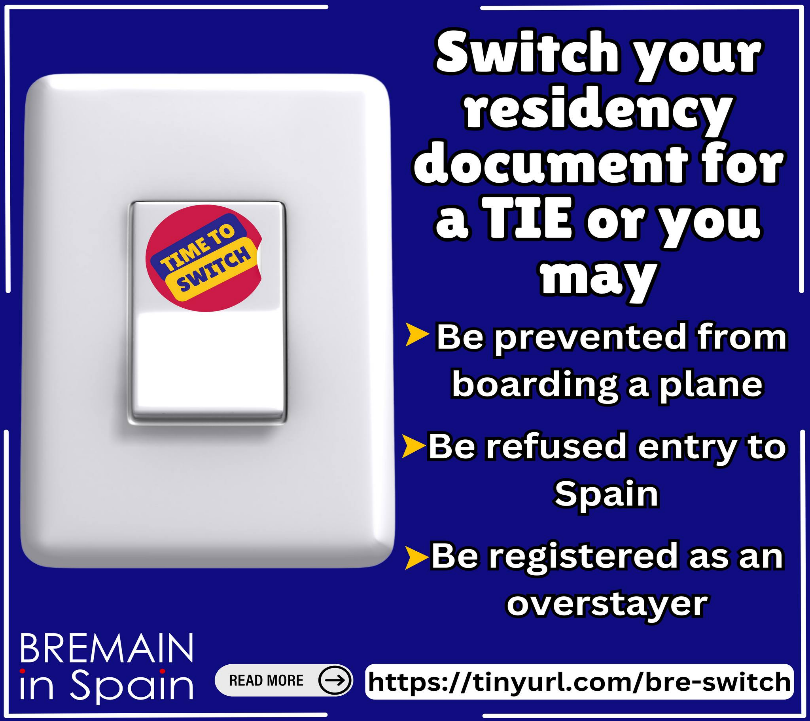
Residencia – a term often used to refer to the green EU residence certificate (TIE) or, more recently, the green EU residence card – is proof of residency provided by the Spanish authorities, now replaced by the new TIE. It contains your name and tax number (NIE), and although it is no longer issued, it remains proof of residency. It provides evidence of the same legal rights, including those covered by the Withdrawal Agreement, as the new TIE. There is no legal requirement to replace your existing green residencia with the new TIE; however, it is highly recommended, as there are benefits to doing so. While the green document/card continues to prove residency status within the country, it is not recognised outside of Spain. Furthermore, with the new Entry Exit System (EES) now in force, only a TIE will exempt you from the new border controls and ensure you are allowed entry into Spain. (See more below on TIEs).


S1 – a certificate of entitlement issued to individuals who live in one Member State but have their healthcare costs covered by another, for example, state pensioners, and entitles them to access to state-provided healthcare on the same basis as domestic nationals. You can find more information on the UK government website here.

Third country national – a national of a country that is not an EU Member/EFTA state. As of 1 January 2021, UK nationals are now third-country nationals in Europe and will lose rights associated with EU citizenship, such as freedom of movement.
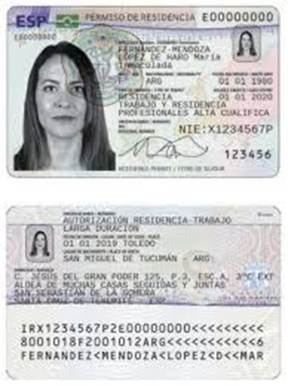
TIE – the ‘Tarjeta de Identidad de Extranjero’, or Foreigners’ Identity Card – is a biometric ID card that contains the identity details of a foreigner living in Spain.
Now that the UK is outside the EU and a 3rd country, the TIE has replaced the older green residency document/card. For those who were legally resident in Spain before the end of the Brexit transition period, the TIE will also identify those whose rights are protected by the Withdrawal Agreement.
Due to the introduction of the EU’s new travel Entry/Exit System (EES) We encourage all British residents in Spain to update their old green residency document to a TIE as soon as possible to avoid problems when entering or leaving Spain or other EU countries.
Withdrawal Agreement (WA)– The international agreement between the UK and the EU that sets out the respective rights and obligations of both parties, following the UK’s withdrawal from the EU. The WA protects the rights of EU nationals residing in the UK and UK nationals residing in the EU before the end of the Brexit transition period and enshrines these rights in law. You can read more here.
**Disclaimer**
This glossary is for general information only and does not constitute legal or professional advice. Rules may change, so readers should check official sources or seek professional guidance where necessary. Last updated February 2026.