During the Spanish Royal visit to the UK John Moffett, Vice Chair of Bremain in Spain, was invited by France24 Live TV to comment on Brexit and how Britons in Spain felt about the State Visit.
Redacción Internacional, 12 jul (EFE).- Españoles en el Reino Unido y británicos en España comparten ansiedad sobre el “brexit” y reclaman que el acuerdo sobre sus derechos ciudadanos tenga prioridad y no esté sujeto al conjunto de las negociaciones, cuya segunda ronda comienza el próximo día 17.
“Pedimos que el acuerdo sobre los derechos tenga solución individual, aparte del resto de los negociaciones”, dijo a Efe Nacho Romero, del grupo “Españoles en el Reino Unido – Surviving Brexit”.
La misma exigencia han planteado a su Gobierno diversos colectivos de británicos expatriados en la UE, que no ven por qué Londres no puede garantizarles ya, sin más demora, los derechos adquiridos en España, el país de la UE que acoge mayor número de británicos.
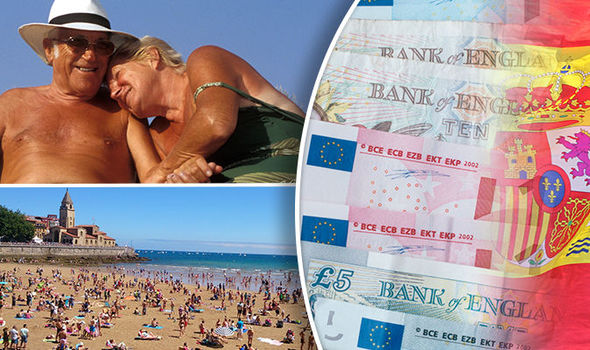
Redacción Internacional (EuroEFE).- España alberga la mayor población británica expatriada en la Unión Europea (UE) y una de las más vulnerables por su alto número de jubilados, que temen perder la asistencia médica gratuita y la actualización de sus pensiones tras el “brexit”.
Su futuro se empezó a negociar en junio, un año después del referéndum que llevó a una mayoría del pueblo británico a aprobar el abandono de la Unión. España es, desde 2005, el país favorito para los británicos asentados en otra nación de la UE.
Según la Dirección General española de Migraciones, a 31 de diciembre de 2016 un total de 299.092 británicos disponían de certificado de registro o tarjeta de residencia en España, el 5,92 % del total de extranjeros en el país y el 10,04 % de los comunitarios.
El 5,12 % tenían hasta 15 años, el 59,72 estaban en edad laboral (de 16 a 64) y el 35,16 eran mayores de 65 años, edad de jubilación de los varones en el Reino Unido (15 meses menos para las mujeres).
La mayoría vivían en localidades con climas benignos de las regiones de Andalucía (sur) y Valencia (este) y de las islas españolas, con concentraciones en las provincias de Alicante (24,3 %) y Málaga (17,3 %).
Muchos británicos se mudaron a España porque, además del buen clima, es un país más barato donde podían comprarse una casa y vivir con sus reducidas pensiones, explicó en enero pasado en una audiencia la Casa de los Comunes Sue Wilson, presidenta de “Bremain in Spain”, un grupo de defensa de este colectivo que es parte de la coalición “British in Europe”.
Wilson dijo a Efe que la cifra real de británicos en España “probablemente sea dos o tres veces” la oficial, incluyendo a aquellos que no están registrados “por razones fiscales” y los dueños de una segunda vivienda que pasan unos cuantos meses al año en suelo español.
De ellos, 108.433 viven con una pensión estatal británica, según registro del Departamento de Trabajo y Pensiones (DWP) de noviembre de 2016. Datos de Eurostat recogidos en el estudio del Parlamento Europeo “Implicaciones del ‘brexit’ para el empleo y los asuntos sociales” reflejan que el número de británicos en España en edad de jubilación se ha duplicado ampliamente en una década:
When will the British media end its infuriating habit of referring to me and the other 1.3million UK citizens who live in the rest of the EU as ‘expats’?
by Laura Shields – Media trainer, EU campaigner, British-American in Brussels 4th July 2017
It might be ok if they referred to our three million EU friends in the UK this way. But they don’t. They’re always ‘migrants’ or ‘nationals’.
And it’s not just the usual right-wing media suspects who employ this silly double standard. As a fully integrated British migrant running a business in Belgium and putting my bi-lingual son through the local school, I regularly have to send my blood off to cold storage whenever I hear the BBC (where I used to work for disclosure’s sake) referring to Theresa May’s ‘fair and serious’. Brexit offer to ‘EU migrants in the UK in the hope that British expatriates in the EU’ will receive the same treatment in return.
For many, the term expat carries associations of privilege and impermanence. So, it’s hardly surprising that the cliché persists that all Britons in Europe are retired asset managers who dress like the Man from Del Monte and have retired to the Riviera with their ill-gotten gains, an intravenous drip of gin and tonic, and an inexhaustible capacity to reminisce about the glory days of the empire.
All while playing bowls.
Let me burst this image for you with some cold hard facts.
Firstly, I know at least three Brits in Europe (including me) who hate gin.
Secondly, four out of five Brits who live in the EU 27 are working age. Many of us run businesses, hold down jobs, pay into the system and make a point of learning the local language. Many of us (again including me) work in several EU countries and really need freedom of movement to be able to do our jobs.
And thirdly – and sorry to disappoint you here – but, as my friend Sue puts it, no Brit in Europe we know has ever set foot in a bowls club.
More worryingly, any British-qualified doctor, architect or vet working in another EU country will tell you that Brexit is putting their qualifications in doubt and without something called ‘mutual recognition of qualifications’ it is unclear whether these hard-won skills will continue to be recognised once the UK ceases to be a member of the EU. If this needs spelling out, pretty much everyone in London, Birmingham or Manchester has been in the back of a taxi driven by a Nigerian doctor or Iranian PhD who can no longer practise their trade because the UK doesn’t recognise their training.
Do I really need to go on?
If the British Government is genuinely ‘serious’ about a ‘fair’ (whatever that means) deal for the five million people affected directly by Brexit then it would help if we Brits in Europe were treated in the same way as our three million EU counterparts and friends in the UK.
The UK should stop the vagaries, step up to the table and agree to the EU’s already comprehensive offer that protects its nationals and us with the full acquired EU rights we were all promised during the Referendum by Vote Leave. And the deal should be agreed and ring-fenced ahead of the inevitable mud-wrestling over money and trade.
Worldwide, there are 4.9million Britons living outside the UK. This is the 10th largest diaspora and builds on a long tradition of Brits going out into the world to seek adventure and be ambassadors for their country. The slimmed down Queen’s Speech made no reference to the Conservative manifesto pledge to restore vote for life to Brits who have lived outside the UK for more than 15 years. This was a mistake in my opinion. In a post Brexit era, the UK is going to need all the friends it can get. It should begin by making some with its own migrants.
Getting our collective name right would be a good start.
Theresa May’s proposal to protect the rights of EU citizens after Brexit is so poor, it will badly damage the rights of Britons living in Europe, campaign groups have told the European commission.
In an official response to the EU Brexit negotiating team, British in Europe and the3million have said that if May’s proposal is adopted it would represent a “severe reduction of the current rights” enjoyed by Britons in Europe.
Last week they expressed fears that Britons would be the “sacrifical lambs” in the Conservatives’ mission to reduce immigration.
The groups say May’s offer looks to curtail citizens’ rights to pensions and to move around the EU to work. They say that, if adopted, the UK proposal could also prevent them from returning to Britain for work or retirement with their EU spouses or to have an elderly parent move in with them in Europe.
British in Europe, which represents 11 grassroots campaign groups in France, Germany, Spain and elsewhere in the block, met Michel Barnier’s article 50 task force last Thursday to express its disappointment and anger over May’s proposal.
It says last year’s referendum said nothing about removing the rights of EU citizens currently in the country or Britons settled in Europe, yet May’s proposal would do just that.
“The choice made in the referendum was about our arrangements going forward, not about unravelling previous commitments,” says the 15-page joint response to the UK’s proposal.
The EU scheme, delivered to Downing Street on 12 June, would extend European laws for all EU citizens post-Brexit, allowing them to continue to live, work and move around the bloc without hindrance for life.
“It is therefore surprising that, instead of taking the framework that exists under EU law as regards the rights of EU citizens in the UK and proposing to incorporate it into UK law as part of the great repeal bill, the UK proposal in fact sets out to unravel previous commitments and replace them with a UK law-based immigration status,” the response paper says.
“It is very difficult to understand how the UK envisages the application of the principle of reciprocity in this case,” says the paper. “Given the mismatch between an EU law proposal to guarantee almost all the rights of both groups and a UK proposal primarily addressing the immigration status post-Brexit of EU citizens in the UK, simply referring to reciprocity does not remedy this omission.”
The main plank of May’s offer is to allow EU citizens who have been in the country for five years to exchange the rights they have under EU law for new rights under UK immigration law.
We use cookies to optimise our website and our service.
Functional
Always active
The technical storage or access is strictly necessary for the legitimate purpose of enabling the use of a specific service explicitly requested by the subscriber or user, or for the sole purpose of carrying out the transmission of a communication over an electronic communications network.
Preferences
The technical storage or access is necessary for the legitimate purpose of storing preferences that are not requested by the subscriber or user.
Statistics
The technical storage or access that is used exclusively for statistical purposes.The technical storage or access that is used exclusively for anonymous statistical purposes. Without a subpoena, voluntary compliance on the part of your Internet Service Provider, or additional records from a third party, information stored or retrieved for this purpose alone cannot usually be used to identify you.
Marketing
The technical storage or access is required to create user profiles to send advertising, or to track the user on a website or across several websites for similar marketing purposes.