
Citizens’ Rights: The road to a satisfactory comprehensive agreement

Citizens’ Rights: The road to a satisfactory comprehensive agreement

British in Europe and the 3Million:
Citizens’ Rights: The road to a satisfactory comprehensive agreement

Introduction

We are at a critical moment in the negotiations between the UK and the EU. The European Council, at its meeting on 19-20 October, did not certify that there had been “sufficient progress” to enable the talks to proceed to Phase 2.  The3million and British in Europe have followed the negotiations on citizens’ rights closely from the outset, making detailed and reasoned submissions after each round.  In this paper we analyse what we see as the major stumbling blocks to reaching an agreement on citizens’ rights.  We then set out what we see as a potential road map to overcome the impasse.  We hope this will stimulate further dialogue between the negotiating parties with a view to finding a comprehensive agreement to protect all of our rights.


The target

In speeches in Florence both M. Barnier (5 May 2017) and Mrs. May (22 September, 2017) have committed to ensuring that “Brexit does not alter the nature of people’s daily lives.”  This should be the core test by which the position of each side should be judged.


Why has a comprehensive agreement not been reached to date?


How the negotiations unfolded

The first offer came from the EU.  They made a principled proposal, which on the face of it encapsulated the aim of M. Barnier and Mrs. May.  If the UK had simply accepted this offer, the negotiations would have gone on to clarify the detail and we believe that a deal would have been done by now, preserving all our interrelated rights.

The UK did not take that course, however.   In an unusual approach to a negotiation, they ignored the offer made by the EU some weeks earlier and simply made their own offer.  Furthermore, the UK made it clear from the outset that they regarded even the Citizens Rights chapter as a matter for standard commercial negotiation.  They made a low offer in what must have been the certain knowledge that they would have to raise it.  They have indeed since made a number of concessions, but they still have a long way to go.

Unfortunately, the EU’s reaction to this approach appears to us to have been to harden its line.  As we demonstrate below, it drew an artificial and erroneous distinction between the rights of citizens covered by the Withdrawal Agreement (“WA”) and the future relationship between the UK and the EU; and adopted a rigid and inflexible approach to the application of EU law to the unprecedented situation of a Member State leaving the Union.


Stumbling blocks for the UK

In looking at the arguments deployed by each side we start by identifying two major stumbling blocks in the UK approach and demonstrating why they are flawed.

The first is a refusal to accept the simple continuation of the existing system of EU residence rights and instead an insistence on requiring EU nationals to be brought under UK immigration law where ‘leave to remain’ is granted to ‘applicants’.  This is a fundamental principle of the UK proposal for ‘settled status’ and without it, their proposal would be completely unworkable.  This principle, however, is fundamentally different to the concept of citizens’ rights in the EU.  Continuing with the ‘settled status’ model will not lead to a comprehensive protection of citizens’ rights.  This is because ‘settled status’ is inherently a far lesser offer for EU citizens in the UK (EUinUK) and if applied would result in major changes in their daily lives.  We argue the immigration law approach taken by the UK is wrong for a number of reasons.

  • This approach exposes EUinUK to the need to apply (again) not for confirmation of rights but instead a grant of ‘leave to remain’ in the UK, to do so under a new and untried system, within a ‘hostile environment’ run by a department with a history of erroneous decision making, quite possibly (because the UK has never stated the contrary) without any right of appeal to court or tribunal, and with new checks for conduct and crime which are completely inconsistent with those under which they moved across the Channel. There are daily new reports of the unjustness of the Home Office, including a recent article[1] by Bail for Immigration Detainees about the growing number of EEA nationals being detained and removed.
  • The reason given for wanting to set up a new set of immigration rules is that “the UK will no longer be subject to EU law”, but there is no reason why aspects of EU law should not continue to apply with appropriate UK implementing legislation. This is after all what the UK itself has said from the outset in relation to healthcare – “the UK will seek to protect the healthcare arrangements currently set out in EU Regulations and domestic law.”  Moreover, it is the approach of the Government’s EU (Withdrawal) Bill to continue to apply existing EU law save where it is specifically disapplied.


The second barrier to agreement is the argument, used to justify a restriction on the right to bring an ageing relative to live with one and the right to bring a future spouse, that the rights of EU citizens in the UK should be no better than those of UK citizens.  The flaw in this argument is that the ageing relatives of most UK citizens in the UK live in the same country and the majority marry fellow-nationals.  So there are no restrictions on them.  When EU citizens moved across the Channel or Irish border the “territory” within which they had rights of family reunification and to bring a spouse extended to the entire EU28.  People do think of these things before moving, and if an EU27 citizen is no longer able to bring a parent to live with them when they need care or a spouse from outside the UK, their lives will not be the same.  And of course UK citizens living in the EU (UKinEU) will be similarly affected either by not being able to return to live in the UK with their EU relatives, or by the EU imposing similar restrictions through reciprocity.

Regrettably, thus far the EU and UK’s positions have largely been to tinker with the mechanics of the UK’s ‘settled status’ offer. Both have failed to agree an alternative solution truly embracing EU citizenship in order to protect all existing rights of EUinUK and UKinEU.


Stumbling blocks for the EU27

Turning to the EU, we identify three elements of their reasoning which have induced a highly restrictive approach, in our view unhelpfully.

First, the EU drew a flawed distinction between the rights of citizens who have already moved and the future relationship between the UK and the EU.   This led it, for example, to refuse to discuss the position of present posted workers, to cut off at Brexit the freedom of movement rights of UK citizens now in the EU, including to work, and to limit dramatically the recognition of professional qualifications upon which people already depend to earn their living, as well as the scope of economic rights. This part of the negotiation is meant to be about the rights enjoyed by individual UK citizens in the EU and individual EU citizens in the UK at Brexit.  Therefore, any issue that may affect these rights, thus potentially disrupting people’s daily lives and their livelihoods, should be included in discussions at this stage of the negotiation.   The EU’s current stance on excluding matters of vital importance to individuals will not ensure that our rights are protected.

Second, the EU’s position that UKinEU should have no right of freedom of movement after Brexit, reflected also in its stance on cross-border working and recognition of qualifications plus economic rights, is inconsistent with Art. 21(b)(i) of the Negotiating Directives which aims to preserve “the residence rights and rights of free movement derived from Articles 18, 21, 45 and 49 of the [TFEU] and set out in Directive 2004/38”.  The EU’s stance respects UKinEU’s established rights of residence in the country of residence but denies UKinEU any right of free movement outside the country of residence at Brexit, although residence and freedom of movement are a composite right conferred by Art. 21.

This position is based on an outdated idea of a “job for life” – i.e. a young person gets a job in another country, moves there, works there and retires there.  But today, individuals frequently move jobs and countries and thereby improve the performance of their employer, or of their own business, and those countries. This flexibility is a vital element of the EU’s success and many UK citizens have worked in a number of EU countries in reliance on it.  At the same time people’s skill sets are increasingly specialised, so the opportunities available in any one State are more limited than they were.  A UK citizen working in, say, Luxembourg needs to be able to work in other countries if their present job ceases to exist or is moved or if they want to enhance their career.

Third, in attaching excessive importance to preserving the integrity of its laws, the EU is failing to recognise the unique and unprecedented circumstance posed by a Member State leaving the Union.  This calls for a more pragmatic and constructive approach by the EU precisely in order to fulfil the underlying purpose of those laws.

A good example is the 2-year rule, under which a person with permanent residence in a State loses that right if s/he is absent for two years.  In the context of EU28 citizens having automatic rights of residence in any State, leaving for 3 years to look after an ageing parent is not catastrophic:  that person can return home and build up permanent residence again.  Take away that context and a person who leaves home for more than 2 years for any reason will be unable to return.    An adjustment of the rule for those covered by the WA is therefore necessary if our daily lives are not to change.  This is not about changing the EU’s laws but simply about modifying their application to the finite group of citizens presently affected.  It appears that the UK has offered to grant an unlimited right to return to EU citizens in the UK in exchange for freedom of movement for UK citizens within the WA, – if this is confirmed, it should be accepted immediately.  This proposal would ensure reciprocity so that EU citizens in the UK and their children and family members would have the unlimited right to return to the UK, and UK citizens in the EU with their children and family members would continue to enjoy their existing rights of free movement across the EU 27.

Another example is the EU’s rejection of the UK proposal to include in the WA specific commitments that, in judging whether at Brexit EU citizens had the necessary residence to be covered by the Agreement, the UK would no longer refuse those who did not have sickness insurance or, if working, a minimum income level.  This is because neither condition is required under UK immigration law.  What we have asked, however, is for an acknowledgment from the UK that access to the National Health Service fulfils the CSI (Comprehensive Sickness Insurance) requirement in the UK – as set out by the European Commission in 2012 – and that this be codified in the WA.  Unless this is the case, unilateral assurances by the present government of the UK lack the force of international law and EUinUK would be at the mercy of a future administration with different views.


Roadmap for reaching a satisfactory agreement on Citizens’ Rights

Moving the negotiations in a positive and constructive direction for genuinely protecting citizens’ rights will require a concerted political effort.  In order to achieve this before the December European Council we set out a practical and achievable roadmap for expediting talks between the two negotiating teams.


Ensure “sufficient progress” and ring-fencing are effective safety nets for citizens

It is of paramount importance that a comprehensive agreement protecting our rights, not just any agreement, be reached on all the issues outlined above, well before the EU27 may deem that “sufficient progress” has been made at the European Council in December allowing the talks to move to Phase 2.  This includes clarity as regards the registration procedure and criteria to be applied by the UK to EU citizens in the UK.

The test of “sufficient progress” is an essential protection for EUinUK and for UKinEU.  If the discussion moves on to matters outside Phase 1 before there has been complete agreement on all the key issues under the Citizens’ Rights chapter, there could then be horse-trading of, say, recognition of qualifications in exchange for some aspect of market access by either side.  If that happens we will be bargaining chips in the full sense of that phrase. Moreover, in order to prevent that from happening, any agreement reached on Citizens’ Rights must be protected so that it cannot be opened up later for use as leverage to gain some collateral benefit.  The current state of the negotiations poses a clear risk of there not being any agreement on all the Phase 1 issues.


Agree a workable alternative to ‘settled status’

We believe that the negotiations have not yet put forward a workable solution as regards the rights of EU citizens in the UK that embraces the principle of EU Citizenship.  Hence, the3million have put forward a satisfactory and workable alternative to ‘settled status’ in their paper entitled “The alternative to current proposals for EU citizens living in the UK before Brexit.”[2]

This proposal departs from the UK’s flawed attempt to fit EU citizens under existing immigration rules. Instead it sets out a map to protect all existing rights of EU citizens in the UK including the right to family reunification. It argues that the rights of EU citizens living in the UK can only be protected by a UK-EU Treaty, subsequently implemented in the UK via a Withdrawal Citizens Rights Act which sets out a status, independent of UK immigration law, to cover this finite group of people.  This Act must allow for direct effect and referral to the CJEU.  The EU is correct to demand that the rights of EUinUK under the WA be subject to ultimate decision by the CJEU to ensure consistency of decision-making and so that EUinUK have equal protection with UKinEU.


Confirm a solution on free movement and the 2-year rule providing reciprocity in practice

The negotiations are also some way short of a workable solution, as regards the rights of UK citizens in the EU, that embraces the principle of EU Citizenship. As explained above, our view is that an agreement on continuing free movement rights to reside and work across the EU 27 for UKinEU and a lifelong right to return to the UK for EUinUK should be reached.  This will ensure a solution that is reciprocal in practice, allowing UKinEU and EUinUK to continue to circulate in the EU27 and UK post Brexit as they are able to do now.  This would solve the issues raised above concerning the 2-year rule for all citizens.  The UK also needs to relax for the specific group of UKinEU covered by the WA the rules restricting the family members UKinEU can bring with them if they decide to return to the UK:  the present restrictions would prevent many UK citizens returning to the UK with spouses they have lived with for years.


Accelerate convergence on other outstanding essential matters

In order to achieve “sufficient progress” on Citizens’ Rights under Phase 1 further movement will be required by both negotiating parties on the following essential matters (which we have already dealt with extensively in our previous submissions).  The position on the first two issues appear to be directly linked to the EU’s position on free movement referred to above:

  • Professional qualifications: mutual recognition of qualifications should be confined to those who have been residing or frontier-working away from their country of origin at Brexit but otherwise should not be restricted to the country of residence, work or individual recognition-decision; recognition of professional qualifications, whether generic or individual-specific, should apply across the EU28 and a professional who has practised under his/her home title should continue to be allowed to do so. Degrees obtained post-Brexit by EU27 students in the UK and vice-versa (including GB passport holders who have lived in the EU27 and vice versa) should be recognised.
  • Economic rights: Again, economic rights such as the right of establishment as a self-employed person or to run a business should continue to apply across the EU for those who are exercising freedom of movement pre-Brexit.
  • Voting rights: a right to vote in local and European Parliamentary elections is an essential aspect of the right to live in a democratic country and the EU should concede it.
  • Export of benefits: the UK should not limit the right to export benefits to those currently being exported (pensions and health benefits of course excepted as agreement has been reached on these).
  • Children born to citizens after Brexit should have life-long rights; however, these cannot be passed on to future generations.

Ultimately, the UK and the EU should acknowledge that, given that the UK will no longer be part of the EU, reciprocity in real life between EU citizens in the UK and British citizens in the EU may require partially different legal solutions. This will therefore require a certain degree of flexibility from both parties achieved through a constructive political agreement.

30 October 2017


[1] http://www.theneweuropean.co.uk/top-stories/cruel-unjust-immigration-centres-1-5249434

[2] British in Europe support and endorse this paper of the3million, as regards the proposals for UKPR and UKTR as an alternative to settled status in the UK, and all the points set out in this summary below of the paper.

EU citizens’ rights groups dismiss May letter as meaningless

EU citizens’ rights groups dismiss May letter as meaningless

Campaigners for the rights of EU citizens in the UK and British nationals in Europe have said a letter from Theresa May reassuring them they will be allowed to stay where they are post-Brexit is “meaningless” and a PR exercise aimed at other EU leaders.

Activists lobbying on behalf of the 3.6 million EU citizens in the UK said the letter was welcome but addressed to the wrong people. “We want to stay in this country. So we agree on that. But this letter is for the eyes of the leaders of the Council of Europe. If she really meant this, this letter would have been sent 12 months ago,” said Nicolas Hatton, the co-founder of the3million group.

He said EU leaders had been happy to meet them, but all requests for meetings with May or the Brexit secretary, David Davis, had been rebuffed. They were meeting the EU’s chief Brexit negotiator, Michel Barnier, again in November, and if May was really committed to their plight then she would meet them too, he said.

British nationals in Europe also expressed scepticism. “It is hard not to take a cynical view [of this letter], especially in view of the timing. I still feel we are the human shields,” said Debra Williams, a Briton living in the Netherlands who runs Brexpats: Hear our Voice.

She called on May to ringfence talks on their rights to ensure Britons in Europe are not deemed unlawful residents in 2019 if the UK crashes out of the EU with no deal.

“I wrote to the Department for Exiting the EU regarding this and I have had four separate replies including a letter from 10 Downing Street. All ignored this question. Yes, we are mightily fed up,” Wilson said.

Hatton said May’s claim that Britain was within touching distance of a deal was hard to reconcile with his group’s view that negotiators were “barely out of the starting blocks”, with fundamental differences of opinion remaining on oversight by the European court of justice and a new “settled status” immigration category that campaigners say amounts to a diminution of existing rights.

Read full article from The Guardian…

Read Theresa May's full Letter

Bremain Needs YOU!

Bremain Needs YOU!

Bremain in Spain is a voluntary organisation that is campaigning to #StopBrexit, and to protect the rights of UK citizens in Spain, and across the EU.

The Bremain team is led by the Bremain Council and a dedicated team of volunteers, with a broad range of skills. As we grow, so does the need for a more defined structure, and the demand for volunteers is ever-increasing. We are currently putting together two new teams and are looking for new recruits to help us. Whether you can only spare a few minutes, or are willing to offer a few hours, please consider joining our band of volunteers. We have outlined a few specific roles that we need to fill, but there are opportunities for anyone interested to help, whether you fit one of the “job descriptions” or not. If you are interested in a specific role, or in helping out on a more adhoc basis, please email us at enquiries@bremaininspain.com with your details.

We look forward to expanding our volunteer team, and to keeping up the fight against Brexit – together we are stronger.

Thank you to all our existing volunteers for their tireless help and support, and we hope to welcome many more!

Sue Wilson Chair

FB Page Manager

Approx 1 hour pd

To manage the FB Bremain in Spain Page, maximise exposure and look for opportunities to promote and advance Bremain’s goals and objectives. Role will be supported by Council members, Admins and other appropriate members and coordinators.

  • Posts – ensure balance of posts (shares and unique content) to maintain interest
  • Liaise with other Bremain Coordinators
  • Monitor page ‘Insights’ to identify most effective posts and other trends
  • Contribute to general FB page guidelines (to be developed)
  • Promote page and/or posts to public and closed groups – build relationships with other groups to promote the page and increase ‘Likes’ and ‘Followers’
  • Encourage participation and comments on page timeline
  • Answer messages to the page, or pass to appropriate person
  • FB ads (paid advertising)

Petitions Coordinator

Approx 1-2 hours pw

To research and evaluate all pro Remain petitions and promote them widely.

  • Research new petitions online and evaluate if appropriate to Bremain
  • Collate information – Title, Description, Link and Deadline
  • Liaise with Web team and promote to FB Page, Group & Twitter
  • Monitor and delete when completed


Campaigns Coordinator

Approx 3-4 hours pw

Promote any Bremain in Spain campaigns and that of pro Remain groups

  • Liaise with any Bremain campaign organisers and promote all Bremain campaigns
  • Research new campaigns online from pro-EU groups, pages, organisations, etc
  • Collate information – Title, Description, Link and Timescale
  • Evaluate whether additional Bremain support might be required.
  • Liaise with web team and promote to FB Page, Group & Twitter
  • Monitor and delete completed


 Web Development, Graphics Assistants & Writers
Different Roles

On Demand

WebsiteBasic experience of WordPress required

  • To assist with website updates and creation of specific posts and publishing on site.

 Graphics

  • To create images/graphics for use by Bremain website, Newsletter and social media.

Photographic

  • Photographic enhancement/manipulation of photos, as required, received from members to maintain quality for website and social media.

Writers

  • Regular contributions for use on website and Newsletter


Tweeters

3-4 hours pw


  • Tweet daily on behalf of Bremain
  • Tweet news stories posted on FB page or group
  • Check for duplicates before tweeting
  • Retweet from other pro EU/anti Brexit sources

Lobby Group Coordinator

Approx 1-2 hours pw

To oversee all Lobby Group activities and liaise with other coordinators and Council

  • Support Lobby Group with up to date info re MP, Peers and MEP contact details.
  • Liaise with Petitions, Events and Campaigns Coordinators and Council re lobbying opportunities
  • Motivate team to promote specific campaigns
  • Liaise with holders of HoL and HoC spreadsheets


Regional Group Coordinators – 8 Positions

Approx 2-3 hours  pw

To further the reach of Bremain in Spain Regional Groups, coordination and management of the development of these groups.

  • Must be resident in the region of the group for which you would have responsibility.
  • Check people’s eligibility to join the group.
  • Motivate and initiate discussions within the group
  • Good organisational skills and the ability to support and encourage group members wanting to arrange meetings.
  • Ensure that the rules of the Facebook group are being followed.


Press Team Assistants

On Demand

To maximise Press coverage for Bremain in Spain activities and campaigns.

Researcher:

  • A flexible role, responding to ongoing needs.
  • Source participants for Press demands for interviews and case studies.
  • Research/verify content online that can be used in our press documents.

Translators:

  • Convert Bremain press releases into Spanish on an ad hoc basis.
  • Monitor Spanish Press and media for Brexit related articles, translate and summarise in English.

Press Office Assistant:

  • Uploading and captioning images (training will be provided), data formatting our target media lists (Excel) etc.

Membership Secretary

Approx 2-3 hours pw

To ensure communication with new and potential members is applied consistently. Data analyst experience useful.


  • Administer & monitor new members
  • Tag on NationBuilder
  • Email and welcome new members
  • Coordinate with Newsletter Coordinator re subscribers

We are a flexible, equal opportunities Volunteer group provider and will consider requests for jobshare and part time volunteering to ease workload.

Focus on: Super EU Girl’s fight to stop Brexit

Focus on: Super EU Girl’s fight to stop Brexit

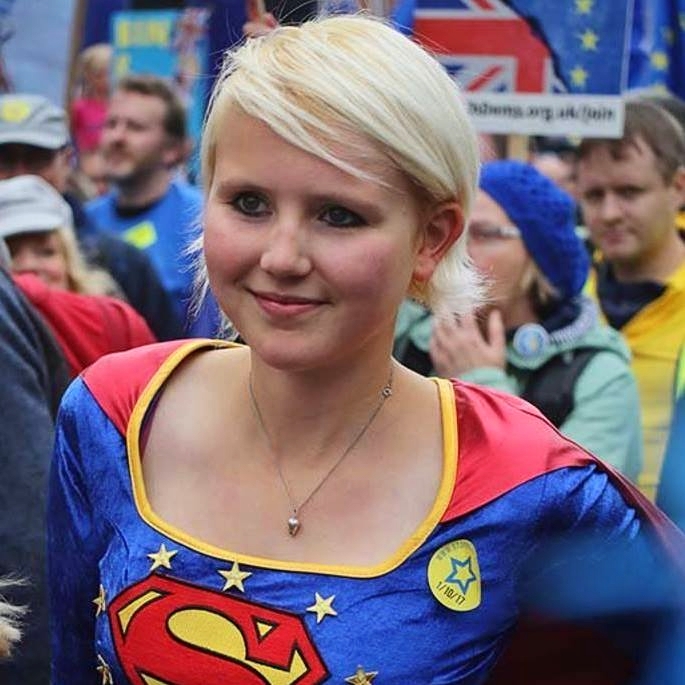
Madeleina Kay, also known as “Super EU Girl”, is an upcoming pro-EU activist and a member of Bremain in Spain. Madeleina made international news earlier this month after being escorted out of the Brussels press conference on the state of progress of the Brexit negotiations – despite having press accreditation. You can read more about how her fancy dress costume raised eyebrows in this Euronews article 

Prior to taking her activism to Belgium, Kay was invited to participate in the panel of Channel 4’s Brexit debate in Bath, where the audience was supposedly made up of people who voted Remain in the 2016 referendum. In this exclusive article, she shares her impressions of the evening and tells us about her current vision for the ongoing fight to stop Brexit.

“I was delighted when a Channel 4 News producer invited me to take part in the “Remainers” panel in the BrexitReality debate. The programme was filmed live in Bath (a heavily Remain voting constituency) in the evening, and as I would miss the last train home to Sheffield, I was forced to stay in Bath overnight, which I was more than happy about as they put me up in a very nice hotel. The day before the filming, I received the final panel shortlist and was slightly nervous when I discovered I was up against MPs from the Labour, LibDem, and SNP parties as well as a Conservative Party member (apparently, they contacted about 40 Tory MPs and couldn’t get a single one to participate… I wonder why?). I was the only young person on the panel; nonetheless, I felt I held my own during the debate and made some important points, although not as many as I would have liked.

Also on the panel was Hugo Dixon, one of Boris Johnson’s former school chums and a vocal Remainer. Unsurprisingly, we got on swimmingly, and voiced many of the same opinions. It was interesting to discover more about his work – attempting to make the fact-based argument to remain in the European Union. I was a bit alarmed when, in the introductions, he mentioned the “H” word, drawing parallels between Brexit and Nazis. I don’t think the majority of people who voted Leave are Neo-Nazis; I think they were lied to and influenced by the ongoing slur campaign against the European Union driven by the right-wing press. I also believe there has been a significant lack of education about the European Union in Britain, and there is a huge amount of ignorance regarding what it actually does and how it benefits the member states. I think that rather than taking a “Project Fear” approach, we need to inspire and educate people about the European Union, and I like to do that by wearing fancy dress costumes and using books and illustrations to communication my message. Having said that, I think that facts and rational argument also play a key role in reinforcing this.

The panel debate was led by Krishnan Guru-Murthy, and followed the preceding week’s “Leavers” panel, which was filmed in Wakefield, an area with a high Brexit vote. There was a high level of audience participation, and as the programme only lasted for 30 minutes, it was difficult to present a developed argument. The purpose of the debate was to show “all the shades of Remain”, and as such, many of the audience and several of the panel were actually “lapsed” Remainers who have given up the fight and accepted the “will of the people”. Unfortunately, this resulted in the majority of the debate revolving around whether we should be pursuing a second referendum on the final deal and whether that would be undemocratic, rather than other issues such as EU citizens’ rights and how we might change the conversation about the EU to promote its values and the opportunities it provides. I was especially infuriated by the number of young people in the audience who had effectively given up on Remain, including a representative from Better Brexit for Young People. I didn’t have the opportunity to point out that there is no “better” Brexit. Instead, there is either the Brexit the Tories serve up or WTO rules, depending on how the negotiations progress. I did make the point that the young 15/16/17-year-olds who were not of voting age on 23 June 2016 ought to have a say in their future when the negotiations are finally over in March 2019 (or however long it takes). I also argued that “the people”, regardless of whether they voted Leave or Remain, have a right to approve the final deal in a second referendum on the terms of exit. If the Tories deliver something totally under-par, then even the most ardent Brexiteer should have the right to reject it. After all, why would be chose to become economically, socially and culturally poorer?

I received two rounds of applause (more than anyone else!) for my contributions, as the audience was generally quite receptive to my arguments. Nonetheless, I was slightly disgruntled to discover that there appeared to be several Brexiteers planted in the audience (if the Bath Conservative Twitter feed is anything to go by), who I believe had snuck into the audience under the guise of being “lapsed” Remainers. One of them made a totally unsubstantiated and illogical argument about EU member states not following EU policy regarding refugees. He claimed to have converted to the Dark Side because the EU has failed to force member states to implement pro-refugee policy. (Many other Brexiteers argue that the EU is too controlling of member states, but it is a recurring theme that they want to have their cake and eat it.) I was a bit thrown when Krishna directed that contribution to me, asking how I would respond. After a brief hesitation, I made the point that actually, to focus on one minor issue like that is to lose sight of the bigger picture. It disregards everything that the EU has achieved in the last 44 years and it overlooks the multiple benefits of EU membership that we are set to lose as a result of Brexit. I received a second round of applause when I pointed out that the Brexit vote was a result of a lack of education and publicity about how EU funding is used.

I would have liked to have taken Steven Kinnock to task on the Labour Party’s stance on Brexit. He was typically in/out in Brexit Hokey-Cokey style with regard to the Single Market, Customs Union etc. However, there was a suspicious absence of conversation about Corbyn during the debate, and it was impossible to alter the direction of the conversation, which was being forcefully led by Krishna. Nonetheless, I was incredibly grateful to be given a voice as a young British citizen and also an unrelenting #StopBrexit campaigner. I still believe there is everything to play for, and we must continue the fight for our rights. Never give up! All the Brexiteers need is a little imagination, and they will see that remaining in the European Union is the best possible outcome for everybody.”

You can follow Madeleina on Twitter @SuperEUGirl

The Leavers debate filmed from Wakefield and the Remainers panel featuring Madeleina can be viewed from these links.

Brexit & You

Brexit & You

With Britain and the EU seemingly no closer to agreement over the shape of Brexit, the talk in the UK this week has focused on what might happen if the country crashes out of the European Union without a deal.

For some Brexiteers this is the preferred option that will deliver the immediate freedom from interfering foreign bureaucrats that they have desired for so long. For Brexiteer Chris Grayling, now transport minister, the food shortages that might result could largely be solved by British farmers growing more.

Meanwhile, demands that the British government come clean over their secret papers assessing the impact of Brexit on the British economy are getting louder. Even without official government studies, there’s concern about the impact on a whole range of sectors – with the wine industry and airlines among those voicing their worries this week (see below).

Those of us on the continental side of the channel at least don’t have to worry about incipient hunger, but people are getting anxious nonetheless about what a Brexit crash landing would mean for citizens and the economy. Below we report on why the Dutch are fretting. And in this week’s feature article, Alex Macbeth looks at how Brits in Spain are organising themselves to deal with the repercussions.

We hope you enjoy this week’s edition. Let us know what you think – email us at brexitandyou@thelocal.com or find us on Twitter @thelocaleurope.

See full newsletter here…

Between a rock and a hard place: Brits in Spain and Brexit

If citizenship rights are the key issue at stake in the Brexit negotiations, then in no other country do Brits have more to lose than in Spain. But the British exit also poses challenges to a vitally important trading relationship.

At least 300,000 UK citizens officially live in Spain, although some estimates say the number is closer to one million. That’s more than a quarter, possibly as much as half or more, of all Brits living in the European Union.

Many face an uncertain future and at least two citizens’ rights groups, Bremain in Spain and Brexpats, have been lobbying and campaigning for the rights of UK citizens in Spain since the Brexit vote.

“We have nearly 5,000 members from all areas of Spain but we are represented in Alicante, Valencia, Malaga, Cadiz, Almeria, Tenerife, Lanzarote, Mallorca and Granada,” Anne Hernandez, founder of Brexpats, who has lived in Spain for more than 30 years, told The Local.

Brexpats acts as a lobby group for the rights of UK citizens and “is in close regular contact with the Consuls,” says Hernandez.

Bremain in Spain is another initiative by Brits in Spain. The lobby’s Facebook group has nearly 5,000 members. Sue Wilson, the founder, says she spends 50-70 hours a week running the initiative, which is self funded by members.

See full newsletter in The Local

Lack of Dutch courage? The Netherlands is feeling low about Brexit

The Dutch economy is beginning to feel the pinch of Brexit uncertainty, if local media reports are any barometer of concern.

“The Netherlands also has a lot to lose in Brexit,” writes Dutch current affairs portal fd.nl. The report cites employer concerns at major trade hubs and ports such as Rotterdam and Amsterdam Schiphol Airport.

“Over 11 per cent of the port’s total imports and exports – some 54 million tonnes – are shipped between the British Isles and the port of Rotterdam every year,” states a communication from the Port of Rotterdam vis-a-vis Brexit.

Landmark events such as the Aalsmeer Flower Auction, the world’s largest flower market, have expressed concerns about the impact Brexit could have on business too. Some 40 million flowers are traded every day in Aalmseer, according to the region’s tourism site.

More than 100,000 jobs are also at stake in the fishing sector, adds the fd.nl report, citing joint agreements on fishing that may need to be renegotiated.

The Dutch pharmaceutical industry could also be affected as it relies on imports from the UK, according to the article.

See full article…

Last in, first out? France’s largest British community

For one of the largest British communities in France, there is a lot at stake in the Brexit negotiations.

While Brits in Paris, Marseilles, Lyon and other major cities will no doubt be watching the negotiations carefully, more than a quarter of France’s 150,000 resident Brits live in the newly created region of Nouvelle Aquitaine, in southwest France, according to insee.fr, France’s national statistics office.

Many Brits only moved to the region in the early 2000s. In 1968, there were less than 1,000 UK citizens living in the area, the capital of which is Bordeaux.

Now there are more than 39,000 officially and Brits constitute the second largest foreign population in the region, after the Portuguese, and the largest British community in any French region. The average age of Brits in Nouvelle Aquitaine is 52 and more than 47 percent are retirees.

British visitors also sustain the local tourism industry. Brits booked 545,000 hotel rooms in 2016, 73 percent of all overnight stays in the region. British companies are well embedded in local commerce too; one fifth of all foreign companies in the region are from the UK.

Read full newsletter…

Brexit Events Europe

Get the run down of Brexit events happening all over Europe in the coming months.   Find one close to you.